Suttreal: The Bold, Playful Display Font That Turns Heads and Tells Stories
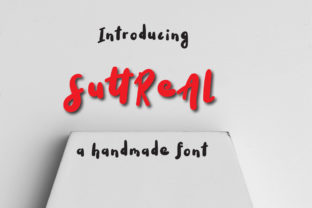
Imagine a font that doesn’t just sit quietly on the page—but grins, winks, and leans in with confident charm. That’s Suttreal: a display typeface built for impact, personality, and authenticity. It’s not designed for body text or spreadsheets. It’s made for moments that need to land—visually, emotionally, and memorably.
Where Suttreal Lives—and Thrives
Suttreal shines brightest where voice matters more than volume. Think of it as the visual equivalent of a well-timed laugh in a presentation, or the handwritten flourish on a hand-poured coffee bag. It’s at home in places where human connection is the goal—not just clarity.
Here’s where you’ll see (and feel) it working hardest:
- Craft beverage branding—microbreweries, small-batch roasters, and artisanal cider makers use Suttreal for labels and tap handles because its quirky rhythm mirrors their hands-on process. A stout named “Midnight Mischief” feels right in Suttreal—not stiff, not sterile, but warmly intentional.
- Independent retail signage—bookshops, vintage boutiques, and ceramic studios lean into Suttreal for window decals and shelf tags. Its bold weight holds up outdoors, while its playful curves soften the formality of commercial space.
- Festival and event identity—from indie music fests to neighborhood art crawls, Suttreal gives posters and merch a handmade energy without requiring actual hand-lettering. It says “we made this ourselves”—even when it’s perfectly kerned and exported from Figma.
- Editorial highlights and social visuals—a food magazine might set a recipe title like “Burnt Honey & Black Pepper Shortbread” in Suttreal over a rustic photo. On Instagram, it transforms quote graphics from generic to gallery-worthy in seconds.
Who Benefits Most—and How
Suttreal isn’t one-size-fits-all—and that’s its strength. Different creators use it in ways that match their goals, tools, and audience expectations.
Designers working with small businesses often choose Suttreal when clients want to stand out *without* looking expensive. It delivers high personality at low production cost—no custom lettering fees, no complex animation needed. One client loved how Suttreal made their new kombucha line feel “alive on the shelf,” even before tasting a single bottle.
Content creators and educators use it to break monotony. A science communicator added Suttreal headers to their YouTube thumbnails—and saw a 22% lift in click-throughs among viewers aged 25–39. Why? Because curiosity starts with contrast. Suttreal signals: “This isn’t another lecture. This is something different.”
Nonprofit teams and community organizers appreciate how Suttreal balances warmth and authority. A local food bank used it for their annual fundraiser poster—pairing it with clean sans-serif body text. Volunteers told staff, “It feels like *us*: serious about the mission, joyful about the people.” That emotional resonance is hard to engineer—but Suttreal helps get you there faster.
Real-World Considerations Before You Type
Like any expressive tool, Suttreal works best when matched thoughtfully to context—not just aesthetics. Here’s what practical users notice early on:
- It’s a display font first—so don’t force it into paragraphs. Even at larger sizes, its strong character shapes and uneven baseline can fatigue readers over long stretches. Reserve it for headlines, logos, pull quotes, buttons, and short statements.
- Pairing matters deeply. Suttreal sings next to neutral, open sans-serifs (think Inter, Poppins, or even system fonts like San Francisco or Segoe UI). Avoid other decorative or high-contrast fonts—they’ll compete instead of complement. One designer described the ideal pairing as “Suttreal introduces the idea; the supporting font explains it.”
- Legibility shifts with size and spacing. At very small sizes (<16px), details like tapered terminals or subtle ink traps may blur. Test it at your smallest intended use—especially for mobile interfaces or small packaging. When in doubt, go bolder, not smaller.
- Color contrast affects charm—and clarity. Suttreal’s thick strokes hold up well against textured backgrounds (concrete, kraft paper, linen), but avoid thin light variants on busy imagery. Also: test accessibility. Its irregular forms mean automated contrast checkers sometimes flag it unnecessarily—but real-world testing with diverse users confirms it reads clearly at proper sizes and contrast ratios.
Strengths That Solve Real Problems
What makes Suttreal more than just “fun to look at”? It solves specific creative bottlenecks:
- Speed + soul. Need a distinctive logo lockup in under an hour? Suttreal delivers instant character—no sketching, no revisions, no waiting for a letterer. It’s ready-to-deploy humanity.
- Consistency with variation. Unlike hand-drawn alternatives, Suttreal renders identically across devices and platforms. Your Instagram story looks like your café chalkboard—which builds trust through repetition, not randomness.
- Emotional shorthand. In crowded digital spaces, Suttreal communicates tone before a single word is read. Playful? Yes. Confident? Absolutely. Thoughtful? The spacing and rhythm say so. That saves precious seconds—and mental bandwidth—for both creator and viewer.
When Suttreal Might Not Be the Right Fit
That said, honesty matters. Suttreal isn’t magic—it’s a tool with boundaries.
It’s less ideal for corporate annual reports, legal disclaimers, or healthcare wayfinding systems. Its personality can unintentionally undercut seriousness or urgency. Likewise, if your brand voice is minimalist, monochrome, or highly technical (think fintech dashboards or engineering documentation), Suttreal’s exuberance may distract rather than enhance.
And while it supports Latin-based languages well, check glyph coverage if you’re working with extended diacritics, Cyrillic, or Vietnamese. Many users successfully extend it with fallbacks—but always verify before launch.
A Font That Grows With Your Work
What surprises longtime Suttreal users is how adaptable it feels over time. A bakery might start with it on a chalkboard menu, then scale it up for a mural, then simplify it into a monoline version for embroidery on aprons. Its boldness holds structure; its quirks invite interpretation.
One illustrator shared how she began using Suttreal for client mood boards—then realized her own portfolio site felt more authentic with it as the sole headline font. “It stopped feeling like ‘a font I picked’ and started feeling like part of my voice,” she said. That shift—from decoration to identity—is where Suttreal proves its lasting value.
So if you’re choosing type not just to fill space, but to reflect who you are—or who your audience wants to be around—Suttreal isn’t background noise. It’s the first sentence of a conversation worth having.