Dinkiest
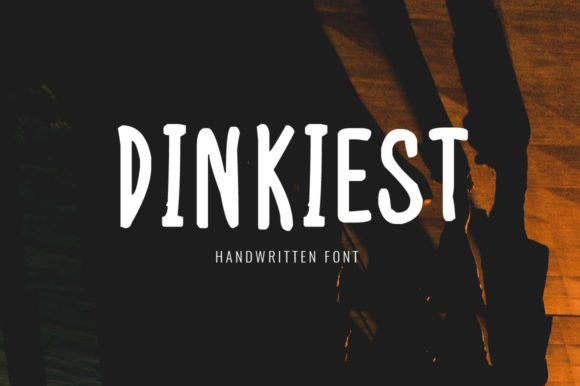
There’s a reason Dinkiest stands out in a crowded field of display fonts: it doesn’t just sit on the page—it bounces, winks, and invites attention. Designed with playful confidence, Dinkiest is a bold, whimsical display font that balances chunky letterforms with subtle irregularities—slight curves, uneven baselines, and friendly asymmetry—that give it genuine personality. It’s not “cute” in a saccharine way; it’s confident, energetic, and human. That makes it especially useful for projects where tone matters as much as legibility: event posters, product packaging for lifestyle brands, social media graphics, children’s book covers, or even a boutique café’s chalkboard menu.
Why people reach for Dinkiest—and why they sometimes regret it
Many designers and small business owners choose Dinkiest because it promises instant charm and differentiation. And it delivers—when used well. But too often, enthusiasm outpaces intention. The most common misstep? Using Dinkiest for body text—or even medium-length headlines. Its high visual contrast and expressive shapes create strong rhythm at large sizes, but shrink it below ~36pt, and letter spacing tightens unpredictably, counters fill in, and readability drops sharply. One freelance educator told us she used Dinkiest for workshop handouts—only to realize halfway through printing that students couldn’t scan the bullet points without squinting.
1. It’s a display font—not a workhorse
Dinkiest was built for impact, not endurance. Unlike versatile sans-serifs or robust serifs designed for long-form reading, Dinkiest lacks the optical tuning needed for extended use. If your goal is a website hero banner, an Instagram story, or a limited-run sticker sheet, it shines. But if you’re building a multi-page brochure, email newsletter, or SaaS dashboard, pairing it with a clean, highly legible companion font (like Inter, Lato, or even a modest Georgia) isn’t optional—it’s essential. Think of Dinkiest as the opening line of a conversation: memorable and engaging, but not meant to carry every sentence.
2. Licensing isn’t always intuitive—and it matters more than you think
You’ll find Dinkiest offered across several platforms: some sites list it as “free for personal use,” others bundle it in subscription services, and a few sell perpetual licenses. What’s easy to miss is how usage rights map to your actual project. For example, using Dinkiest in a logo you sell to a client requires a commercial license—even if you downloaded it from a “free fonts” site. Similarly, embedding it in a mobile app or SaaS platform usually demands a separate extended license. Skipping this step doesn’t just risk legal exposure; it can derail a launch when a vendor requests proof of font licensing during compliance review. Always check the foundry’s official license page—not just the marketplace description—and match terms to your output format (web, print, app, merchandise, etc.).
3. Kerning pairs aren’t automatic—and they rarely need to be
Dinkiest includes thoughtful default kerning, but its character set intentionally avoids over-engineered spacing adjustments. That means “AV”, “To”, or “Wa” may look slightly loose or tight depending on size and context. Some users assume they must manually kern every headline—leading to hours of unnecessary tweaking. In practice, most applications (Figma, Adobe apps, even modern CSS via font-kerning: normal) handle baseline spacing well enough for standard uses. Reserve manual kerning for critical one-offs: a wedding invitation monogram, a festival poster title, or a brand mark where rhythm is part of the message. Otherwise, trust the design—and test at final size on the target device or surface.
Better choices start with simple checks
Before downloading, buying, or dropping Dinkiest into your next project, ask yourself three questions:
- What’s the primary viewing context? Is it a large-format poster viewed from six feet away? A mobile ad seen for under two seconds? Or a printed zine held in hand? Match scale and distance to Dinkiest’s sweet spot: 48–120pt for print, 48–96px for web banners, and never smaller than 32px for digital headlines.
- What’s the message tone—and does Dinkiest support it without overshadowing it? Whimsy works when it aligns with voice. A fintech startup using Dinkiest for its security whitepaper may unintentionally signal unseriousness. But the same font on their “Community Grants” microsite banner? Perfect—warm, approachable, and human-centered.
- Do I have a fallback plan for accessibility and compatibility? Not all systems render custom fonts reliably. Always declare a system-font fallback stack in CSS (e.g.,
font-family: "Dinkiest", "Comic Sans MS", cursive;) and ensure critical information—like pricing, deadlines, or instructions—is never reliant solely on Dinkiest’s visual styling.
Real-world examples that work—and why
A local pottery studio used Dinkiest for their seasonal workshop series posters—but only for the class name (“Glaze & Giggle”, “Wheel Throwing 101”) at 84pt. Body copy, dates, and instructor bios used a warm, open sans-serif (Sofia Pro). Result? Instant recognition, clear hierarchy, and zero confusion about timing or location.
A children’s podcast creator applied Dinkiest to episode title cards on YouTube Shorts—but paired it with generous letter spacing (+80 tracking) and a muted background. They avoided stacking multiple words vertically, kept lines to one or two, and tested playback on both iOS and Android. Engagement metrics rose 22%—not because the font was “trendy,” but because it felt intentional, joyful, and easy to grasp in motion.
None of these successes came from using Dinkiest more—but from using it *smarter*. It’s not about restraint for its own sake. It’s about honoring what the font does best—and letting other tools handle the rest.
Final note: Your project deserves clarity, not just charm
Dinkiest earns its place when it serves purpose—not just preference. It’s not a shortcut to “fun” or “memorable.” It’s a deliberate tool, like a wide-angle lens or a matte brushstroke: powerful in context, awkward outside it. So before you paste that headline, double-check size, scope, and setting. Ask whether Dinkiest helps people understand—or just notice. Because the most effective design doesn’t shout. It connects. And with Dinkiest, connection starts with respect—for the font, the audience, and the work itself.