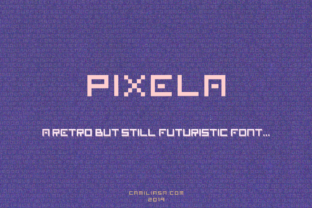
Pixela: A Playful Display Font That Delivers Charm
Pixela isn’t just another decorative typeface—it’s a thoughtful, hand-crafted display font with genuine warmth and quiet confidence. Its letterforms balance clean geometry with subtle irregularities: slightly rounded corners, uneven stroke endings, and gentle asymmetry that feels intentional, not accidental. It’s not pixel-perfect in the digital sense—there’s no retro grid or 8-bit rigidity. Instead, Pixela evokes the tactile charm of hand-drawn signage, chalkboard lettering, and vintage packaging—without leaning into nostalgia for its own sake. The result? A premium font that feels both contemporary and human-scaled.
Where Pixela Fits Naturally (and Where It Doesn’t)
Pixela shines brightest where personality matters more than prolonged reading: logos, social media banners, book covers, greeting cards, product labels, event posters, and website headers. Think bakery branding, indie podcast intros, craft fair booth signage, or a boutique newsletter banner. Its friendly, approachable tone makes it ideal for small businesses and creators who want to signal authenticity without sacrificing polish.
It’s not built for body text. You won’t want Pixela in long paragraphs, dense editorial layouts, or legal disclaimers—and that’s by design. As a display font, its strength lies in impact, not endurance. When used well, it creates immediate visual hierarchy: your headline grabs attention, sets mood, and invites the reader deeper into your message. Used poorly—say, in a multi-page report or as a UI label—it undermines clarity and feels out of place.
How It Shapes Perception—Without Saying a Word
Typography is silent brand language. Pixela communicates care, creativity, and approachability before a single word is read. That matters. A local florist using Pixela in their Instagram bio or shop sign signals warmth and craftsmanship—not corporate distance. A children’s illustrator choosing Pixela for a book title tells readers, “This world is gentle, imaginative, and handmade.” That impression sticks because it’s consistent: every time someone sees the font tied to your work, it reinforces that feeling.
Consistency builds recognition faster than you might expect. One client—a ceramicist launching her first online shop—used Pixela only for her logo and product tags. Within three months, customers began referring to her pieces as “those cute Pixela ones” in comments. She hadn’t named the font publicly—yet its distinct rhythm and shape had become part of her brand identity.
Pairing It Thoughtfully (Not Just Matching)
Pixela works best when paired with a grounded, legible companion—something that lets it breathe and shine. A neutral sans serif like Inter, Lato, or even system fonts like Helvetica Neue provides reliable contrast without competing. Avoid other display fonts or overly stylized serifs; they’ll clash tonally. Skip script fonts unless you’re aiming for deliberate irony—the contrast usually feels forced, not clever.
Here’s what we’ve observed in real projects:
- A food blogger uses Pixela for recipe titles and Inter for ingredient lists—clean, scannable, and warm.
- A stationery brand pairs Pixela with a light-weight serif (like Merriweather) for product descriptions—elegant but never stiff.
- An indie game studio uses Pixela exclusively for their game logo and loading screen text, then switches to a monospace for in-game UI—clear functional separation.
Test pairings at actual size and context. What looks balanced on a mockup may feel cramped in a mobile notification or lost on a café menu board. Print a sample, hold it at arm’s length, step back—then ask: does the hierarchy still hold?
What’s Inside the Family—and What to Check Before You Commit
Pixela ships with one weight—regular—with full Latin character support, standard punctuation, and basic OpenType features like ligatures and stylistic alternates. There’s no bold, italic, or condensed variant. That’s intentional: it’s designed as a focused tool, not an all-purpose system. If your project needs typographic flexibility across multiple weights or moods, Pixela may not be the sole solution—but it can anchor a broader system beautifully.
Readability at smaller sizes (under 24px on screen or 10pt in print) drops off quickly. That’s fine—display fonts aren’t meant to shrink. Use it where it has room to express itself: headlines above 36px, signage at 48pt+, packaging front panels, or social thumbnails where it’s the dominant visual element.
Licensing is straightforward: one-time purchase for commercial use, including web embedding (with proper @font-face setup), app integration, and physical products. No subscriptions, no monthly caps, no hidden tiers. You own the license outright—ideal for freelancers juggling multiple clients or small studios building reusable design assets.
Real Talk: Does Pixela Fit Your Project?
Ask yourself three questions before downloading:
- Is this the first thing people will see? If yes—and it’s meant to set tone, not explain details—Pixela is likely a strong fit.
- Does your audience respond to warmth over formality? Teachers, makers, wellness practitioners, and creative service providers often find Pixela resonates more than sleek, minimalist alternatives.
- Are you willing to limit its use to high-impact moments? Pixela earns its keep when used with restraint—not sprinkled everywhere as decoration.
We once advised a nonprofit rebranding their annual report. They loved Pixela’s charm but needed clarity across 40+ pages. Our recommendation? Use Pixela only on the cover and chapter openers—then switch to a highly legible serif for body copy. The result felt cohesive, intentional, and far more professional than forcing one font to do two very different jobs.
Pixela doesn’t solve every design challenge. But when your goal is to make something feel welcoming, memorable, and quietly confident—without shouting or overcomplicating—it delivers with sincerity. It’s the kind of font that reminds you why typography still matters: not as decoration, but as connection.