Blues Vacations: Vintage Charm for Standout Design
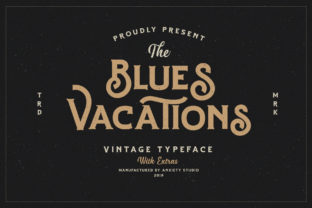
When a design needs to feel both timeless and intentional—like a well-worn porch swing, handwritten recipe card, or sun-faded postcard from the Lowcountry—you’re not just choosing a font. You’re selecting a tone, a mood, a quiet confidence. Blues Vacations is that kind of typeface: a vintage display font inspired by Southern charm, built for moments where visual voice matters more than mere legibility.
More Than Nostalgia—A Strategic Design Choice
Blues Vacations isn’t about replicating the past—it’s about borrowing its emotional resonance. Its slightly irregular letterforms, gentle contrast, and warm, organic rhythm evoke authenticity without slipping into kitsch. That makes it especially useful when your goal is to signal sincerity, craftsmanship, or regional character—not just in branding, but in editorial layouts, packaging, invitations, or digital campaigns where personality drives connection.
For example, a small-batch coffee roaster in Charleston might use Blues Vacations for their seasonal blend label. The font doesn’t shout “premium”—it implies it through texture and care. Similarly, an educator creating printable literacy resources for early readers could pair Blues Vacations (for titles and headers) with a clean sans-serif body font. The contrast supports visual hierarchy while adding warmth that invites engagement—especially helpful for reluctant readers or multilingual learners who respond to expressive, human-centered design.
Where Blues Vacations Fits—and Where It Doesn’t
Because it’s a display font, Blues Vacations works best at larger sizes: headlines, posters, logos, social media banners, book covers, and signage. Its charm lives in scale and intention—not in paragraphs or dense UI text. Attempting to use it for body copy, forms, or mobile navigation would compromise readability and accessibility. That’s not a flaw; it’s a design constraint worth honoring.
This focus actually saves time. When you know a font has clear boundaries—where it shines and where it shouldn’t go—you spend less time second-guessing hierarchy or over-compensating with workarounds. Designers, marketers, and small business owners report faster mockup iterations once they treat Blues Vacations as a deliberate accent rather than a default.
Real-World Use Cases Across Roles
Creatives & Freelancers: If you’re building brand identities for lifestyle brands, artisanal goods, or hospitality clients, Blues Vacations adds instant narrative depth. One freelance designer used it across a full rebrand for a Nashville-based vinyl record shop—pairing it with a muted palette and tactile paper stock. The result felt cohesive, rooted, and distinct from generic “retro” fonts flooding design marketplaces.
Educators & Publishers: Teachers crafting classroom posters, lesson slide decks, or student-facing handouts find Blues Vacations helps anchor thematic units—think “Southern Literature,” “Civil Rights History,” or “Folk Art Traditions.” Its presence subtly reinforces context without distracting from content. A middle school librarian in Georgia reported higher student engagement with book display banners using Blues Vacations alongside curated quotes and local author spotlights.
Small Business Owners: For brick-and-mortar shops, farmers’ market vendors, or wedding stationers, Blues Vacations lends credibility through craft. A Savannah florist uses it on her seasonal menu cards and Instagram story highlights—always with ample white space and natural photography. Customers consistently comment on how “true to place” the visuals feel, reinforcing trust before the first conversation.
Pairing With Purpose
Blues Vacations gains strength through thoughtful pairing. Its vintage soul pairs well with neutral, functional typefaces: geometric sans-serifs like Inter or IBM Plex Sans for balance; warm serifs like Freight Text or GT America for layered elegance; even monospaced fonts like Fira Code in creative tech contexts (e.g., a coding bootcamp with Southern roots using Blues Vacations for workshop titles). Avoid overly decorative or high-contrast companions—the goal is harmony, not competition.
Color matters too. Blues Vacations thrives with earthy tones—sage, clay, indigo, cream—but also holds up against deep navy or charcoal. It softens stark black-and-white layouts and adds dimension to pastel palettes. Test it at 48–96pt in your layout software before finalizing color choices; what reads as warm on screen may shift under print conditions.
Accessibility & Practical Considerations
Like all display fonts, Blues Vacations requires attention to accessibility standards. It should never be the sole method of conveying critical information (e.g., error messages, form labels, or navigation links). Always provide sufficient contrast (at least 4.5:1 against background), avoid justified alignment (which can create uneven spacing), and ensure fallbacks exist in responsive environments.
Also note: Blues Vacations includes standard Latin characters and basic punctuation, but lacks extended language support (e.g., Central/Eastern European diacritics, Cyrillic, or Vietnamese tone marks). If your audience spans multilingual markets—or your project requires robust OpenType features like stylistic sets or discretionary ligatures—review the character map before committing. Some users supplement it with a versatile secondary font for captions or footnotes.
Why This Font Endures—And Why It Might Be Right for You Now
In a landscape saturated with algorithmically generated “vintage” fonts—many overly distressed, inconsistent, or digitally sterile—Blues Vacations stands out by prioritizing subtlety over spectacle. Its Southern inspiration isn’t literal (no magnolia motifs or script flourishes); it’s atmospheric. That restraint gives it longevity. A logo set in Blues Vacations today won’t feel dated in five years because it avoids trend-dependent gimmicks.
If you’ve ever hesitated before choosing a font—wondering whether it conveys enough warmth, authority, or distinction—Blues Vacations offers a grounded alternative. It won’t fix weak messaging or poor layout, but it *will* elevate strong ideas. It rewards intentionality. It supports storytelling without overshadowing substance. And for professionals who value clarity, craft, and quiet confidence in their work, that’s not just practical—it’s essential.
Whether you’re refining a brand voice, designing learning materials, launching a product, or simply seeking a more resonant visual language, Blues Vacations earns its place—not as decoration, but as considered contribution.