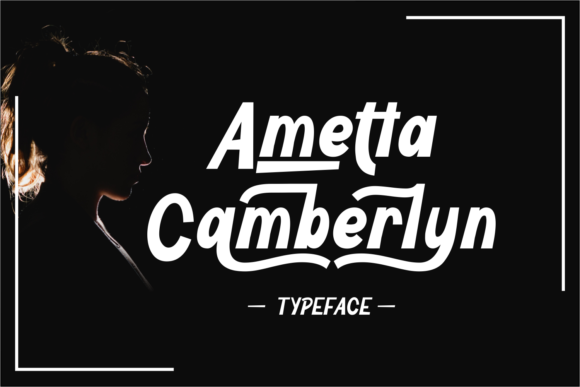
Ametta Camberlyn: A Bold Display Font That Delivers—If You Use It Right
Ametta Camberlyn isn’t just another decorative typeface. It’s a beautiful, playful, and boldly expressive display font with a distinctive twist—think confident curves, rhythmic contrast, and subtle personality in every glyph. Designers, marketers, educators, and small business owners often reach for Ametta Camberlyn when they need to grab attention fast: on social banners, event posters, product packaging, or hero sections of a website. But here’s what many overlook—its strengths are highly situational. Used carelessly, even the most captivating font can undermine clarity, accessibility, or brand cohesion.
“I Just Need Something Eye-Catching”—And That’s Where Things Go Off Track
One of the most common missteps is treating Ametta Camberlyn as a general-purpose font. Its high visual energy makes it unsuitable for body text, long headlines, or interfaces requiring quick scanning. Imagine using it for a restaurant menu’s dish descriptions—or worse, for legal disclaimers on an e-commerce checkout page. Readers won’t just skim past it; they’ll hesitate, misread, or abandon the task entirely. That’s not a flaw in Ametta Camberlyn—it’s a mismatch between intent and application.
Another frequent oversight? Assuming all versions of Ametta Camberlyn behave the same. Some users download free variants from unverified sources, only to discover missing glyphs (like accented characters for Spanish or French), inconsistent spacing, or no OpenType features like stylistic alternates or ligatures. These gaps don’t just look unpolished—they limit real-world usability, especially for creators serving global audiences or multilingual clients.
What You’re Not Checking Before You Commit
Before licensing or downloading Ametta Camberlyn, pause and verify three things:
- Licensing scope: Does the license cover your use case? A personal license won’t allow you to use Ametta Camberlyn in a client’s logo or a Shopify theme you’re selling. Commercial licenses vary—some include web font hosting, others don’t. Check whether variable fonts, SVG support, or app embedding are included if your project needs them.
- Technical compatibility: Test how Ametta Camberlyn renders across devices and browsers—not just on your design screen. Some display fonts show unexpected weight shifts or clipping in Safari or older Android browsers. If you’re using it in a web project, confirm whether the provider offers WOFF2 files and fallback strategies.
- Pairing readiness: Ametta Camberlyn thrives alongside neutral, highly legible companions—like a well-hinted sans-serif (e.g., Inter, Manrope, or even system fonts like Segoe UI). Avoid pairing it with other decorative fonts, overly condensed types, or fonts with competing x-heights. The goal isn’t visual “busy-ness”—it’s hierarchy with purpose.
Real Examples—And Smarter Alternatives
Consider a freelance educator designing a workshop flyer. They choose Ametta Camberlyn for the headline “Unlock Your Creative Confidence”—a great instinct. But then they set the bullet-point list of takeaways in the same font, at 14px. Result? Low readability, uneven line spacing, and attendees missing key details. A better approach: keep Ametta Camberlyn for the main title only, and switch to a clean, accessible sans-serif (with generous letter-spacing and line-height) for supporting text.
Or take a small bakery launching Instagram ads. They love Ametta Camberlyn’s warmth and whimsy—perfect for their “Handcrafted Sourdough Every Friday” banner. But they apply it at ultra-thin weight and low contrast against a busy photo background. The message vanishes. Instead: use the medium or bold weight, add a subtle semi-transparent overlay behind the text, and ensure at least 4.5:1 color contrast against its backdrop. Tools like WebAIM’s Contrast Checker take seconds—and prevent wasted ad spend.
Don’t Skip the Details—Especially the Ones You Can’t See
Many assume that because Ametta Camberlyn looks “finished,” it’s automatically production-ready. Not quite. Look closely at punctuation—especially quotation marks, em dashes, and ellipses. Some display fonts treat these as afterthoughts, resulting in awkward spacing or mismatched weights. Similarly, check how numbers align: proportional figures may clash with tabular data; old-style numerals can feel charming in headlines but confusing in pricing tables.
If you’re integrating Ametta Camberlyn into Figma, Adobe Creative Cloud, or Canva, test how it behaves with auto-resizing text boxes or responsive layouts. Some display fonts don’t scale gracefully below 36px—or distort when stretched across columns. A quick 10-minute stress test saves hours of revision later.
When Simplicity Serves You Better Than Sparkle
There’s nothing wrong with wanting impact—but impact without intention rarely lasts. Ametta Camberlyn shines brightest when it has room to breathe and a clear role: leading, emphasizing, distinguishing. It’s not meant to narrate, explain, or persuade over time. That work belongs to quieter, more resilient typefaces.
Ask yourself: Is this the *only* place where personality needs to lead? If the answer is yes—great. If the answer is “everywhere,” reconsider. A strong brand doesn’t rely on constant visual surprise. It builds recognition through consistency, contrast, and thoughtful restraint.
Final Practical Notes Before You Download or License
Start small. License Ametta Camberlyn for one specific, high-impact use—like a keynote slide deck or seasonal campaign banner—before rolling it out across your entire toolkit. That gives you real-world feedback without overcommitting.
Download a trial version first—even if it’s time-limited. Test it in context: paste sample copy into your actual layout tool, preview on mobile, and ask someone unfamiliar with the project to read it aloud. If they stumble or ask, “What does this say again?”—that’s valuable data, not failure.
Lastly, remember that typography is communication—not decoration. Ametta Camberlyn succeeds when it helps people understand, remember, or feel something meaningful—not when it simply looks impressive in a font showcase. Its beauty lies in how it serves your message, not how it stands apart from it.