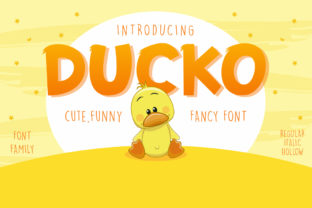
Ducko: The Playful Font That Turns Design Into Delight
Imagine typing the word “cupcake” — and watching it instantly smile back at you. That’s Ducko in action. Not just another display font, Ducko is a burst of personality in typographic form: round, bouncy, gently wobbly, and irresistibly charming. It doesn’t shout — it giggles, winks, and tilts its head just slightly to the left, like it knows a secret you’ll love.
What Makes Ducko Feel So… Duck-Like?
The name isn’t arbitrary. Ducko channels the soft curves of a duck’s beak, the gentle plumpness of its body, and that unmistakable, friendly tilt of its head. Every glyph — from the wide-eyed A to the bobbing g — carries subtle asymmetry and organic rhythm. There’s no rigid geometry here. Instead, Ducko uses hand-drawn warmth: slight variations in stroke weight, soft terminals, and generous counters that invite the eye to linger.
It’s not a script font — no flowing connections or cursive flourishes. And it’s not a slab serif pretending to be fun. Ducko occupies its own joyful niche: a display sans with cartoon soul. That distinction matters. It means Ducko works where other playful fonts falter — especially at larger sizes, on screens, and in branding contexts where clarity and charm must coexist.
Where Ducko Shines (and Where It Steps Back)
Ducko thrives in moments that call for instant emotional resonance. Think: a toddler’s birthday invitation where “Happy 3rd Birthday!” needs to feel like a hug in type. Or a boutique ice cream shop’s chalkboard menu — “Rainbow Sprinkle Surprise” practically melts into your mouth when set in Ducko. Even digital spaces benefit: app onboarding screens, playful error messages (“Oops! Your cart quacked away — let’s bring it back!”), or social media banners for pet wellness brands.
But Ducko knows its role. It’s not built for body text. You wouldn’t set a 1,200-word blog post in Ducko — readability would suffer, and the charm would overwhelm rather than enhance. Likewise, formal reports, legal disclaimers, or corporate investor decks? Ducko politely excuses itself. Its superpower lies in emphasis, not endurance.
Real-World Pairings That Just Work
Ducko plays exceptionally well with others — especially fonts that ground its exuberance. Try pairing it with:
- Inter or Poppins — clean, neutral sans-serifs that act as the calm narrator to Ducko’s animated protagonist;
- Playfair Display — a refined serif that creates elegant contrast for headings + subheadings (e.g., Ducko for “Summer Camp Fun!” and Playfair for the descriptive paragraph);
- Comic Neue — if you want double the whimsy but with more structure, especially for educational kids’ apps or classroom posters.
The key is contrast with intention. Ducko shouldn’t compete — it should complement. When used as a headline, logo lockup, or accent label (like “NEW”, “YUM”, or “WAG!"), it adds micro-moments of delight without sacrificing hierarchy.
Why Designers Reach for Ducko Again and Again
Beyond aesthetics, Ducko solves real workflow problems. It’s lightweight — under 40KB as a WOFF2 file — so it loads fast, even on slower connections. It includes full Latin character sets, basic punctuation, numerals, and thoughtful OpenType features like stylistic alternates (a wigglier Q, a squinting 8) that let designers fine-tune tone without switching fonts.
It’s also cross-platform friendly. Whether you’re designing in Figma, Adobe Illustrator, or coding directly in CSS, Ducko renders consistently across browsers and devices. No pixelated edges on mobile Safari. No unexpected spacing shifts in Chrome. That reliability makes it a low-risk, high-reward addition to any design system — especially for small studios or solo creators who need efficiency *and* expression.
Brands That Speak Ducko’s Language
You’ll spot Ducko’s influence — or direct use — in spaces where authenticity and approachability are non-negotiable:
- Kid-focused edtech tools — where learning feels like play, not pressure;
- Plant-based food startups — packaging that conveys freshness, friendliness, and a wink of humor;
- Indie game UIs — health bars labeled “Snack Power”, quest logs titled “Adventure Time!”;
- Therapist or coach websites — where warmth and accessibility matter more than austerity.
It’s not about being childish — it’s about being human-centered. Ducko signals: “You’re safe here. This won’t be boring. We see you — and we’re smiling while we do.”
Choosing Ducko: What to Consider Before You Type
If you’re evaluating Ducko for a project, ask yourself three things:
- Is this moment meant to be memorable — not just legible? If yes, Ducko earns its place.
- Does the brand voice lean toward kindness, curiosity, or gentle humor? Ducko amplifies those tones — but can’t invent them from scratch.
- Will users interact with this text repeatedly — or just once, briefly? Ducko excels in short, high-impact encounters: buttons, banners, icons, logos. Less so in navigation menus or long-form labels.
Also worth noting: Ducko has excellent accessibility support when used thoughtfully. Its generous x-height and open counters improve readability at size — especially for users with mild dyslexia or visual processing differences. Just ensure sufficient color contrast (aim for at least 4.5:1 against the background) and avoid using it over busy textures or photos without solid overlays.
How to Use Ducko Without Overdoing It
Less is more — but “less” with Ducko still feels generous. Here’s how seasoned designers keep the joy intact without tipping into clutter:
- One headline, max two words — e.g., “Hop In!” instead of “Please Hop In and Enjoy Our Wonderful Services Today!”;
- Combine with ample whitespace — Ducko breathes best when surrounded by quiet;
- Use color sparingly but intentionally — try soft pastels (mint, buttercream, sky blue) or warm neutrals (oat, clay, sage) rather than neon overload;
- Scale it generously — Ducko gains charm at 48px and above. At 16px, it loses its magic and becomes merely odd.
And remember: Ducko doesn’t need animation to feel alive. Its inherent bounce does the work. Skip the wobble CSS transitions — they distract. Let the font speak for itself.
Ducko Isn’t Just a Font — It’s an Attitude Shift
In a world saturated with sharp corners, ultra-thin weights, and algorithmically optimized minimalism, Ducko is a gentle rebellion. It says: Yes, function matters — but so does feeling good while using it. It’s proof that typography can comfort, connect, and quietly convince — all before the first word is read.
Whether you’re launching a new product, refreshing a website, or crafting a one-off illustration, Ducko offers something rare: immediate recognition, emotional resonance, and zero pretense. It doesn’t ask you to take it seriously — just to enjoy it. And honestly? That kind of lightness is harder to find — and more valuable — than most designers realize.
So go ahead. Type “Hello!” in Ducko. Then smile. That’s not coincidence — that’s design working exactly as it should.