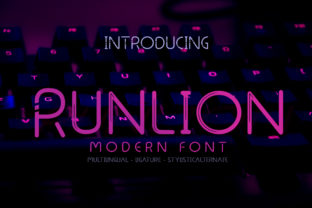
Runlion: A Modern Display Font with Mysterious Character
Runlion is a contemporary display font designed for visual impact and atmospheric resonance—not utility at small sizes or extended reading. Its character emerges from deliberate tension: geometric precision meets subtle organic distortion, clean lines carry faint echoes of analog imperfection, and uniform letterforms are offset by unexpected weight shifts and asymmetrical terminals. This isn’t a font built for body text or interface labels. It’s crafted for moments where tone matters as much as legibility—headline statements, branding accents, editorial features, and immersive digital experiences.
What Sets Runlion Apart
At first glance, Runlion reads as futuristic—but not in the sterile, hyper-digital sense. Its mystery lies in restraint. Unlike many sci-fi–adjacent fonts that rely on exaggerated angles, neon sheens, or overt tech motifs, Runlion communicates futurism through subtlety: slightly condensed proportions, softened but intentional corners, and a rhythmic inconsistency in stroke modulation that suggests human intention rather than algorithmic uniformity. The lowercase a and g feature closed, almost cloaked counters; the uppercase R ends in a tapered leg that doesn’t quite resolve—hinting at motion or incompleteness. These aren’t flaws. They’re calibrated decisions that give Runlion its quiet authority.
This distinctiveness becomes especially apparent when placed alongside other modern display fonts. Some alternatives prioritize extreme minimalism—thin weights, razor-sharp joins, absolute neutrality—making them versatile but emotionally neutral. Others lean into retro-futurism with chrome finishes, grid-based distortions, or heavy optical corrections that date quickly. Runlion avoids both poles. It occupies a middle ground: technically refined, yet expressive; forward-looking, yet grounded in typographic tradition. Its design language invites interpretation without demanding it.
Fitness for Purpose: Where Runlion Excels
Runlion performs best when used intentionally and sparingly. Consider these realistic applications:
- Editorial headlines for long-form digital features on innovation, speculative design, or cultural forecasting—where the font’s quiet intensity reinforces thematic weight without shouting.
- Brand identity systems seeking differentiation in saturated markets (e.g., creative agencies, independent publishers, or tech-adjacent studios) that value nuance over novelty.
- Immersive web experiences, such as interactive storytelling or exhibition sites, where typography functions as environmental texture—not just information delivery.
- Print collateral like limited-run posters or exhibition catalogs, where high-resolution output reveals fine details like ink spread simulation in its heavier weights.
In each case, Runlion contributes atmosphere—not clarity. It assumes the reader already has context. That’s a strength, not a limitation—if applied with awareness.
Tradeoffs to Acknowledge
No display font excels across all conditions, and Runlion is no exception. Its most notable tradeoff is functional scope. It is not optimized for:
- Small-scale legibility: Below 24px, details like terminal variations and counter closures begin to merge, reducing distinction between characters—especially in lower contrast environments.
- Multilingual support: While covering Latin-based languages comprehensively, Runlion currently lacks extended Cyrillic, Greek, or extended diacritic coverage. Projects requiring broad linguistic reach may need supplemental typefaces.
- UI or navigation elements: Its rhythmic irregularities—so effective in large settings—can disrupt scanning patterns in menus, buttons, or form fields where predictability and speed matter more than mood.
- High-contrast accessibility requirements: Though readable at appropriate sizes, its moderate contrast ratio (between stem and counter) falls short of WCAG AA recommendations for text under 18pt bold or 24pt regular—meaning it should never serve as primary interface text for users relying on screen readers or low-vision accommodations.
These aren’t shortcomings in an absolute sense—they reflect design priorities. Runlion was conceived as a voice, not a toolset. Using it outside those boundaries risks diluting its effect or compromising usability.
Comparing Approaches: When to Choose Runlion—or Not
Choosing Runlion isn’t about “better” or “worse.” It’s about alignment. Ask yourself:
- Is the goal to evoke a specific emotional or conceptual tone? If yes—and that tone leans toward contemplative futurism, restrained innovation, or layered ambiguity—Runlion is worth serious consideration. If the priority is warmth, approachability, or timelessness, other display fonts with softer curves or more open apertures may serve better.
- Will this font appear in isolation or alongside others? Runlion pairs effectively with highly legible, neutral sans-serifs (e.g., modest geometric or humanist options) precisely because it doesn’t compete for attention—it anchors. But pairing it with another expressive display font often creates visual friction rather than harmony.
- What’s the technical environment? Runlion includes OpenType features like stylistic alternates and ligatures, which enhance its character—but only if your platform supports them reliably. Legacy CMS platforms or email clients may fall back to basic glyphs, flattening its nuance. Test rendering across target environments before finalizing.
- Who is the audience—and what do they need from typography? Design-savvy readers may appreciate Runlion’s subtlety; general audiences encountering it in dense UI contexts may find it distracting or difficult to parse quickly. Context determines whether its mystery enhances or obstructs.
A practical example: A climate-tech startup developing a public-facing dashboard might consider Runlion for its campaign landing page headline (“Reimagining Resilience”)—but switch to a robust, accessible sans-serif for data labels, navigation, and explanatory paragraphs. That layered approach leverages Runlion’s strengths without asking it to do work it wasn’t designed for.
Implementation Realities
Using Runlion well involves more than selecting a font file. Its effectiveness depends on spacing, sizing, and surrounding design choices. Kerning pairs are thoughtfully adjusted, but tracking often benefits from slight expansion (50–100 units) in larger settings to preserve breath and prevent visual crowding. Line height should be generous—especially in multi-line headings—to avoid compressing its vertical rhythm. And color contrast must be deliberate: deep charcoal on off-white often reveals more texture than pure black on white, reinforcing its tactile quality.
Licensing is straightforward—available via standard desktop and web font subscriptions—but verify usage rights for embedded applications (e.g., PDF generation or native mobile apps), as some licenses treat those separately. Also note that variable font versions (if available) offer finer control over weight and width axes, enabling tighter tuning for responsive layouts—but require modern browser support.
Making the Call
Runlion won’t solve every typographic challenge. It won’t make a weak concept compelling, nor will it compensate for unclear messaging. What it can do—when chosen deliberately—is deepen resonance. It works when you need typography to function as quiet narrative scaffolding: supporting meaning without explaining it.
If your project values atmosphere as much as information, if your audience responds to nuance over noise, and if you’re willing to pair Runlion with complementary, functional typefaces rather than rely on it alone, then it’s a compelling option. But if your priority is universal readability, rapid comprehension, or broad linguistic coverage out of the box, stepping back to evaluate alternatives—perhaps with stronger functional foundations—is the more responsible choice.
Ultimately, Runlion invites intentionality. It rewards careful application and thoughtful context. That makes it less of a default and more of a decision—one that reflects how seriously you take the relationship between form, feeling, and function.