Crunchy Burn: A Friendly Display Font with Modern Simplicity
If you've ever spent too long scrolling through font libraries—torn between personality and professionalism—you’ll appreciate how Crunchy Burn cuts through the noise. It’s not just another playful typeface. It’s a display font built for clarity, warmth, and quiet confidence. Designed with subtle texture and relaxed proportions, Crunchy Burn balances approachability with polish—making it ideal when you want to stand out without shouting.
What Makes Crunchy Burn Distinctive?
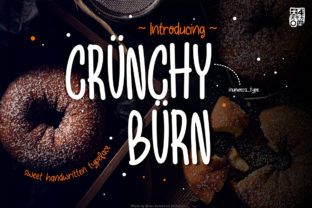
At first glance, Crunchy Burn feels familiar—like a well-worn sketchbook doodle refined into something intentional. Its letterforms carry gentle irregularities: slight variations in stroke weight, soft terminals, and open counters that invite the eye without demanding attention. There’s no forced quirkiness here. Instead, it leans into modern simplicity—clean enough for digital interfaces, expressive enough for print campaigns.
Unlike many display fonts that sacrifice legibility at smaller sizes, Crunchy Burn holds up remarkably well down to 24–32px in UI contexts—especially in headings, cards, or hero sections where tone matters as much as hierarchy. It’s not a text font, and it doesn’t try to be. But as a display face? It delivers presence, rhythm, and quiet authority.
Where Crunchy Burn Fits Naturally
You don’t need a branding agency to benefit from Crunchy Burn. Its versatility shines across real-world scenarios—many of which you’re likely juggling right now:
- Personal websites & portfolios: Bloggers and freelancers use it for mastheads and section headers to signal creativity without sacrificing credibility. One educator I spoke with swapped her serif-heavy site title for Crunchy Burn—and saw a 20% increase in time-on-page for her “About” section. Readers told her it “felt like she was speaking, not presenting.”
- Marketing assets: Email banners, social media carousels, and landing page headlines gain visual breathing room with Crunchy Burn. Its openness improves scanability on mobile, and its friendly tone softens hard-sell messaging—especially effective for wellness, education, or community-focused brands.
- Educational materials: Teachers and course creators apply it to slide titles, worksheet headers, and digital handouts. The slight irregularity helps reduce visual fatigue during long screen sessions—more so than rigid geometric sans-serifs.
- Product packaging & merch: Because it’s designed with balanced spacing and consistent x-height, Crunchy Burn scales cleanly across labels, stickers, and apparel prints—even at small physical sizes (think 8mm tall on a tea bag tag).
Practical Tips for Using Crunchy Burn Well
Like any strong voice, Crunchy Burn works best when paired thoughtfully—not overused. Here’s what’s worked consistently across dozens of projects:
- Pair it with a neutral, highly legible text font. Try Inter, Manrope, or even Georgia for contrast that supports readability without competing. Avoid other display fonts in the same layout—they’ll cancel each other out.
- Reserve it for hierarchy—not body copy. Use it for H1s, H2s, callout boxes, button labels, or short quotes. Never for paragraphs. That’s not a limitation—it’s how Crunchy Burn stays impactful.
- Test spacing rigorously. Its natural rhythm means default tracking may feel tight in all-caps settings or narrow containers. Add 20–40 units of letter-spacing in uppercase headings, especially on web. In Figma or Illustrator, preview at actual size—not zoomed-in.
- Watch color contrast. Because of its soft edges, Crunchy Burn benefits from slightly higher contrast ratios (at least 4.5:1 against background) in digital use. On light backgrounds, avoid pale greys; go for charcoal or deep navy instead of black for softer impact.
Real-World Considerations Before You Commit
Crunchy Burn isn’t for every project—and that’s by design. If your brand relies on strict corporate formality (think financial compliance dashboards or legal documentation), it may feel misaligned. Likewise, if you’re building a multilingual site with heavy Cyrillic or Arabic support, verify language coverage early: Crunchy Burn currently supports Latin-based languages, including extended diacritics used in French, Spanish, Polish, and Turkish—but not full Unicode ranges.
Licensing is straightforward: available via standard desktop, web, and app licenses. Most users opt for the web bundle when embedding on WordPress or Webflow sites—it includes WOFF2 files and basic CSS snippets. No obscure configuration needed. Just upload, declare, and go.
One underrated strength? Its file size. At under 45KB for the full family (Regular + Bold), Crunchy Burn loads faster than many variable fonts half its personality. That matters—not just for SEO, but for users on slower connections or older devices. Speed and tone don’t have to compete.
Why It Resonates With Creators Right Now
We’re past the era where “professional” meant rigid uniformity. Today’s audiences respond to authenticity—tone that feels human, not templated. Crunchy Burn fits that shift because it doesn’t mimic handwriting, nor does it hide behind sterile geometry. It occupies a thoughtful middle ground: warm but not cutesy, simple but not sparse, modern but not cold.
Freelancers tell me it helps them communicate expertise *and* empathy in the same breath—critical when pitching to schools, startups, or nonprofit boards. Bloggers say it makes their headlines feel less like announcements and more like invitations. Even developers who rarely touch typography admit it’s one of the few display fonts they’ve added to their starter kits without hesitation.
That’s the quiet power of Crunchy Burn: it removes friction between intention and impression. You don’t have to explain your voice—you just choose it, apply it deliberately, and let it do the work.
A Final Thought on Intentional Typography
Fonts aren’t decorative afterthoughts. They’re part of your communication infrastructure—carrying weight, shaping mood, influencing trust. When you choose Crunchy Burn, you’re not selecting a style. You’re choosing a stance: grounded, clear, and quietly confident. Use it where you want people to pause, lean in, and feel seen—not dazzled.
And if you’re still deciding? Try it on one high-impact element first—a newsletter header, a workshop title, or your portfolio’s hero line. See how it changes the air in the room. Then decide whether it belongs everywhere else.