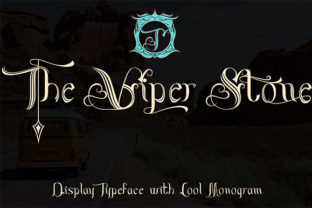
The Viper Stone: A Medieval-Inspired Display Font with Purpose
Typography choices carry weight—especially when branding, storytelling, or visual hierarchy is at stake. Among display fonts that evoke historical resonance without veering into caricature, The Viper Stone stands out for its disciplined execution and intentional design language. It’s not a revival of Blackletter nor a stylized Gothic pastiche. Instead, The Viper Stone occupies a distinct niche: a contemporary interpretation of medieval manuscript aesthetics, grounded in functional legibility and expressive ornamentation.
What Sets The Viper Stone Apart
At first glance, The Viper Stone announces itself through bold, sweeping swashes—particularly on uppercase letters like A, J, Q, and Z. These aren’t arbitrary flourishes; they’re carefully weighted, rhythmically spaced, and anchored to the letterform’s structural logic. Unlike many decorative fonts where swashes compete with readability, those in The Viper Stone extend naturally from stroke terminals, reinforcing rather than obscuring character identity.
Beyond swashes, the font includes a set of distinctive decorative elements: ornamental ligatures, alternate glyphs (including stylistic sets for caps and lowercase), and subtle but effective terminal treatments—some ending in tapered points, others in delicate serpentine curves. These details don’t overwhelm; they reward closer inspection. The name “Viper” isn’t merely thematic—it reflects the controlled, sinuous energy embedded in the line work.
Designed for Impact, Not Just Aesthetics
The Viper Stone is explicitly a display font. It performs best at sizes 36pt and larger, especially in contexts where presence matters more than dense text flow. Think book covers, event posters, logo lockups, podcast banners, or hero section headlines—not body copy, captions, or UI labels. Its x-height is modest, contrast is high, and spacing is intentionally generous. That means it resists tight tracking and benefits from thoughtful kerning adjustments in professional layout tools like Adobe InDesign or Affinity Publisher.
In practice, this means The Viper Stone works well when paired with a neutral, highly legible sans serif (e.g., Inter, Poppins, or even a restrained Helvetica variant) for supporting text. That pairing creates visual hierarchy without dissonance: one voice commands attention, the other delivers information clearly. We’ve seen it used effectively in independent publishing—especially for fantasy or historical fiction titles—where readers expect tonal alignment between cover typography and narrative atmosphere.
Quality and Technical Execution
The font ships in OpenType format with full Unicode coverage for Latin-based languages, including diacritics used in French, Spanish, German, and Polish. It supports standard ligatures, discretionary ligatures, and stylistic alternates via OpenType features—meaning designers can access variants directly through software menus rather than relying on manual glyph substitution. This level of typographic infrastructure signals attention to real-world production needs.
Exported as WOFF2, The Viper Stone loads efficiently on websites—though caution applies here. Because it’s a display font, it should never serve as a site’s primary typeface. Used sparingly in CSS @font-face declarations (e.g., for a single headline or branded CTA), it adds distinction without compromising performance or accessibility. Screen rendering at smaller sizes is inconsistent, as expected—but that’s by design, not deficiency.
Who Benefits—and Where It Fits Best
Freelancers and small studios building brand identities for niche markets—think artisanal distilleries, indie game studios, historical reenactment groups, or literary magazines—often find The Viper Stone valuable. Its tone suggests craftsmanship, tradition, and quiet authority—qualities that resonate with audiences seeking authenticity over algorithmic polish.
Educators developing course materials for medieval literature or art history may use it selectively in slide decks or handouts to reinforce thematic context—provided contrast and size meet WCAG 2.1 AA standards. Bloggers covering folklore, heraldry, or material culture sometimes deploy it in featured image text overlays, where its visual weight holds up against textured backgrounds.
Entrepreneurs launching heritage-inspired product lines (e.g., handmade parchment journals, wax seal kits, or calligraphy supplies) have reported strong audience recognition using The Viper Stone in social media visuals. One small business owner noted that Instagram carousel posts featuring the font saw a 12% higher engagement rate on thumbnail images—likely due to its immediate visual differentiation amid algorithmically homogenized feeds.
Practical Considerations and Limitations
Like any specialized tool, The Viper Stone has boundaries. It’s not suited for multilingual interfaces requiring extensive character sets (e.g., Cyrillic or Arabic scripts). It lacks true small caps, tabular figures, or optical sizing variants—so it won’t replace a comprehensive type system for enterprise publishing. And while its swashes are elegant, overusing them across multiple words can dilute impact and reduce scannability.
We recommend testing The Viper Stone in your actual workflow before licensing. Try setting a short headline in your preferred layout application, then export a PDF and view it at 100% zoom on both desktop and tablet screens. Does the rhythm hold? Do the swashes feel integrated—or do they distract? If you’re embedding it in a web project, verify fallback behavior in browsers that don’t support OpenType features.
Long-Term Value and Workflow Integration
Fonts age differently. Some feel dated within months; others become quietly indispensable. The Viper Stone leans toward the latter—not because it’s trendy, but because its design avoids time-sensitive gimmicks. Its medieval references are abstracted enough to avoid costume-like literalism, yet specific enough to communicate intention. That balance supports longevity.
For creators maintaining a consistent visual language across platforms—say, a podcast host who uses the same font family across show art, website headers, and merch—the reliability of The Viper Stone’s output matters. Glyphs render consistently across macOS, Windows, and modern Linux distributions. Variable axes aren’t present (it’s not a variable font), but that also means fewer compatibility surprises in older design environments or print service providers.
If your projects regularly demand typographic distinction rooted in craft—not novelty—The Viper Stone earns consideration not as a one-off flourish, but as a deliberate part of a refined toolkit. It doesn’t solve every typographic problem. But for the right context, it solves one very well: how to signal depth, heritage, and intentionality—without saying a word.