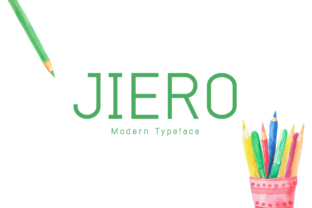
Jiero: A Modern Display Font for Clear, Confident Communication
When you’re choosing a font for a logo, a t-shirt design, or the headline on your blog’s homepage, you’re not just picking letters—you’re selecting tone, intention, and first impression. Jiero arrives as a thoughtful response to that moment: a brand-new modern display font designed with clarity, versatility, and quiet confidence in mind.
Unlike many display fonts that lean heavily into ornamentation or extreme contrast, Jiero balances distinctive character with functional readability. Its clean lines, subtle geometric influence, and carefully tuned letter spacing make it stand out without shouting—ideal when you need visual impact paired with legibility at scale.
Why Jiero Fits Real Creative Workflows
For freelancers building client brands or small business owners designing their own flyers, time is finite. Jiero simplifies decisions—not by limiting options, but by offering consistent performance across contexts. You can use the same font family for a café’s chalkboard-style menu, its Instagram story header, and the vinyl sticker on its takeout bag—and maintain cohesion without extra tweaking.
This isn’t theoretical. Designers report using Jiero for music album covers where track titles need rhythm and presence, yet must remain readable on mobile screens. Educators choose it for classroom posters because its open counters and generous x-height improve scanning at a glance—especially helpful for younger students or learners with visual processing preferences.
Where Jiero Delivers Practical Value
Stationery and print materials benefit from Jiero’s balanced weight distribution. It holds up well in letterpress, foil stamping, and laser printing—no thin strokes that risk breaking or filling in. If you're ordering custom notecards or wedding invitations, Jiero offers elegance without fragility.
Websites and digital headers gain from its optimized hinting and responsive behavior. When used in CSS as a web font (with proper fallbacks), Jiero renders cleanly across devices—even at smaller sizes in hero sections or image sliders where text overlays photos. Its vertical metrics align predictably with common UI frameworks, reducing layout shifts during loading.
T-shirts and apparel present unique constraints: fabric texture, screen-print limitations, and viewing distance. Jiero’s sturdy lowercase ‘a’, ‘e’, and ‘g’ avoid ambiguity at medium sizes, while its uppercase letters carry enough presence for chest logos without needing bold overrides or tracking adjustments.
Who Benefits Most—and Why
Entrepreneurs launching a new brand often juggle budget, speed, and differentiation. Jiero supports all three: it’s distinct enough to help a local pottery studio stand out among competitors using overused sans-serifs, yet familiar enough to feel trustworthy—not distracting. No need to commission custom lettering unless your vision demands it.
Bloggers and content creators find Jiero especially useful for featured post titles or newsletter banners. Its slight warmth—achieved through soft terminals and gentle curve modulation—adds approachability without sacrificing polish. That matters when readers decide in under two seconds whether to click or scroll past.
Marketing teams running seasonal campaigns appreciate how Jiero scales across touchpoints. A single font file can serve a billboard mockup, an email subject line preview, and a QR-code flyer—reducing asset management overhead and reinforcing message consistency.
Thoughtful Use Cases—and When to Pause
Jiero excels in display roles: headlines, short quotes, product names, call-to-action buttons, and branding elements. It’s not intended for long-form body copy. For paragraphs or article text, pair it with a highly legible text face like Inter, Lora, or even system fonts—this contrast strengthens hierarchy and improves reading flow.
It works best at medium to large sizes (24px and up for web, 18pt+ for print). At very small sizes—like fine print on packaging or footnote labels—it may lose some of its nuance. That’s not a flaw; it’s intentional design focus. Knowing that helps you deploy Jiero where it shines, rather than forcing it where it doesn’t belong.
Also consider context: if your project requires multilingual support beyond Latin-based languages (e.g., extended Cyrillic, Vietnamese diacritics, or Arabic script), verify Jiero’s current language coverage. While it includes robust Latin-1 and basic Latin Extended-A, complex typographic needs may call for supplemental fonts or alternatives.
Pairing Jiero Thoughtfully
A strong pairing isn’t about contrast for contrast’s sake—it’s about supporting meaning. Try Jiero with a neutral, open-textured sans-serif for body copy: something like Poppins (for friendly energy) or Source Sans Pro (for quiet authority). For editorial layouts or creative studios, a modest serif like Merriweather adds gravitas without competing.
Avoid pairing with other high-contrast display fonts. Two strong voices cancel each other out. Jiero’s strength lies in its ability to anchor a composition—not dominate it.
Designing With Intention, Not Just Aesthetics
Good typography solves problems before they arise. Jiero helps reduce revision cycles: clients rarely ask “Can we make the logo bolder?” because its default weight carries presence naturally. Printers rarely flag “stroke thinning” issues because its outlines are engineered for physical reproduction. Developers rarely adjust line-height overrides because its metrics integrate smoothly with modern CSS defaults.
That reliability saves time—but more importantly, it frees mental space. Instead of troubleshooting rendering quirks or reworking spacing for every new format, you invest attention where it matters most: your message, your audience, your goal.
For educators designing learning materials, that means more time refining explanations instead of adjusting font size across five slide decks. For podcasters creating cover art, it means faster iteration between concept and final upload—without sacrificing visual polish.
A Note on Licensing and Implementation
Jiero is distributed under clear, straightforward licensing terms suitable for commercial use—including websites, merchandise, and client projects. Always check the license details for your specific use case, especially if embedding in apps or SaaS platforms. Web use typically involves self-hosting or linking via a trusted CDN, with standard @font-face declarations.
Because it’s newly released, you’ll find fewer third-party templates pre-loaded with Jiero—but that’s also an advantage. It means your work won’t look like dozens of others using the same trending font. You’re choosing distinction rooted in function, not novelty for its own sake.
Ultimately, Jiero matters because it reflects a shift in how designers think about type: not as decoration, but as infrastructure. It’s the kind of tool that becomes invisible in the best way—supporting your voice, clarifying your intent, and helping your audience see what matters most.