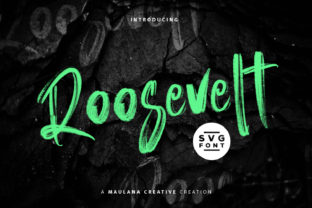
Roosevelt: The Bold, Handcrafted Display Font That Commands Attention
Imagine opening a boutique coffee shop and wanting your sign to feel warm, human, and unforgettable—not sterile or algorithmically perfect. Or launching a small-batch candle line where every detail, down to the label typography, must whisper craftsmanship. That’s where Roosevelt steps in: not just another display font, but a deliberate, expressive tool built for authenticity.
What Makes Roosevelt Stand Out?
Roosevelt is a bold, high-contrast display typeface designed with the rhythm and imperfection of hand-lettering—yet refined enough for professional use. Its strokes carry subtle swelling and tapering, its serifs are slightly irregular, and its capital letters have confident, sculptural presence. Unlike many “handwritten” fonts that rely on randomness or script mimicry, Roosevelt feels intentionally drawn: strong, grounded, and quietly confident.
It’s not meant for body text—and that’s by design. Roosevelt thrives where impact matters most: headlines, logos, packaging, posters, signage, and hero sections. Its visual weight and character make it instantly legible at scale, while its organic texture keeps it from feeling cold or corporate.
Key Characteristics, Explained Simply
- Bold by nature, not by force: Roosevelt doesn’t need extra weight or effects to stand out—it’s inherently commanding, thanks to its generous x-height and dynamic stroke modulation.
- Handcrafted, not handmade: Each glyph was carefully crafted to suggest human touch—slight asymmetry in curves, intentional ink-like density shifts—but remains highly consistent across characters. This balance makes it reliable for branding.
- High readability at large sizes: Even in tight layouts or on textured backgrounds (like kraft paper or brushed metal), Roosevelt maintains clarity without sacrificing charm.
- Designed for versatility within focus: It includes standard Latin characters, numerals, punctuation, and basic accented letters—enough for most English-language branding needs, but not overloaded with extended language support.
Who Benefits Most From Using Roosevelt?
Roosevelt isn’t for everyone—and that’s part of its strength. It serves creators and businesses who value distinctiveness over universality. Here’s who finds it especially useful:
- Small business owners launching food trucks, artisan bakeries, apothecaries, or local boutiques—where personality and trust are as important as product.
- Designers and agencies building brand identities for lifestyle, wellness, heritage, or craft-focused clients who want to avoid generic sans-serifs.
- Content creators producing Instagram carousels, YouTube thumbnails, or podcast cover art—where a single headline must stop the scroll.
- Print professionals working on limited-run posters, festival programs, wedding invitations, or gallery announcements where tactile quality matters.
Real-World Uses That Work Well
- A microbrewery’s taproom menu header: Roosevelt pairs beautifully with rustic wood grain backgrounds and minimalist iconography—adding gravitas without pretension.
- An independent bookstore’s seasonal reading list poster: Its warmth invites curiosity; its boldness ensures titles pop from across the room.
- A sustainable skincare brand’s product label: When set alongside clean, functional sans-serif subtext, Roosevelt conveys care and intention—key emotional cues for conscious shoppers.
- A university’s alumni campaign banner: Used sparingly for a tagline like “Rooted. Resilient. Real.”—it adds humanity to institutional messaging.
Strengths You Can Count On
When used thoughtfully, Roosevelt delivers consistent value:
- Instant tone-setting: It communicates sincerity, confidence, and approachability—often in under five words.
- Strong visual hierarchy: Even alongside neutral supporting fonts, Roosevelt naturally becomes the focal point—no extra styling needed.
- Timeless over trendy: While inspired by early 20th-century letterpress aesthetics, it avoids retro clichés. It feels classic, not costumed.
- Print-and-digital ready: Optimized for both high-res output and modern web rendering, including variable font compatibility in supported environments.
Things to Keep in Mind
Like any specialized tool, Roosevelt shines brightest when matched to the right job. Consider these practical realities before committing:
- Not ideal for long-form reading: Its boldness and decorative details fatigue the eye in paragraphs. Reserve it for headlines, logos, and short impactful phrases.
- Limited language coverage: While excellent for English and many Western European languages, it doesn’t include extended Cyrillic, Greek, or Asian character sets. Check the glyph list if multilingual support is essential.
- Pairing matters: Roosevelt works best with understated companions—think neutral sans-serifs (e.g., Inter, Poppins, or Lato) or gentle serifs (e.g., Merriweather or Cormorant Garamond). Avoid competing display fonts or overly ornate scripts.
- Context shapes perception: Used on a fintech dashboard or a medical device interface, Roosevelt may unintentionally signal informality. Match the font’s energy to your audience’s expectations.
How to Test If Roosevelt Fits Your Project
Before licensing or integrating Roosevelt, try this quick litmus test:
- Write your core message—just one sentence or phrase you want people to remember (e.g., “Fresh Bread Daily” or “Built for Real Life”).
- Set it in Roosevelt at 48–72pt on a mockup of your intended medium (a product label, website hero, or social post).
- Ask three questions:
- Does it feel true to the values I’m trying to express?
- Is it immediately clear—even at a glance or from across the room?
- Does it elevate the message, or distract from it?
- If two or more answers are “yes,” Roosevelt is likely a strong fit.
Final Thoughts: Typography as Quiet Confidence
In a digital landscape saturated with sameness—where dozens of brands use nearly identical fonts to convey “trust” or “innovation”—Roosevelt offers something rarer: quiet confidence rooted in craft. It doesn’t shout. It stands. It feels human because it was made that way—not generated, but considered.
You don’t need a massive budget or a design team to benefit from it. A solo maker printing labels at home, a café owner updating their chalkboard menu digitally, or a nonprofit designing an awareness campaign—all can use Roosevelt to say, without words: This matters. We made it with care.
Typography isn’t decoration. It’s voice. And with Roosevelt, your voice gains presence, warmth, and unmistakable character—without saying a thing.