Alchimique: A Display Font That Commands Attention—Without Compromising Clarity
Alchimique stands apart in the crowded landscape of display typefaces—not by chasing trends, but by balancing assertive structure with deliberate nuance. It’s not a font designed for body text or extended reading. Instead, Alchimique is built for moments where hierarchy, tone, and intention converge: a logo lockup, a book cover title, a keynote slide headline, or a limited-edition product label. Its value lies in how it performs when visual impact must be immediate, memorable, and stylistically coherent.
What Makes Alchimique Distinctive—Beyond “Bold”
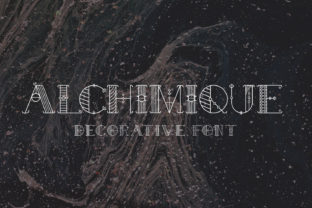
At first glance, Alchimique reads as bold and confident—but that impression deepens on closer inspection. Its letterforms feature subtle tapering in vertical strokes, carefully calibrated contrast between thick and thin elements, and a restrained yet expressive flair in terminals and junctions. Unlike many high-contrast display fonts that risk fragility at small sizes or digital scaling, Alchimique maintains structural integrity across common use cases: from 36pt print headlines to responsive web banners rendered at variable widths.
The uppercase set carries particular weight and presence, with strong horizontal emphasis and generous x-height proportions that enhance legibility without sacrificing elegance. Lowercase characters are less frequently deployed—but when used (e.g., in stylized subheads or short taglines), they retain rhythmic consistency and avoid visual dissonance. The italic variant isn’t a slanted copy; it’s a purpose-built companion with reworked curves and adjusted spacing to preserve typographic harmony.
Where Alchimique Excels—and Where It Doesn’t
Alchimique shines in controlled, intentional applications. Consider a boutique design studio launching a new brand identity: pairing Alchimique for the logotype with a neutral, highly legible sans-serif like Inter or Manrope for supporting text creates clear visual hierarchy and tonal distinction. Or imagine an independent publisher using Alchimique for a poetry collection cover—its confident stance reinforces the gravity of the content without veering into theatricality.
It also holds up well in motion graphics and editorial layouts where typography needs to anchor composition without competing with imagery. In one real-world case, a sustainability-focused apparel brand applied Alchimique to campaign posters displayed both digitally and in transit shelters. Designers noted its readability at distance and its ability to convey seriousness and craftsmanship—key brand attributes—without relying on color or illustration alone.
That said, Alchimique isn’t suited for interfaces requiring dense information scanning, multilingual support beyond Latin-based scripts, or environments demanding extreme scalability (e.g., dynamic data dashboards with auto-resizing headers). It lacks OpenType features like stylistic sets, contextual alternates, or extensive numeral variants—so users needing granular typographic control across complex documents may find its flexibility bounded.
Practical Integration: Workflow and Compatibility
Alchimique is distributed in standard WOFF2 and OTF formats, making it straightforward to implement in modern web projects via @font-face declarations or through platforms like Adobe Fonts and Google Fonts (where available). Load performance remains efficient: the full family (regular, italic, bold) clocks in under 180 KB total—well within recommended thresholds for critical display assets.
In desktop design tools—including Figma, Sketch, and Adobe Creative Cloud—it behaves predictably. Kerning pairs are thoughtfully included, and baseline alignment remains consistent across weights. Users report minimal adjustment needed when swapping in Alchimique during late-stage mockups, suggesting reliable interpolation and spacing logic.
One practical note: because Alchimique’s personality is strong, pairing requires discipline. Avoid stacking it with other high-contrast or decorative faces. Instead, pair it with humanist or geometric sans-serifs that offer neutrality and breath—fonts with open apertures and even stroke distribution work best. For print use, ensure sufficient bleed and trapping allowances, especially with tight letter-spacing or reversed-out treatments.
Audience Fit: Who Benefits Most—and Why
Freelance designers and small creative studios benefit most from Alchimique’s ability to elevate client deliverables quickly and cohesively. When time is constrained but brand perception matters—such as crafting a pitch deck for a fintech startup or redesigning a museum exhibition title wall—Alchimique delivers authority with little iteration.
Entrepreneurs launching direct-to-consumer brands often face the challenge of communicating differentiation amid visual noise. Alchimique helps establish tone before a single word is read: a skincare line using it for packaging communicates precision and care; a vinyl record label applying it to limited-run sleeve art signals intentionality and craft.
Educators and publishers working with visual literacy curricula also find utility in Alchimique—not as a teaching tool per se, but as a real-world example of how typographic contrast, proportion, and rhythm shape interpretation. Its balance of formality and character makes it accessible for discussion without being overly academic or obscure.
Long-Term Value and Consistency
Fonts age—not in technical obsolescence, but in cultural resonance. Alchimique avoids trend-driven quirks (excessive distortion, arbitrary ligatures, or exaggerated serifs) that can date quickly. Its foundation in classical proportion and contemporary refinement suggests longevity: it’s likely to remain effective five years from now in contexts where clarity and confidence remain priorities.
Consistency across weights and styles is another strength. Unlike some display families where bold variants feel like afterthoughts or optical mismatches, Alchimique’s bold retains the same underlying skeleton—just amplified with intention. This supports scalable branding systems where tone must remain unified whether appearing on a business card or a billboard.
Reliability extends to rendering. Tested across Chrome, Safari, Firefox, and Edge—including older iOS and Android WebView environments—Alchimique renders cleanly without hinting artifacts or unexpected glyph substitution. Print output at 300+ DPI shows no irregularities in stroke weight or corner treatment, confirming solid hinting and vector fidelity.
Realistic Recommendations for Implementation
- Start small: Test Alchimique in one high-impact location first—a hero section headline, logo revision, or social media banner—before expanding across a full system.
- Respect its role: Use it for emphasis, not exposition. If your message requires scanning or skimming, choose a more functional typeface instead.
- Adjust tracking deliberately: Its default spacing works well at larger sizes, but tightening letter-spacing by –20 to –40 units often enhances cohesion in all-caps settings—especially for logos or short phrases.
- Test accessibility early: While Alchimique itself isn’t WCAG-compliant for body text, ensure any surrounding interface text meets contrast and sizing standards. Never rely solely on Alchimique to convey meaning.
- Consider licensing scope: Verify usage rights match your distribution channels—especially if embedding in SaaS dashboards, mobile apps, or physical merchandise with mass production.
Alchimique doesn’t solve every typographic challenge—but it solves a specific, recurring one exceptionally well: how to project assurance and individuality without sacrificing legibility or professionalism. For creators who understand that type is never neutral—that it carries weight, history, and implication—Alchimique offers a refined, dependable voice. It’s not flashy. It’s not minimalist. It’s simply well-made, purpose-built, and quietly confident—qualities that resonate long after the first glance.