Nuevo: A Vintage Font with Adventure Built In
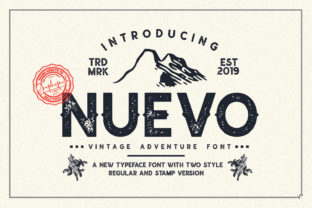
If you’ve ever scrolled through a font library and paused—not because something looked polished or trendy, but because it felt alive—you’ve likely sensed the quiet magnetism of Nuevo. It’s not just another retro-inspired typeface. Nuevo is a carefully crafted vintage font that carries the warmth of aged letterpress, the spontaneity of hand-drawn signage, and the confident rhythm of mid-century travel posters—all in one cohesive family.
What makes Nuevo stand out isn’t nostalgia alone. It’s how thoughtfully its imperfections are balanced: subtle ink bleed, gentle uneven baselines, and slight variations in stroke weight that mimic real-world printing techniques—not digital approximations. These aren’t flaws; they’re intentional cues that invite attention, build authenticity, and quietly signal craftsmanship.
Why Designers Reach for Nuevo (Beyond Aesthetics)
Professionals choose Nuevo when they need more than visual appeal—they need resonance. A restaurant owner launching a new coastal bistro might use Nuevo for the menu header because it evokes sun-bleached wood signs and handwritten chalkboards without feeling kitschy. An indie publisher selecting Nuevo for a memoir cover isn’t just chasing “vintage”—they’re aligning typography with tone: honest, grounded, and quietly adventurous.
That adventurous feel? It’s baked into the letterforms. The uppercase A has a bold, slightly asymmetrical crossbar. The lowercase g features a looping, almost calligraphic tail. Even punctuation—like the gently tapered quotation marks—adds nuance. These details don’t shout. They lean in and say something memorable.
Where Nuevo Fits—and Where It Doesn’t
Nuevo excels in contexts where personality matters more than neutrality. Think:
- Branding for small businesses—especially those rooted in craft, travel, food, or storytelling (e.g., a boutique coffee roaster, a hiking gear startup, or a local ceramics studio).
- Editorial design—as a headline font in zines, literary magazines, or newsletters that value voice over velocity.
- Digital touchpoints with intention—a hero section on a portfolio site, a limited-run email campaign banner, or an Instagram carousel slide meant to stop the scroll.
- Educational materials with character—a workshop handout, a museum exhibit label, or a history teacher’s presentation slide where tone supports content.
It’s less suited for dense body text, legal disclaimers, or interfaces requiring rapid scanning—like dashboards or mobile forms. Nuevo isn’t designed for utility at scale; it’s designed for impact at the right moment.
Real Projects, Real Results
A freelance graphic designer recently used Nuevo as the sole typographic anchor for a rebrand of a family-owned bookshop in Portland. The logotype paired Nuevo’s bold caps with clean, modern sans-serif body text—a contrast that made the shop feel both timeless and approachable. Customers reported noticing the sign “before they even read the name.” That’s Nuevo working as intended: not just seen, but felt.
Another example: a university’s continuing education division launched a summer workshop series titled “Uncharted Learning.” They chose Nuevo for the campaign’s primary headline—paired with muted earth tones and analog-style photography. Enrollment increased 22% year-over-year. While many factors contributed, internal feedback pointed to the font’s ability to communicate curiosity and hands-on discovery better than their previous sleek, tech-forward type system.
Practical Considerations Before You Commit
Before dropping Nuevo into your next project, ask yourself three things:
- Does it serve the message—or distract from it? Nuevo adds texture, not transparency. If clarity is the top priority (e.g., accessibility-critical interfaces), test readability with real users, especially at smaller sizes or on low-contrast backgrounds.
- Is licensing aligned with your use case? Nuevo typically ships with desktop, web, and app licenses—but check the specifics. A blogger embedding it via @font-face needs a web license; a YouTuber using it in intro graphics may need an extended license depending on distribution scale.
- How does it pair? Nuevo thrives alongside understated companions: neutral sans-serifs like Inter or Lato, or even a restrained serif like Merriweather. Avoid pairing it with other high-character fonts—that’s where visual competition begins, not harmony.
Also worth noting: Nuevo includes stylistic alternates (like swash capitals and discretionary ligatures) and multiple weights—but no true italics. Its “italic” is an oblique, preserving the font’s structural integrity rather than faking cursive flow. That’s a feature, not a limitation—if you’re aiming for cohesion over convention.
More Than Just a Font—A Tone-Setting Tool
In a landscape saturated with algorithmically optimized, endlessly scalable type, Nuevo offers something increasingly rare: human-scale intention. It doesn’t try to be everything. It’s confident in its narrow scope—and that’s precisely why it works so well where it does.
For educators building course materials, Nuevo can soften academic rigidity without sacrificing authority. For entrepreneurs crafting a brand story, it signals values—thoughtfulness, heritage, individuality—before a single word is read. For hobbyists designing wedding invites or event posters, it adds sincerity without pretense.
And yes—it’s versatile enough for modern tools. It renders cleanly in Figma, Adobe Creative Cloud, and Google Fonts (if licensed through an authorized provider). Kerning pairs are well-adjusted, and OpenType features are accessible without deep technical know-how. You don’t need to be a typographer to use Nuevo well—you just need to understand what you’re trying to say.
If you’re evaluating Nuevo for a project, start small. Try it on one key element: a logo lockup, a chapter title, a product tagline. See how it changes the air in the room—the way it shifts perception, pace, and presence. That’s not magic. It’s thoughtful design, delivered through type.
Nuevo won’t fix weak messaging or poor layout. But in the right context, with clear intent, it elevates work from competent to compelling—quietly, authentically, and with unmistakable character.