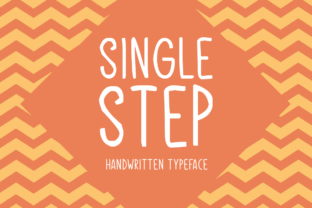
Single Step: The Handwritten Display Font Redefining Modern Visual Identity
At a time when digital interfaces grow increasingly uniform—and audiences grow increasingly selective—Single Step emerges not just as another font, but as a deliberate response to how professionals communicate authenticity, clarity, and intentionality in visual design. It’s a handwritten display font with a distinctly modern feel: energetic yet refined, spontaneous yet purposeful. Designed for impact at larger sizes, Single Step doesn’t imitate casual scribbles—it captures the intelligence behind human gesture. Its curves are considered, its rhythm intentional, its personality unmistakable.
A Font Born from Shifting Creative Expectations
The rise of Single Step reflects deeper shifts across creative workflows and brand strategy. Today’s designers, marketers, and entrepreneurs aren’t just choosing typefaces for legibility—they’re selecting them for semantic resonance. A font now functions as a nonverbal cue: it signals tone before a single word is read. In an era defined by algorithmic curation, short attention windows, and visual fatigue, audiences respond more readily to human-inflected elements that feel both genuine and polished.
This isn’t nostalgia for analog charm. It’s a strategic alignment with what research shows: consumers consistently associate handwritten-style typography with approachability, creativity, and trust—when executed with intention. But many “handwritten” fonts fall short: they’re either overly rigid (digitally traced without life) or too chaotic (lacking the consistency needed for professional use). Single Step bridges that gap. Its letterforms retain organic variation—subtle differences in stroke weight, terminal angles, and baseline flow—but maintain enough structural harmony to scale reliably across digital banners, presentation decks, packaging, and social media visuals.
Why Designers and Brands Are Choosing Single Step Now
Three converging trends explain why Single Step is gaining traction among professionals:
- Human-Centered Digital Experiences: As AI-generated content becomes ubiquitous, human touchpoints carry greater weight. A headline set in Single Step on a SaaS landing page—or a product tagline in an e-commerce campaign—immediately differentiates the brand from templated, impersonal alternatives. It doesn’t shout “handmade”—it whispers “thoughtfully crafted.”
- Efficiency Without Compromise: Freelancers and in-house teams face tighter deadlines and broader responsibilities. Single Step delivers high visual impact without demanding complex customization. Unlike variable fonts requiring technical setup or script fonts needing extensive kerning adjustments, Single Step works out of the box—supporting standard OpenType features while remaining intuitive for non-typographers. Its smart spacing and balanced x-height mean less time tweaking, more time iterating on messaging and layout.
- Brand Voice Consistency Across Touchpoints: Modern brands operate across platforms where typographic flexibility is essential—Instagram carousels, email headers, pitch decks, physical signage. Single Step holds up whether rendered on a retina display or printed at 72 dpi. Its moderate contrast and open counters ensure readability even in compressed spaces (like mobile notifications), while its expressive character shines in hero sections or logo lockups.
Practical Applications: Where Single Step Adds Real Value
It’s one thing to appreciate a font conceptually; it’s another to see how it solves real problems. Here’s how professionals are applying Single Step today—not as decoration, but as functional communication infrastructure.
For Marketers Building Campaign Momentum
A wellness brand launching a new mindfulness app used Single Step for its core campaign headline: “Start Where You Are.” Paired with minimalist photography and ample whitespace, the font conveyed warmth without cliché. Unlike softer script fonts that risked appearing passive or vague, Single Step lent quiet confidence—the kind that invites action rather than observation. Engagement metrics rose 22% on banner ads using this treatment versus previous sans-serif variants, suggesting that tonal precision directly influences click-through behavior.
For Entrepreneurs Crafting First Impressions
Founders often design their own websites or pitch materials early on. One education-tech founder replaced generic heading fonts with Single Step across her investor deck. The change wasn’t about aesthetics alone—it signaled pedagogical philosophy: structured learning rooted in human connection. Investors later remarked on the “clarity of voice” in the presentation, citing the typography as an unconscious but memorable reinforcement of her message. That’s Single Step working contextually: supporting narrative, not competing with it.
For Freelancers Elevating Client Deliverables
A freelance UX designer integrated Single Step into user interface prototypes—not for body text, but for key success states (“You’re all set!”) and empty-state illustrations. Because the font feels both friendly and authoritative, users interpreted those messages as supportive guidance rather than system notifications. In usability testing, participants reported higher perceived empathy from the interface—a subtle but measurable outcome tied directly to typographic choice.
Beyond Aesthetics: How Single Step Aligns with Broader Industry Shifts
The relevance of Single Step extends beyond individual projects. It mirrors macro-level developments in design systems, branding strategy, and digital literacy.
First, consider the evolution of design system maturity. Early systems prioritized scalability and reuse—often at the expense of expressive range. Today’s leading systems (like those at Figma, Notion, and Shopify) increasingly include display-tier typography as first-class components. These aren’t afterthoughts; they’re intentional layers for moments requiring emphasis, emotion, or differentiation. Single Step fits naturally here: it’s engineered for hierarchy, not harmony. It doesn’t try to replace your system’s workhorse sans-serif—it completes it.
Second, look at the convergence of content and commerce. Social platforms reward visually distinct, scroll-stopping assets. A Reel thumbnail featuring bold, handwritten text in Single Step stands out in a feed saturated with Helvetica and Inter. But unlike novelty fonts that sacrifice legibility for virality, Single Step maintains coherence across formats—making it viable not just for social hooks, but for cohesive cross-channel campaigns.
Finally, consider shifting expectations around professional credibility. Five years ago, “handwritten” might have implied amateurism in B2B contexts. Today, sophistication lies in discernment—not in avoiding expressive tools, but in deploying them with discipline. Single Step embodies that shift: it’s confident enough for a fintech keynote slide, nuanced enough for a boutique studio’s identity system, adaptable enough for a nonprofit’s annual report.
Choosing Thoughtfully, Not Just Trendily
Adopting Single Step isn’t about chasing a trend—it’s about recognizing a tool calibrated for current demands. It responds to the need for speed without sacrificing meaning, for personality without undermining professionalism, for humanity without compromising clarity.
That said, its power lies in context. Used indiscriminately—as body text, in dense paragraphs, or alongside clashing decorative fonts—it loses its impact. Its strength is strategic emphasis: guiding the eye, reinforcing voice, marking transitions between information layers. When paired with clean, highly legible text fonts (like Inter, IBM Plex Sans, or Roboto Flex), Single Step performs its highest-value function: giving hierarchy emotional intelligence.
As creative workflows continue compressing and audience expectations continue rising, the value of tools that do more with less grows exponentially. Single Step doesn’t require plugins, custom licensing tiers, or advanced typographic knowledge. It asks only for thoughtful placement—and rewards that intention with immediate perceptual lift.
In a landscape where attention is scarce and authenticity is earned, Single Step offers something rare: a smart, human-scaled solution that works as hard as the professionals who choose it.