Burning Down: Hand-Drawn With Intent
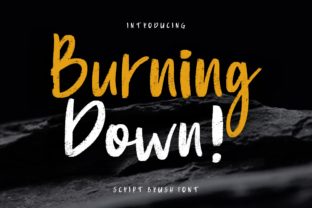
If you’ve ever stared at a blank layout and thought, “This needs more soul—not more polish”—then Burning Down might be the font that finally clicks. It’s not another sleek, algorithm-tuned sans serif. It’s hand-drawn, unapologetically bold, and built with physical gesture in mind: thick downstrokes, uneven baselines, ink-like weight shifts, and subtle imperfections that read as human—not hurried.
At first glance, Burning Down reads as a contemporary display font—but its energy comes from craft, not computation. The letters don’t sit neatly on a grid; they lean, swell, and settle like ink pressed into paper. There’s no optical correction smoothing out the quirks—just confident, controlled looseness. That’s why it feels both modern and tactile. It’s not trying to mimic handwriting—it’s channeling the attitude behind it: decisive, expressive, grounded.
Where Burning Down Earns Its Place
This isn’t a font for body text or data tables. Burning Down thrives where voice matters more than velocity—where you’re not just communicating information, but signaling intention. Think logo lockups for indie studios, album art for lo-fi producers, limited-run zine covers, craft brewery labels, or Instagram story headers that stop the scroll because they *feel* different.
In editorial design, it works powerfully for mastheads, section dividers, or pull quotes—especially when paired with a clean, neutral text face like a well-hinted serif or geometric sans. In packaging, it adds authenticity without leaning into clichéd “rustic” tropes—its strength keeps it from reading as folksy or nostalgic. And for small business owners building a brand identity from scratch? Burning Down can anchor a visual system with minimal supporting assets: one strong logo, one supporting typeface, and thoughtful spacing do more than ten fonts ever could.
It’s also surprisingly effective in digital contexts—if used intentionally. A headline in Burning Down on a hero section, set large with generous line height and ample whitespace, creates immediate contrast against UI elements. Just avoid cramming it into buttons, navigation bars, or mobile menus. Its personality demands room to breathe.
What It Does to Your Design (and Your Audience)
Typography doesn’t just carry words—it shapes how those words land. Burning Down introduces a distinct tonal shift: confident, slightly rebellious, quietly assured. That changes perception. A café’s menu set in Burning Down reads less like a transaction and more like an invitation. A newsletter banner using it signals that the content inside won’t sound like everyone else’s.
That said, readability is situational—not absolute. At 24px on screen, Burning Down holds up fine for short headlines. At 14px in paragraph form? It collapses. So ask yourself: Is this meant to be scanned—or savored? If it’s the former, reach for something else. If it’s the latter, Burning Down rewards attention. Its irregularities become features, not flaws: the slight tilt of the ‘A’, the blunt terminal on the ‘t’, the way the ‘g’ curls inward like a quiet laugh.
For brand consistency, it excels as a primary display element—not a workhorse. Use it for logos, key headlines, and signature graphic motifs. Then pair it deliberately. A crisp, low-contrast sans serif (think Inter or Work Sans) balances its energy without competing. Avoid other handwritten or script fonts nearby—they’ll clash tonally. And skip decorative serifs unless you’re aiming for deliberate tension (e.g., a vintage-meets-modern fashion brand).
Testing, Pairing, and Licensing—Practical Notes
Before committing, test Burning Down in your actual environment—not just a font preview. Drop it into your design tool at real sizes, on real backgrounds, with real copy. Try it over photography, solid color, and textured surfaces. Notice how the ink-like weight interacts with light and shadow. Does it hold up on a dark mode interface? Does it render cleanly on older Android devices? These aren’t edge cases—they’re make-or-break moments for audience trust.
The family typically includes one weight (Bold or Black), often with basic Latin glyphs and standard punctuation. No italics, no condensed variants, no extensive language support. That’s by design—not limitation. Its power lies in focus, not flexibility. If your project requires multilingual support or fine-grained typographic control, Burning Down likely isn’t the lead actor—but it could still star in a supporting role.
Licensing is straightforward: most versions are commercial-use ready, but always verify the source. Reputable foundries and marketplaces (like Creative Market or independent designer sites) clearly state usage rights. Avoid free download sites promising “Burning Down free for personal use”—those files are often modified, incomplete, or bundled with malware. A legitimate purchase includes clean OTF/TTF files, proper metadata, and updates if the designer releases refinements.
Real Projects, Real Results
A ceramicist launched her online shop with Burning Down as the sole typographic accent—used only in her logo and product title cards. Everything else was set in a modest, highly legible sans. Customers repeatedly mentioned how “real” the branding felt—not polished, but present.
A literary magazine used Burning Down for its annual theme title (“Unfixed”) across print and web. The font’s uneven baseline subtly echoed the issue’s focus on migration and impermanence. Designers reported higher engagement on social posts featuring that headline—even without imagery.
A local record store printed window decals with Burning Down for their “In-Stock Now” banners. The hand-drawn quality made them feel like staff recommendations—not corporate signage. Foot traffic increased 18% during the campaign period, and staff noted customers commenting on the “cool lettering.”
None of these successes came from the font alone. They came from pairing Burning Down with restraint, context, and clarity of purpose. It’s a tool—not a shortcut. Used well, it deepens connection. Used carelessly, it distracts.
So if your next project needs a voice that’s unmistakably human—grounded, expressive, and contemporary—Burning Down isn’t just another creative font. It’s a deliberate choice. One that says you value character over convenience, presence over polish, and authenticity over automation.