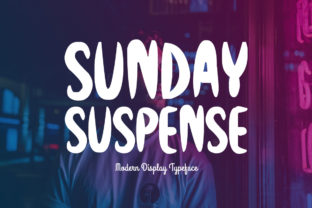
Sunday Suspense: Where Nostalgia Meets Modern Design Intent
There’s a quiet shift happening in how designers, marketers, and independent creators approach typography—not toward maximalism or algorithm-driven trends, but toward intentionality. Sunday Suspense stands at that intersection: a display font rooted in mid-century charm, yet flexible enough to feel fresh in today’s leaner, more human-centered design landscape. It’s not just “vintage-inspired.” It carries warmth, rhythm, and subtle personality—qualities increasingly valued when attention is scarce and authenticity is non-negotiable.
What Makes Sunday Suspense Distinct—Beyond Aesthetic
Sunday Suspense isn’t built for body text or interface labels. It’s a display font—meant to anchor moments of emphasis: a podcast title, a book cover, an event poster, a boutique brand’s logo lockup. Its letterforms balance structural clarity with expressive quirks: slightly tapered serifs, uneven stroke contrast, and a gentle irregularity that suggests hand-drawn confidence rather than digital perfection. That slight imperfection is key. In an era saturated with ultra-polished, AI-generated visuals, Sunday Suspense offers a tactile, human signature without requiring illustration skills or custom lettering.
Unlike many retro fonts that default to loud novelty or kitschy cliché, Sunday Suspense avoids caricature. Its proportions remain legible at scale, its spacing thoughtful—not cramped, not overly generous—and its weight distribution supports readability even in tight compositions. That practical foundation is why it works equally well on a minimalist Instagram story and a printed zine cover.
Why Now? Timing, Trust, and the Quiet Rejection of Uniformity
Over the past five years, we’ve seen a steady retreat from homogenized visual language. Brands once chasing “clean” and “universal” are now leaning into specificity—tone, texture, and typographic voice matter more than ever. This isn’t about rejecting modern tools; it’s about using them to express something distinct. Sunday Suspense fits naturally here—not as a throwback prop, but as a deliberate choice to signal warmth, craft, and narrative awareness.
Consider how content consumption has changed: scrolling happens fast, but engagement deepens when users sense care in execution. A blog post titled “The Slow Art of Making Coffee” gains quiet resonance when set in Sunday Suspense—not because it’s “old,” but because the font subtly reinforces the theme: unhurried, intentional, grounded. Similarly, a small business selling handmade ceramics might use Sunday Suspense for its seasonal newsletter headline—not to shout, but to invite pause.
This aligns with broader shifts in user expectations. People don’t just want information; they want context, coherence, and cues about values. Typography is one of the most immediate, subconscious carriers of those cues. Sunday Suspense doesn’t scream “fun”—it suggests it through rhythm and proportion. It doesn’t claim “authenticity” outright—it demonstrates it through restraint and character.
Real-World Use Cases—Not Just Theory
Designers aren’t adopting Sunday Suspense as a novelty—they’re integrating it where it solves real problems:
- Podcast branding: Hosts building intimate, story-driven shows (true crime, memoir, local history) use Sunday Suspense for titles and episode cards—its cadence echoes spoken pacing and builds familiarity across seasons.
- Educational materials: Educators creating downloadable worksheets or workshop handouts choose it for section headers—not to distract, but to create visual breathing room and emotional tone. One literacy tutor noted students respond more readily to reading prompts set in Sunday Suspense versus generic sans-serifs, citing “less pressure, more invitation.”
- Small-batch product labels: From small-batch hot sauce to artisanal tea blends, makers use Sunday Suspense on front-of-pack to convey craftsmanship without resorting to faux-vintage clichés like distressed textures or excessive ornamentation.
- Event promotion: Local theaters, indie bookstores, and community centers apply it to posters for author talks or live storytelling nights—leveraging its narrative warmth to signal “this is about people, not platforms.”
Importantly, Sunday Suspense performs well across formats. It scales cleanly from mobile screens to large-format prints. It pairs effectively with neutral, highly legible text fonts—think Inter, Lora, or even system fonts like Georgia—without competing or clashing. That versatility matters in workflows where consistency across web, email, and print is no longer optional.
Practical Integration—No Overhead, No Guesswork
Adopting Sunday Suspense doesn’t require redesigning your entire brand system. Start small and intentional:
- Identify one high-impact moment: Is it your newsletter subject line? Your portfolio project title? Your Instagram highlight cover? Choose where emphasis and tone matter most—not where speed or neutrality do.
- Test contrast and hierarchy: Use Sunday Suspense only for primary headlines or short phrases. Never for long paragraphs or navigation menus. Ensure sufficient color contrast against backgrounds—especially if used digitally. Its charm fades fast when hard to read.
- Respect its role: Sunday Suspense thrives when paired with typefaces that recede gracefully. Avoid pairing it with other display fonts or overly decorative scripts. Let it lead; let the supporting type support.
- Consider licensing early: It’s available through reputable foundries with clear web and desktop licenses. If you’re embedding it on a client site or SaaS dashboard, verify usage rights upfront—no surprises later.
One freelance designer shared how she began using Sunday Suspense exclusively for client presentation decks—not in final deliverables, but in pitch slides. “Clients immediately described the work as ‘thoughtful’ and ‘human,’ even before seeing the full mockups. It shaped their first impression in a way I couldn’t replicate with layout alone.” That’s not magic—it’s typography doing its job quietly and well.
Looking Ahead—Not Toward Trends, But Toward Clarity
The future of typography isn’t about chasing novelty. It’s about matching form to function with increasing precision—and Sunday Suspense reflects that evolution. As tools grow more powerful (and accessible), the differentiator won’t be technical capability, but discernment: knowing which typeface signals the right thing, to the right person, at the right moment.
That’s why Sunday Suspense feels both timely and enduring. It doesn’t try to be everything. It excels where it’s meant to: in moments that ask for attention, not noise; warmth, not whimsy; distinction, not distraction. For professionals balancing speed and substance, for creators building trust over time, and for anyone who believes design should serve meaning—not just aesthetics—it remains a quietly powerful tool.
Its relevance isn’t tied to nostalgia alone. It’s tied to a growing understanding that how something looks is inseparable from how it’s received—and that sometimes, the most forward-looking choice is a font that remembers how to breathe.