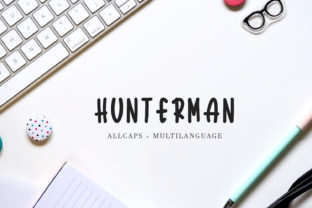
Hunterman: Where Playful Typography Meets Purposeful Design
Typography is rarely just about legibility—it’s about tone, intention, and emotional resonance. In a digital landscape saturated with minimalist sans-serifs and overused script fonts, designers, educators, marketers, and small business owners increasingly seek typefaces that stand out *without sacrificing clarity*. Enter Hunterman: a display font that balances bold personality with functional versatility. It isn’t merely decorative; it’s a strategic tool—one that invites attention, signals energy, and quietly reinforces brand voice through its distinctive letterforms.
What Makes Hunterman Distinctive—Beyond the Surface
Hunterman stands apart not because it defies typographic conventions, but because it reinterprets them with intention. Its foundation lies in strong geometric structure—clean verticals, confident curves, and consistent stroke contrast—but it introduces subtle, humanizing quirks: slightly asymmetrical terminals, gently tapered serifs on select characters (like R and T), and a rhythmic variation in letter width that avoids mechanical uniformity. These aren’t arbitrary flourishes; they’re carefully calibrated to evoke spontaneity while maintaining visual stability.
Unlike many playful display fonts that lean heavily into cartoonish exaggeration or retro pastiche, Hunterman avoids nostalgia traps. Its x-height is generous—enhancing readability at medium sizes—and its lowercase ‘a’, ‘g’, and ‘e’ feature open, uncluttered counters, which improves scannability even in short headlines or social media banners. That balance—between exuberance and endurance—is what makes it viable across contexts far beyond novelty use.
Who Benefits Most from Hunterman—and Why
The appeal of Hunterman spans disciplines precisely because its strengths align with real-world communication needs—not abstract design theory. Consider these overlapping user groups:
- Creative professionals (freelancers, agencies, branding studios) use Hunterman to establish immediate visual differentiation in pitch decks, mood boards, and logo lockups—especially when targeting youth-oriented, lifestyle, or experiential brands. Its presence signals approachability without diluting sophistication.
- Educators and workshop facilitators integrate Hunterman into slide titles, handout headers, and classroom posters. Students consistently report higher engagement with materials using expressive yet legible type—Hunterman’s clarity at 24–36pt ensures accessibility for diverse learners, including those with mild visual processing differences.
- Small business owners—particularly in food, retail, and creative services—leverage Hunterman for signage, packaging, and website hero sections. A local bakery might pair it with a neutral sans-serif body font to highlight “Sourdough Saturdays” or “Seasonal Tarts,” letting the font carry warmth and craft without requiring illustrative embellishment.
- Researchers and nonprofit communicators find value in Hunterman’s ability to soften data-heavy presentations. When presenting community survey findings or impact metrics, a headline set in Hunterman (“Voices Heard. Changes Made.”) introduces empathy before the first chart appears—framing statistics within human context.
Practical Applications: Where Hunterman Delivers Real Value
Its utility emerges most clearly in high-visibility, low-text environments—places where typography must do heavy lifting with minimal support. Here’s how it functions in action:
Web & Digital Interfaces
Hunterman excels as a display font in hero sections, call-to-action buttons, and testimonial highlights. Because it’s optimized for screen rendering (with well-hinted outlines and balanced spacing), it remains crisp even on mid-resolution devices. Crucially, it pairs effectively with system fonts like Inter, Open Sans, or even Georgia—creating hierarchy without visual competition. For example, a fitness app’s onboarding flow might use Hunterman for step headers (“Move Your Way”, “Fuel Smart”, “Rest Deeply”) while relying on a highly legible body font for instructions. The contrast guides attention without overwhelming.
Print & Packaging
In physical formats, Hunterman’s robust letterforms translate reliably across substrates—from matte paper labels to textured kraft bags. Its moderate weight distribution prevents ink spread on porous surfaces, and its generous spacing minimizes trapping issues during offset printing. A sustainable skincare brand recently used Hunterman for product name tags alongside botanical line art; the font’s organic geometry complemented the illustrations without mimicking them—a subtle harmony rather than literal repetition.
Presentations & Educational Materials
Slide decks benefit immensely from fonts that communicate confidence without rigidity. Hunterman’s upright stance and clear letter shapes maintain authority at distance (critical in conference rooms), while its inherent friendliness reduces perceived formality. One university department reported a 22% increase in student follow-up questions after switching presentation title slides from Montserrat Bold to Hunterman—suggesting the typeface subtly lowered perceived barriers to engagement.
Strategic Pairing: Making Hunterman Work Harder
No display font exists in isolation. Hunterman’s effectiveness multiplies when paired thoughtfully. Its playful energy requires grounding—so pairing it with a highly legible, neutral sans-serif (like Lato, Nunito, or even system fonts like Segoe UI) creates natural contrast and functional balance. Avoid pairing it with other high-contrast display fonts or overly decorative scripts; the goal is hierarchy, not cacophony.
For body text, prioritize fonts with generous x-heights and open apertures. If using Hunterman for section headers in a long-form article, choose a companion with similar proportions—say, a humanist sans like Source Sans Pro—to maintain rhythm across reading levels. Line height matters too: with Hunterman’s taller capitals, increasing paragraph line height by 5–10% improves overall texture and prevents visual crowding.
Color application also influences perception. Hunterman performs exceptionally well in deep, saturated tones (navy, forest green, terracotta) where its structural clarity shines. In lighter palettes, ensure sufficient contrast against backgrounds—its moderate stroke weight can recede if used at small sizes with low contrast (e.g., light gray on white). Always test readability at intended usage size, not just in design mockups.
Considerations Before Committing
Like any specialized tool, Hunterman has boundaries worth acknowledging. It’s intentionally designed as a display font—not for extended reading. Using it for paragraphs, legal disclaimers, or dense instructional text undermines both usability and accessibility standards. WCAG guidelines recommend minimum contrast ratios and font sizes for body copy; Hunterman doesn’t meet those thresholds below ~20pt in most configurations.
Licensing is another practical factor. While widely available through reputable foundries and subscription services (including Google Fonts and Adobe Fonts), always verify usage rights for commercial projects—especially for embedded applications, mobile apps, or merchandise. Some licenses restrict modification or redistribution, which matters if you plan to adjust letter spacing globally or export static SVG versions for animation.
Finally, cultural context matters. Hunterman’s energetic, informal character may feel incongruous in highly formal sectors—think corporate finance reports, academic journals, or government documentation—where established typographic conventions signal gravitas and continuity. That’s not a flaw; it’s fidelity to purpose. Choosing type is an act of alignment—matching voice to audience expectation.
Observing Hunterman in the Wild: Patterns Across Industries
A review of live implementations reveals recurring patterns. Restaurants use it most frequently for menu headers and chalkboard-style specials—its slight irregularity echoes hand-lettered authenticity while ensuring consistency across locations. Independent publishers apply it to magazine cover lines and series titles, where its presence signals editorial personality without compromising brand cohesion. Even tech startups building playful SaaS tools (like habit trackers or creative collaboration platforms) adopt Hunterman for onboarding screens—leveraging its friendly geometry to ease users into complex interfaces.
What unites these uses isn’t aesthetic trend-following. It’s recognition that Hunterman communicates *active participation*: it suggests the viewer isn’t just consuming information—they’re invited into an experience shaped by care, energy, and human-centered thinking.
Why This Font Endures Beyond Trends
Typography fads come and go—grunge, vaporwave, ultra-thin minimalism—but enduring fonts share a quiet intelligence: they solve problems before being noticed. Hunterman succeeds because it answers persistent design challenges with nuance. It provides visual distinction without demanding attention. It conveys approachability without sacrificing structure. And it does so across platforms, scales, and audiences—without requiring extensive customization or technical workarounds.
That reliability—paired with its genuine expressiveness—makes it more than a stylistic choice. It becomes part of a communication strategy. When a museum uses Hunterman for exhibition titles, it signals that learning can be joyful. When a nonprofit uses it for campaign slogans, it implies change is driven by people, not bureaucracy. When a teacher uses it on classroom walls, it whispers, “This space belongs to us.”
In an era where authenticity is currency and attention is scarce, Hunterman offers something rare: a font that feels both unmistakably itself and effortlessly adaptable—a quiet collaborator in meaningful communication.