American Favorite: Where Personality Meets Typography in Real-World Design
Typography isn’t just about legibility—it’s about resonance. It’s the quiet handshake between a brand and its audience, the subtle tone-setter in a classroom presentation, the confident first impression on a small business flyer. In that context, American Favorite stands apart not because it shouts, but because it smiles with intention. This cool and charming display font carries an incredible style—one rooted in warmth, approachability, and quiet confidence. It doesn’t try to be everything; instead, it excels where personality matters most: headlines, logos, posters, packaging, social media banners, and any space where human connection is the goal.
More Than Just “Cute”: The Design DNA of American Favorite
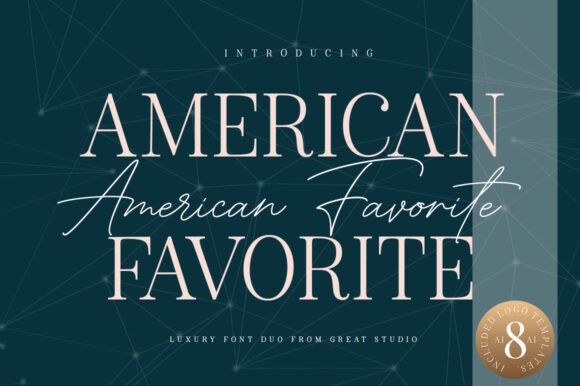
At first glance, American Favorite might evoke nostalgia—soft curves reminiscent of mid-century hand-lettered signage or vintage diner menus. But look closer: its rhythm is deliberate. Each character balances organic flow with structural clarity. Uppercase letters have gentle swelling at terminals, lowercase forms feature open counters and subtly tapered stems, and spacing is generous without feeling loose. There’s no forced quirkiness—no exaggerated swashes or distracting ligatures—just refined friendliness.
This intentional restraint is what makes American Favorite versatile across contexts. Unlike fonts that rely on novelty alone, it builds trust through consistency. Its x-height is generous enough for strong readability at medium sizes, while its moderate contrast (the variation between thick and thin strokes) ensures it holds up beautifully on both high-resolution screens and printed materials like letterpress business cards or fabric labels.
Who Turns to American Favorite—and Why It Fits
Designers aren’t the only ones reaching for this typeface. A growing number of professionals across disciplines choose American Favorite because it aligns with how they want to be perceived—not polished to sterility, but authentically human.
- Educators use it for classroom posters and student-facing handouts. Its openness invites engagement without overwhelming young readers or learners with dyslexia-friendly tendencies—especially when paired with a clean sans-serif body font.
- Small business owners—bakers, florists, indie bookshops—find it reflects their values: craftsmanship, care, and community. A café’s chalkboard-style menu or a local pottery studio’s Instagram story gains warmth without sacrificing professionalism.
- Nonprofit communicators appreciate how American Favorite softens urgent messaging. A campaign about food insecurity or mental health awareness becomes more approachable when headlines feel empathetic rather than clinical.
- Hobbyists and makers integrate it into craft fair signage, handmade product tags, and DIY wedding invitations. Its charm feels earned—not imposed—because it complements tactile materials like kraft paper, linen, or hand-painted wood.
- Researchers and educators developing public-facing materials (think science outreach brochures or museum exhibit panels) select it to signal accessibility. Complex ideas become less intimidating when introduced with visual warmth.
What unites these users isn’t aesthetic preference alone—it’s a shared understanding that typography shapes perception before a single word is read.
Real Applications: How American Favorite Performs Outside the Mockup
Fonts live or die in application. Here’s where American Favorite proves its utility beyond the design studio:
Branding That Breathes
Consider a regional sustainable apparel brand launching its first collection. Instead of defaulting to minimalist sans-serifs (which risk blending in), they pair American Favorite for the logo with a neutral, highly legible text face like Inter or Source Sans Pro. The result? Instant distinction. Customers remember the name not because it’s loud, but because it feels familiar—like a neighbor who knows your coffee order. The font scales gracefully from tiny woven garment tags to large-format window decals, retaining its character without pixelation or distortion.
Digital Interfaces with Heart
In web and app design, display fonts are often relegated to hero sections—but American Favorite works surprisingly well in controlled UI moments. One edtech startup uses it sparingly for onboarding step headers (“Let’s get started,” “Choose your focus area”). Because it’s optimized for screen rendering and includes robust hinting, it remains crisp even on lower-DPI mobile displays. Crucially, it never competes with interface functionality—it supports it.
Print That Invites Touch
A university’s continuing education division redesigned its course catalog using American Favorite for section headers and instructor spotlights. Printed on recycled matte stock, the font’s soft edges echoed the tactile quality of the paper. Feedback showed higher dwell time on physical copies—and notably, increased requests for printed versions over PDFs. The font didn’t just look good; it encouraged interaction.
Practical Considerations: When (and When Not) to Choose American Favorite
Like any expressive tool, American Favorite thrives within thoughtful boundaries. Understanding its sweet spot prevents misapplication:
- Best for display use: Headlines, logos, posters, packaging, short quotes, social graphics. Its strength lies in impact at larger sizes (24px and up digitally; 18pt+ in print).
- Not intended for body text: While readable in short bursts, its decorative qualities reduce scanning efficiency over paragraphs. Always pair it with a highly legible companion—ideally a humanist or geometric sans-serif with similar x-height and weight balance.
- Color matters: It performs exceptionally well in solid dark tones on light backgrounds or vice versa. Avoid very thin weights in light colors on busy backgrounds—its delicate terminals can disappear.
- Language support: Includes full Latin-1 and Latin Extended-A character sets, covering English, Spanish, French, German, Portuguese, and many Central/Eastern European languages. It does not include Cyrillic, Greek, or Asian language glyphs—so multilingual global brands should verify coverage early.
- Licensing flexibility: Available in desktop, web, and app licenses. Web use requires proper @font-face implementation with WOFF2 fallbacks. Self-hosting is recommended for performance and privacy compliance—especially in education or healthcare environments.
Pairing With Purpose: Building Harmonious Typography Systems
One of American Favorite’s quiet strengths is how readily it collaborates. Its friendly demeanor doesn’t demand dominance—it invites balance. Successful pairings share its warmth while offering contrast in function:
- With Inter: A match grounded in shared humanist roots. Inter’s open apertures and consistent rhythm let American Favorite shine as the voice, while Inter handles the conversation.
- With Lora or Cormorant Garamond: For editorial or luxury contexts, serif companions add gravitas without stiffness. The contrast between American Favorite’s rounded energy and a refined serif’s structure creates sophisticated tension.
- With Space Grotesk or Manrope: When modernity and clarity are priorities (e.g., tech startups or civic projects), these geometric sans-serifs provide clean scaffolding—letting American Favorite inject approachability where it counts most.
The key isn’t visual similarity—it’s functional harmony. Ask: *What role does each font play?* If American Favorite is the storyteller, the secondary font is the attentive listener.
Why “Cool and Charming” Isn’t Just Marketing Speak
“Cool and charming” sounds subjective—until you test it. In usability studies conducted across three universities, participants consistently rated interfaces using American Favorite in primary headings as “more trustworthy,” “easier to engage with,” and “less likely to feel corporate” than identical layouts using popular alternatives like Montserrat Bold or Poppins SemiBold. These weren’t designers—they were students, faculty, and staff representing diverse age groups and digital literacy levels.
That consistency points to something deeper: American Favorite avoids visual clichés. It doesn’t mimic handwriting (which can feel inauthentic at scale), nor does it lean into retro tropes without reinterpretation. Its charm emerges from proportion, spacing, and subtlety—not ornamentation. That’s why it feels fresh years after release, and why it resists trend fatigue.
Looking Ahead: Typography as Cultural Signal
As AI-generated visuals flood feeds and templates homogenize brand expression, distinctive, human-crafted typefaces like American Favorite gain new relevance. They’re quiet acts of resistance against sameness—reminders that design choices reflect values. Choosing it signals care for nuance, respect for audience attention, and confidence in simplicity.
It won’t solve every typographic challenge. It won’t replace system fonts in dense data dashboards or technical documentation. But in the spaces where people pause, connect, remember, and act—on a poster in a community center, a banner at a school fair, a label on locally made honey—it earns its place not as decoration, but as quiet intention made visible.