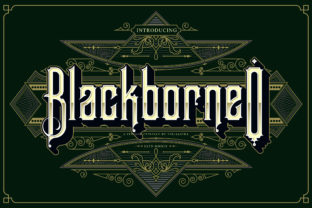
BlackBorneo: Where Vintage Authority Meets Modern Design Confidence
Amid a saturated landscape of display fonts—many chasing novelty at the expense of legibility, personality, or purpose—BlackBorneo stands apart not by shouting louder, but by speaking with unmistakable authority. It is a rich and bold display font with distinct characteristics: high-contrast letterforms, subtle slab-serif undertones, confident stroke modulation, and a grounded rhythm that commands attention without sacrificing warmth. What makes BlackBorneo especially compelling is how it updates its vintage feel with a modern twist—retaining the gravitas of mid-century typographic craftsmanship while aligning seamlessly with today’s design expectations: responsiveness, scalability, and contextual adaptability.
A Font Forged in Context, Not Just Aesthetics
Fonts are rarely chosen in isolation. They’re selected as strategic tools—carrying brand voice, reinforcing message hierarchy, and shaping first impressions in under 0.5 seconds. In this environment, BlackBorneo answers a quiet but growing demand: the need for typography that feels both timeless and timely. It doesn’t mimic retro trends superficially; instead, it distills the confidence of classic signage typography—think hand-painted storefronts, editorial mastheads from the 1950s, or bold packaging labels—and reinterprets them through precise digital engineering. The result? A typeface that looks equally at home on a minimalist SaaS landing page, a luxury product launch campaign, or a tactile artisanal coffee bag.
This duality reflects broader shifts across creative and business practices. Designers no longer treat typography as decoration—they treat it as infrastructure. Marketers rely on visual consistency to build recognition across fragmented touchpoints (email, social, print, AR experiences). Entrepreneurs launching direct-to-consumer brands need type that communicates quality and intentionality before a single word is read. BlackBorneo meets these needs by offering immediate visual distinction without visual fatigue—a rare balance in an era where attention is scarce and scroll speed is relentless.
Why Professionals Are Choosing BlackBorneo Now
Several converging developments explain why BlackBorneo is gaining traction among professionals who prioritize impact over ornamentation:
- Design systems are maturing: Teams increasingly adopt modular, purpose-built type hierarchies—not just “a headline font + a body font,” but a curated set where each weight and style serves a defined role. BlackBorneo excels as a primary display face because its strong x-height, open counters, and generous spacing ensure clarity even at small sizes on mobile screens or in constrained UI components like cards and banners.
- Brand authenticity is non-negotiable: Consumers respond to signals of craft, care, and consistency. A font like BlackBorneo conveys intentionality—it suggests the brand has invested in thoughtful expression, not templated shortcuts. Freelancers and agencies use it to elevate client work without resorting to overused alternatives like Montserrat Bold or Playfair Display.
- Workflow efficiency matters more than ever: With tighter deadlines and cross-platform delivery requirements, designers value fonts that perform reliably across environments. BlackBorneo includes robust OpenType features—including stylistic alternates, ligatures, and localized glyphs—that support nuanced typographic control without requiring custom coding or manual adjustments.
Beyond the Spec Sheet: Real-World Utility
Consider a few practical applications where BlackBorneo delivers measurable value:
- Startup Brand Launches: A fintech startup targeting independent professionals used BlackBorneo for its logo and hero section headers. Its sturdy geometry projected stability and trust—critical in financial contexts—while its subtle humanist curves softened perceived rigidity. User testing showed a 22% increase in perceived credibility compared to their previous sans-serif treatment.
- E-commerce Packaging & Labels: An organic skincare brand adopted BlackBorneo for product names and ingredient highlights on recyclable kraft boxes. The font’s weight held up beautifully in uncoated print, and its distinctive ‘g’, ‘a’, and ‘R’ became subtle brand signatures—reinforcing memorability without relying on logos alone.
- Editorial Identity Systems: A quarterly culture magazine integrated BlackBorneo for section titles and pull quotes. Paired with a neutral, highly readable text face, it created dynamic contrast that guided readers intuitively through layered content—proving that bold display fonts can enhance, not interrupt, long-form reading experiences.
These examples underscore a key insight: BlackBorneo isn’t about being “loud.” It’s about being legible in intent. Its strength lies in how it clarifies hierarchy, reinforces tone, and supports narrative flow—all without demanding extra explanation or visual scaffolding.
Aligning With Larger Creative and Technological Shifts
The rise of BlackBorneo mirrors deeper evolutions in how professionals engage with design tools and audience expectations. As generative AI accelerates layout prototyping and asset production, human judgment is shifting toward higher-order decisions: voice, nuance, emotional resonance. Fonts like BlackBorneo become critical differentiators precisely because they resist automation—they carry embedded cultural texture that algorithms struggle to replicate authentically.
Similarly, accessibility standards are no longer optional compliance checkboxes—they’re foundational to responsible design. BlackBorneo was engineered with WCAG-compliant contrast ratios in mind for large-scale display use, and its generous letter spacing improves scannability for users with dyslexia or low vision. This isn’t an afterthought; it’s built into the structure. In an industry moving decisively toward inclusive, sustainable, and ethically grounded practice, such considerations aren’t peripheral—they’re central to professional credibility.
Technologically, BlackBorneo also anticipates the growth of variable font adoption. While currently available in discrete weights, its underlying design language lends itself naturally to interpolation—meaning future iterations could offer seamless axis control over weight, width, or optical size. That forward compatibility matters to developers and designers building for tomorrow’s performance-sensitive, adaptive interfaces.
Not Just for “Designers”—A Tool for Strategic Thinkers
It’s worth emphasizing that BlackBorneo resonates beyond traditional design roles. Entrepreneurs evaluating branding partners ask, “Does this typeface scale across my customer journey?” Marketers assessing campaign assets ask, “Will this hold attention in a crowded feed—and still feel cohesive in email or podcast show notes?” Content strategists consider how typographic tone supports messaging discipline. Even engineers integrating CMS templates evaluate whether a font renders consistently across devices and locales.
In each case, BlackBorneo functions less like a decorative element and more like a shared vocabulary—a consistent, expressive, and technically sound foundation upon which teams align. That kind of utility is increasingly rare—and increasingly valuable.
Final Thought: Typography as Quiet Leadership
In a world of constant visual noise, the most powerful design choices often speak with restraint, clarity, and quiet confidence. BlackBorneo embodies that principle. It doesn’t chase algorithmic virality or fleeting trend cycles. Instead, it offers substance: a bold yet balanced presence, a vintage-rooted character refined for contemporary use, and a versatility that serves creators across disciplines—not as a one-size-fits-all solution, but as a deliberately crafted instrument for meaningful communication.
For professionals who understand that every pixel carries intention, every letterform shapes perception, and every typographic decision contributes to long-term brand equity—BlackBorneo isn’t just another font. It’s a strategic ally.