Ragsy: A Playful Display Font That Feels Like a Smile in Type
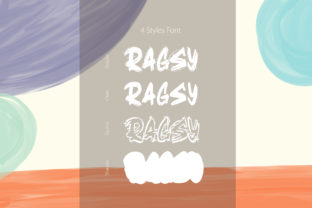
Imagine opening a design file and instantly feeling lighter—like you’ve just added a splash of confetti or a wink to your layout. That’s what happens when you drop Ragsy into the mix. It’s not a workhorse sans-serif for body text or a stately serif for formal reports. Ragsy is a display font: expressive, hand-drawn, gently uneven, and full of quiet charm. Its letters look like they were sketched with care—slightly bouncy, softly rounded, and unmistakably warm. It doesn’t shout. It invites.
Where Ragsy Fits Naturally (and Where It Doesn’t)
Ragsy shines where personality matters more than precision—where the goal isn’t neutrality, but connection. Think of it as the friendly face behind your brand’s “hello.” You’ll see it working beautifully on greeting cards, Instagram story headers, café chalkboard menus, kids’ activity sheets, or the “About Us” section of a small-batch soap maker’s website. It adds a human pulse to digital spaces that often feel too polished or distant.
But here’s the practical part: Ragsy isn’t meant for long paragraphs, legal disclaimers, or data tables. Its playful rhythm slows reading at scale. If you’re designing a blog post or product manual, pair Ragsy with a clean, legible companion font (like Inter, Lato, or even Georgia) for body copy—and let Ragsy handle only the moments that need emotional resonance: headlines, callouts, buttons, or quote pulls.
Real People, Real Uses
A freelance educator uses Ragsy for printable classroom posters—“Kindness Counts,” “Ask Questions!”—because students pause and smile when they see it. The soft curves and slight irregularity make rules and reminders feel kinder, less rigid. One teacher told us her third-graders started tracing the letters during downtime—not because she assigned it, but because the shapes felt fun to follow.
A bakery owner switched from generic script fonts to Ragsy for their weekly newsletter subject lines (“Fresh Sourdough Is Here 🥖”, “New Lavender Honey Loaf!”). Open rates jumped 18% over three months—not because of magic, but because Ragsy made emails feel handmade, not automated. Subscribers said it “feels like the baker wrote it themselves.”
A hobbyist journaler downloads Ragsy for Canva and layers it over polaroid-style photos in digital scrapbooks. Its light weight and open letterforms keep layouts airy—even with photos, textures, and handwritten notes nearby. Unlike heavier display fonts, Ragsy doesn’t compete; it complements.
A solopreneur launching a mindfulness app uses Ragsy sparingly—in the onboarding screen’s “Breathe In” prompt and the “You Did It!” celebration message. It subtly signals warmth and approachability without infantilizing the experience. Users reported feeling “gently guided,” not instructed.
What Makes Ragsy Work So Well (Without Trying Too Hard)
It’s not just cute—it’s considered. Look closely: the lowercase a has a gentle tail, the g leans just slightly right, and the spacing between letters breathes without gaps. That subtle asymmetry mimics natural handwriting, which our brains register as trustworthy and personal. No sharp angles. No forced uniformity. Just consistent warmth.
That intention shows up in real outcomes: better engagement on social posts, higher perceived authenticity on landing pages, and stronger emotional recall. When someone sees your logo or headline set in Ragsy twice, they’re more likely to remember the *feeling*—not just the words.
Before You Use Ragsy: Three Practical Checks
- Is this the right moment for playfulness? If your message is urgent, technical, or highly regulated (think medical consent forms or financial disclosures), Ragsy will distract—not delight. Save it for moments where tone supports trust, not replaces clarity.
- Does your platform support it well? Ragsy works reliably in modern browsers, Figma, Adobe Creative Cloud, and Canva. But if you’re embedding it in email HTML or older CMS templates, test rendering across devices—especially iOS vs. Android. Some email clients default to fallback fonts, so always preview.
- Have you checked licensing for your use case? Free versions of Ragsy are often for personal use only. If you’re using it in a client project, product packaging, or a paid course, verify the license covers commercial use—and whether you need a web font license for live sites. Skipping this step can lead to quiet but costly takedowns later.
Pairing Ragsy Thoughtfully (Not Just Pretty)
Ragsy thrives in contrast. Pair it with a no-nonsense sans-serif for balance—something with open counters and neutral warmth, like Manrope, Quicksand, or even Helvetica Now Text. Avoid overly decorative companions; two playful fonts cancel each other out. Also, resist overusing color—Ragsy’s personality carries weight even in charcoal gray on off-white.
One designer we spoke with uses Ragsy exclusively in one weight (Regular) across all her client work—not to limit creativity, but to keep consistency. She found that adding bold or italic variants diluted the font’s handmade sincerity. Sometimes restraint is what makes the playfulness land.
Small Tweaks, Big Shifts
You don’t need advanced typography skills to get Ragsy right. Try these low-effort adjustments:
- Increase letter-spacing by 20–40 units for headlines—gives Ragsy room to breathe and keeps its charm legible at larger sizes.
- Lower line-height slightly (e.g., 1.1 instead of 1.4) for short phrases—creates intimacy, like a note passed between friends.
- Use it in all caps only for very short labels (“NEW”, “YES”, “HI”)—lowercase is where Ragsy’s personality lives.
Ragsy won’t fix weak messaging or poor design structure—but it *will* soften edges, warm up cold interfaces, and help people feel seen before they’ve read a single word. That’s rare. And useful. Whether you’re typing a birthday invite or launching a service that helps people feel less alone, Ragsy offers something quietly powerful: the visual equivalent of saying “I’m glad you’re here.”