Pudding Pie Duo: Whimsy, Craft, and Clarity
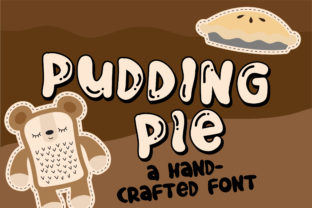
There’s a quiet magic in fonts that feel handmade—not just designed, but *made*. Pudding Pie Duo is one of those rare premium fonts where you can almost see the ink drying on the paper. It’s not sterile or algorithmically smoothed. It’s warm, slightly uneven, full of gentle curves and thoughtful imperfections—like a favorite ceramic mug glazed by hand. At its core, Pudding Pie Duo is a display font duo: one playful handwritten script paired with a clean, friendly sans serif—all crafted in-house, with intention.
The script half has soft entry and exit strokes, subtle tapering, and a relaxed rhythm—never frantic, never forced. It leans gently right, like someone smiling mid-sentence. The sans serif companion isn’t generic; it’s got rounded terminals, open apertures, and just enough personality to hold its own without competing. Together, they don’t just coexist—they converse. One says “celebrate,” the other says “let’s get started.” That balance makes Pudding Pie Duo unusually versatile for a creative font.
Where This Duo Actually Shines (Beyond Just “Cute”)
Because it’s rooted in craft—not trend—it works where many whimsical fonts fail: in real-world applications with real audiences. Think beyond birthday invitations. A local bakery uses Pudding Pie Duo on their chalkboard menu headers (script) and daily specials list (sans)—instant warmth, zero kitsch. A sustainable skincare brand applies the script to product names (“Lavender Cloud Serum”) and the sans for ingredient lists and usage instructions. The contrast feels intentional, human, trustworthy.
In editorial design, it anchors feature headlines in indie magazines—especially lifestyle, food, or slow-living publications—without overwhelming body text set in a neutral serif. For packaging design, the duo gives small-batch goods (jams, candles, stationery) visual distinction on crowded shelves. The script draws the eye; the sans delivers clarity. On social media graphics, it holds up well even at smaller sizes—unlike many delicate script fonts—because the sans has generous x-height and consistent spacing.
Web design teams use it sparingly but effectively: as a hero headline paired with a system font for body copy. It loads quickly (it’s a lightweight OTF/TTF package), and because both styles are carefully hinted, it renders cleanly across browsers and devices. No fuzzy edges. No awkward kerning jumps at 24px vs. 48px.
What It Does for Your Brand—Not Just Your Layout
Typography shapes perception faster than most people realize. Pudding Pie Duo subtly signals approachability, care, and authenticity—without saying a word. That matters for small business owners building trust with local customers, or content creators cultivating loyal readers. It doesn’t scream “premium” like a high-contrast serif might—but it whispers “thoughtful,” which resonates deeply in today’s oversaturated digital space.
Readability isn’t sacrificed for charm. The sans serif maintains strong legibility even in tight line lengths or low-contrast settings (e.g., light gray text on off-white backgrounds). The script, while decorative, was drawn with clear letterforms—no excessive flourishes that blur into one another. You’ll find it performs reliably in print at 14pt+ and on screen at 28px+, especially when used for short phrases, not paragraphs.
Consistency comes naturally here. Because both fonts share underlying proportions and spacing logic, switching between them feels like shifting tone—not changing languages. That cohesion strengthens brand identity over time, whether you’re designing a quarterly newsletter, updating Instagram Stories, or refreshing your website footer.
Practical Tips Before You Install
Start by asking: *Is this solving a real problem—or just adding flair?* Pudding Pie Duo excels when you need warmth without cliché, distinction without distraction. If your project relies heavily on long-form readability (e.g., a 50-page ebook), lean on the sans for body text—and reserve the script for chapter titles or pull quotes. Don’t force the script where clarity is non-negotiable.
Test pairings early. Try the sans against a classic serif like Merriweather or Lora for print layouts—or pair the script with Inter or Open Sans for web interfaces. Avoid pairing it with other highly stylized scripts or condensed sans serifs; the contrast should support, not compete. Also check the included weights: Pudding Pie Duo ships with regular and bold for the sans, and standard and “alt” versions of the script (the alt includes alternate glyphs for common letter combinations—great for avoiding repetitive joins).
Licensing is straightforward: one commercial license covers unlimited projects—client work, merchandise, apps, videos—as long as you’re not reselling the font files themselves. No subscriptions, no monthly fees. You download it once, install it locally, and use it across platforms. Just remember: web use requires embedding via @font-face (not Google Fonts), and you’ll need to host the files yourself or use a service that supports custom font hosting.
A Few Real Moments Where It Made the Difference
A children’s book illustrator used the script for character names and the sans for narration boxes—readers told her the type “felt like the story was being told just to them.” A podcast about mindful entrepreneurship applied the duo to episode thumbnails: script for title, sans for guest name and date. Click-through rates improved—not because of the font alone, but because the combination made each thumbnail feel personal and grounded.
One craft brewery printed Pudding Pie Duo on their limited-release can labels: script for the beer name (“Honeycomb Haze”), sans for ABV, style, and tasting notes. Retailers reported customers lingering longer at the cooler, commenting on how “friendly” the cans looked. That’s not accidental—it’s what happens when typography aligns with voice, values, and audience expectation.
If you’ve ever hesitated to use a playful font because it felt too fragile, too fleeting, or too hard to control—Pudding Pie Duo is worth your attention. It doesn’t ask you to choose between charm and competence. It’s a reminder that good design assets don’t shout. They settle in. They make people pause—not because they’re flashy, but because they feel quietly, unmistakably *right*.