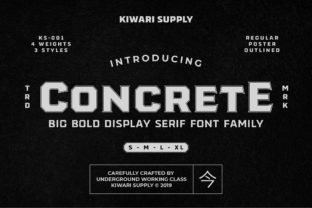
Concrete: A Display Font Family Built for Impact and Clarity
Typography isn’t just about legibility—it’s about presence. When a headline lands, when a brand statement holds attention, or when a digital interface communicates authority without saying a word, it’s often the font doing the heavy lifting. Concrete was designed with that intention in mind: not as a neutral workhorse, but as a deliberate, confident voice. It’s a display font family engineered to deliver strength, modernity, and visual weight—without sacrificing clarity or versatility.
What Makes Concrete More Than Just Another Bold Typeface?
At its core, Concrete is a tightly crafted sans-serif display family. Its letterforms feature strong vertical stress, generous x-heights, and subtle geometric discipline—think clean terminals, balanced proportions, and intentional contrast between thick and thin strokes. Unlike ultra-narrow or overly decorative display fonts, Concrete avoids trend-driven extremes. It doesn’t rely on gimmicks; instead, it leans into structural integrity and typographic confidence. That balance makes it especially effective at larger sizes—on hero banners, presentation slides, packaging, signage, and editorial mastheads—where first impressions matter most.
What sets Concrete apart isn’t just how it looks, but how it functions across real-world contexts. It includes multiple optical sizes (Display, Subhead, and Text variants), meaning its design adapts intelligently depending on scale—not just through resizing, but through refined stroke weights, spacing, and character shaping. This responsiveness reflects how typography is increasingly expected to behave: not as static assets, but as adaptive components within dynamic layouts.
Why Display Fonts Like Concrete Are Gaining Strategic Importance
Designers and brands are shifting away from generic system fonts or overused web-safe families—not because those fonts are inadequate, but because audiences now expect visual distinction even in everyday interfaces. With attention spans compressed and digital clutter intensifying, differentiation happens in milliseconds. A well-chosen display font like Concrete becomes an immediate signal: this message is intentional, this brand has a point of view, this experience was thoughtfully constructed.
This shift aligns with broader patterns in digital behavior. Users scroll faster, skim deeper, and respond more readily to visual hierarchy than dense text blocks. At the same time, tools like Figma, Webflow, and modern CSS allow designers to implement custom type with far less technical friction than even five years ago. The barrier to using expressive typography has dropped—so the expectation has risen. Concrete fits naturally into this ecosystem: it’s optimized for variable font compatibility, includes robust OpenType features (like stylistic alternates and figure sets), and performs reliably across browsers and devices.
From Branding to Learning: Where Concrete Adds Real Value
Consider a small business launching a new product line. Their website needs to convey innovation and reliability—not through stock photography or vague adjectives, but through consistent, memorable visual language. Using Concrete for headlines and key CTAs creates instant cohesion. Paired with a neutral, highly readable text font (like a well-spaced grotesk or humanist sans), it forms a clear typographic rhythm: bold statements followed by accessible explanation. That pairing doesn’t shout—it asserts, then listens.
Educators and course creators face similar challenges. Online learning platforms thrive on scannability and emotional resonance. A lecture title set in Concrete feels substantive—not flashy, but grounded. It subtly reinforces credibility, especially when contrasted with softer body copy. One instructional designer we spoke with replaced a standard bold sans with Concrete for module headers and reported a measurable increase in student engagement metrics—particularly in video thumbnail previews and syllabus skimming behavior.
Even in print, Concrete holds up. Its ink traps and generous counters ensure crisp reproduction on everything from uncoated paper to large-format vinyl. A local nonprofit used it for a campaign poster series: the font’s solidity translated directly into perceived trustworthiness, while its clean geometry kept the messaging feeling current—not dated or corporate.
How Concrete Fits Into Evolving Creative Workflows
Modern design isn’t siloed. A single project might move from Figma prototype to WordPress site to Instagram carousel to printed brochure—all requiring consistent yet context-aware typography. Concrete supports that fluidity. Its variable font axis allows designers to fine-tune weight and width without loading multiple files. That means a headline can be slightly condensed for mobile without losing impact, or gently expanded for a wide-screen banner—all from one efficient file.
For developers, Concrete integrates cleanly via standard @font-face declarations or font-display strategies that prioritize perceived performance. No JavaScript dependencies, no render-blocking surprises. And because it’s built with real-world testing in mind—not just theoretical metrics—it renders predictably across Windows, macOS, iOS, and Android, including legacy environments where font fallbacks still matter.
Choosing Concrete Thoughtfully—Not Just Boldly
Like any powerful tool, Concrete works best when applied with intention. It’s not meant for long-form reading, footnotes, or data tables—those demand neutrality and endurance, not emphasis. Its strength lies in framing, signaling, and anchoring. Think of it as the typographic equivalent of a well-placed accent wall: it defines space, directs focus, and establishes tone—but only where it’s needed.
That means pairing matters. Concrete pairs well with humanist sans-serifs (like Inter or Source Sans), low-contrast serifs (such as Literata or PT Serif), or even restrained monospaced fonts for technical contrast. Avoid pairing it with other high-contrast or geometric display fonts—that risks visual competition rather than harmony. Also, consider color contrast carefully: its boldness shines against deep backgrounds or muted tones, but can feel overwhelming against bright, saturated hues unless intentionally dialed back with letter-spacing or line-height adjustments.
Realistic Recommendations for Getting Started
- Start small: Try Concrete for just one element—your site’s main headline, your newsletter subject line, or your presentation title slide. See how it changes perception before overhauling your entire system.
- Test at scale: View it on mobile, in dark mode, and at 125% zoom. Does it retain legibility? Does spacing hold up? Concrete’s optical sizing helps, but context still rules.
- Respect hierarchy: Use its Display variant for primary headings, Subhead for section titles, and reserve its Text cut only for short captions or labels—not paragraphs.
- Think beyond the web: Export SVG versions for logos, use it in After Effects motion graphics, or embed it in PDF reports. Its vector precision translates across mediums.
Typography evolves not through radical reinvention, but through thoughtful refinement—addressing how people actually read, interact, and remember. Concrete reflects that evolution: it’s not chasing novelty, but solving for clarity, impact, and adaptability in environments that demand all three. It doesn’t try to be everything. It does one thing exceptionally well—and does it consistently, across platforms, use cases, and expectations.
For professionals building brands, educators shaping understanding, entrepreneurs launching ideas, or creators defining their voice: Concrete offers more than aesthetic appeal. It offers a reliable, contemporary way to say what matters—loudly, clearly, and without apology.