Orion: A Bold, Futuristic Font for Space-Themed Design Projects
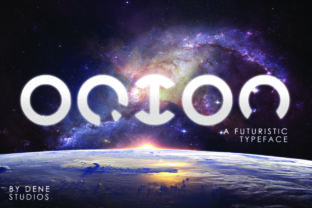
Orion stands out as a distinctive typeface designed with outer space and science fiction in mind. It’s round, bold, and deliberately futuristic—not merely stylistic, but conceptually aligned with themes of exploration, technology, and speculative design. Unlike many sci-fi fonts that rely on sharp angles, excessive glitch effects, or monospaced rigidity, Orion uses smooth curves, generous letter spacing, and balanced weight to suggest both advanced capability and human-centered clarity. Its design language avoids cliché while remaining instantly legible and thematically resonant.
What Makes Orion Different From Other Sci-Fi Fonts?
Most fonts labeled “futuristic” fall into two broad categories: those built for technical interfaces (think terminal displays or control panels) and those leaning into retro-futurism (inspired by 1950s–70s visions of space travel). Orion occupies a middle ground—it’s neither sterile nor nostalgic. Its rounded terminals and open counters improve readability at small sizes, while its consistent stroke weight and subtle optical adjustments ensure cohesion across headlines, UI labels, and promotional materials.
Where some alternatives prioritize novelty over function—adding simulated scan lines, uneven baselines, or forced distortion—Orion prioritizes typographic integrity. It doesn’t mimic hardware limitations; instead, it evokes the confidence of systems engineered to operate reliably under uncertainty. That distinction matters when selecting a font for projects where tone and usability must coexist: a documentary title sequence, an interactive museum exhibit about Mars rovers, or a game interface that balances immersion with accessibility.
Fitness for Purpose: Where Orion Excels
Orion works especially well in contexts where visual identity needs to signal forward-thinking ideas without sacrificing professionalism. Consider these realistic use cases:
- Exhibition graphics for planetariums or science centers—its rounded forms soften high-concept subject matter, making complex topics feel approachable;
- Branding for startups in aerospace, satellite data, or climate modeling—Orion conveys innovation while avoiding the cartoonishness that can undermine credibility;
- Book covers and editorial design for hard sci-fi novels or nonfiction titles about astrophysics—its presence commands attention without competing with illustrative elements;
- UI elements in simulation software or educational apps—where consistent hierarchy and clear visual feedback are essential.
In each case, Orion contributes to a cohesive aesthetic without requiring heavy graphic support. Its versatility stems from thoughtful construction: uppercase and lowercase glyphs share proportional harmony, and the font includes standard OpenType features like ligatures and alternate numerals—useful for refining typographic detail without custom coding.
Tradeoffs and Practical Limitations
No font is universally optimal—and Orion reflects intentional design choices that also define its boundaries. Its bold weight and rounded geometry make it less suitable for dense body text in long-form reading. While perfectly legible in short bursts, extended paragraphs may fatigue readers due to reduced contrast between characters and higher visual density. For editorial layouts requiring sustained reading, pairing Orion with a neutral, highly readable text face (like a well-hinted sans-serif or even a low-contrast serif) is advisable rather than extending Orion beyond its strengths.
Another consideration is licensing scope. Orion is typically distributed as a desktop + web license, but usage in mobile apps or embedded systems may require additional permissions. Designers evaluating Orion for cross-platform products should verify technical compatibility—especially if variable font support, dynamic scaling, or multilingual character sets (beyond Latin-based languages) are required. While Orion covers Western European diacritics comprehensively, its support for Cyrillic, Greek, or extended Unicode ranges varies by version and vendor.
How Orion Compares With Broader Typographic Categories
Rather than positioning Orion against specific named fonts, it’s more useful to compare it along functional dimensions common in professional typography decisions:
- Legibility vs. atmosphere: Some sci-fi fonts sacrifice immediate recognition for mood—Orion leans toward legibility first, atmosphere second. That makes it safer for public-facing applications where clarity can’t be compromised.
- Customization potential: Orion offers fewer stylistic variants (e.g., no ultra-light or black weights, limited italics) compared to expansive families like Inter or Roboto. If your project demands fine-grained typographic hierarchy across many content tiers, you may need supplemental fonts—even if Orion anchors the primary voice.
- Cultural resonance: Fonts rooted in analog tech (e.g., monospaced terminals or early digital displays) carry strong period associations. Orion avoids anchoring itself to any single era, giving it longer shelf life—but potentially less immediate nostalgic appeal for audiences drawn to vintage futurism.
This isn’t a deficit—it’s alignment. Orion serves designers who value consistency, scalability, and thematic coherence over stylistic fragmentation. When a project calls for a unified visual language across print, screen, and environmental signage, Orion’s structural discipline becomes an asset, not a limitation.
When to Choose Orion—and When to Look Elsewhere
Orion is likely the right choice when:
- You’re developing a brand or campaign centered on real-world space exploration, scientific research, or next-generation engineering;
- Your audience includes general-interest viewers—not just genre enthusiasts—who benefit from intuitive, uncluttered typography;
- You need a strong visual anchor that supports, rather than overshadows, photography, data visualization, or motion graphics;
- You’re working within tight production timelines and want predictable rendering across devices and platforms.
Conversely, Orion may not be ideal when:
- The project relies heavily on irony, parody, or retro aesthetics—fonts with stronger historical signatures (like those mimicking 1970s NASA typography or 1980s arcade interfaces) may communicate more precisely;
- You require extensive multilingual support or specialized symbols (e.g., mathematical notation, phonetic alphabets);
- Design constraints demand extreme thinness, extreme width, or dramatic contrast variation—Orion’s design intentionally avoids extremes to preserve balance;
- You’re building a highly modular, component-driven design system where flexibility across weight, width, and optical size is non-negotiable.
Ultimately, choosing Orion isn’t about finding the “most futuristic” font—it’s about selecting one whose structure, tone, and behavior match the substance of your work. Its strength lies in quiet confidence: it doesn’t shout “space!” but instead supports the message with intelligent, grounded form.
Making an Informed Decision
Evaluating Orion—or any specialized font—requires looking beyond first impressions. Test it in context: set actual headlines alongside supporting imagery, preview it on target devices, and assess how it performs in both static and animated states. Compare it side-by-side with alternatives not just on style, but on functional criteria: Does it scale predictably? Does it pair cleanly with your existing text fonts? Does it remain legible under lighting conditions your audience will encounter?
Professional designers often find Orion most valuable when used deliberately—not as a blanket solution, but as a strategic element within a broader typographic strategy. Its round, bold, futuristic character gives it presence, but its real utility emerges through restraint: letting it define key moments while allowing other voices in the composition room to breathe.
If your goal is to communicate ambition, precision, and human-centered progress—without leaning on tropes—Orion offers a rare combination of thematic relevance and typographic reliability. It won’t solve every design challenge, but where its qualities align with your project’s goals, it adds substance, not just surface.