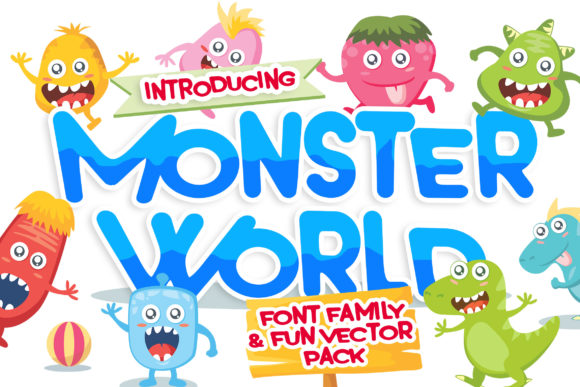
Monster World: A Playful, Versatile Font for Lighthearted Design Projects
Monster World is a distinctive display font designed to bring energy, charm, and personality to visual projects without sacrificing legibility or craft. Unlike many playful fonts that lean heavily into cartoonish exaggeration or niche themes, Monster World balances whimsy with usability—offering three intentional weights (light, bold, and bounce bold) and a curated set of vector illustrations as a practical bonus. It’s not built for body text or formal documents, but rather for moments where tone matters as much as typography: a birthday invitation that feels alive, a children’s book cover that invites curiosity, or a boutique kids’ clothing label that communicates joy at first glance.
What Sets Monster World Apart
At its core, Monster World stands out through thoughtful contrast—not just in weight, but in intention. The “bounce bold” style isn’t merely a bolder version of the base; it introduces subtle upward momentum in letterforms, giving static text a sense of lift and rhythm. This isn’t achieved through arbitrary distortion, but through consistent, hand-tuned curves and spacing that preserve readability even at smaller sizes on posters or product tags. The light weight offers delicate contrast for layered designs, while the standard bold provides reliable impact without visual fatigue.
The included vector pack reinforces this design philosophy: it’s not generic clip art, but a cohesive set of friendly, scalable monsters and accessories that align stylistically with the font’s proportions and personality. That means icons can be resized alongside headlines without clashing, and color palettes stay harmonious across text and imagery—something designers often need to reconcile manually when mixing third-party assets.
Fitting Into Real-World Design Workflows
Monster World works best when the goal is expressive clarity—not neutrality. If you’re designing a logo for a preschool music class, a limited-run sticker sheet for a summer camp, or chapter headings in an illustrated middle-grade novel, Monster World delivers tone efficiently. Its letterforms avoid overused tropes like dripping paint, exaggerated wobbles, or forced cuteness—making it more versatile than fonts that rely on a single gimmick.
That said, it’s not a system font. You won’t use Monster World for interface labels, legal disclaimers, or long-form editorial layouts. Its strength lies in short bursts of communication where voice and mood are primary considerations. In practice, designers often pair it with clean, neutral sans-serifs (like Inter, Open Sans, or Montserrat) for supporting text—creating hierarchy without competition.
Comparing Approaches: When Playfulness Needs Precision
Many designers exploring fun fonts weigh options along two axes: expressiveness versus adaptability. Some fonts prioritize maximum character—think exaggerated serifs, irregular baselines, or heavy texture—but require significant layout adjustments to work reliably across formats. Others aim for broad compatibility but end up feeling generic or emotionally flat.
Monster World occupies a pragmatic middle ground. It’s more restrained than highly illustrative display fonts (e.g., those built from hand-drawn scans or pixel-art constraints), which often limit scalability or color flexibility. Yet it’s more intentionally crafted than basic rounded sans-serifs marketed as “kid-friendly”—fonts that may lack distinct rhythm, consistent spacing, or typographic nuance across weights.
This balance becomes especially relevant when output includes both digital and print applications. Because Monster World is a well-hinted OpenType font, it renders cleanly on screens at various resolutions and holds up under offset printing or screen-printing processes—unlike some decorative fonts that rely on embedded raster effects or complex layering that don’t translate reliably outside design software.
Practical Use Cases—and Where It Might Not Fit
Consider Monster World when:
- You’re developing branding for a small business targeting families—like a local toy shop, pediatric therapy practice, or after-school art studio—and want typography that reflects warmth without seeming infantilized.
- You’re designing physical materials such as party supplies, school event posters, or library program flyers where visual appeal must grab attention quickly in busy environments.
- You need a consistent look across multiple touchpoints (e.g., social media banners, email headers, and printed handouts) and want to minimize asset management overhead—the vector pack reduces the need to source matching icons elsewhere.
It’s less suited for:
- Brands requiring serious, authoritative, or minimalist expression—even if they serve children (e.g., educational nonprofits, medical providers, or academic publishers).
- Projects demanding multilingual support beyond basic Latin characters. Monster World currently covers Western European languages but doesn’t include extended Cyrillic, Greek, or Asian language sets.
- Situations where tight budget or timeline constraints leave no room for typographic refinement—Monster World benefits from deliberate pairing, spacing, and color decisions, not just drag-and-drop application.
How It Compares With Common Alternatives
When evaluating fonts for lighthearted design, many professionals consider broader categories: rounded sans-serifs, handwritten styles, and illustrative display faces. Each carries tradeoffs.
Rounded sans-serifs (e.g., Quicksand, Nunito, or Varela Round) offer wide language support and excellent readability but often lack distinctive voice—making them safe, but rarely memorable. Monster World trades some universality for stronger character, which pays off in contexts where differentiation matters.
Handwritten fonts convey informality and approachability, but their variability can hinder consistency—especially across team collaborations or multi-page documents. Monster World avoids this by maintaining precise metrics and spacing across all weights, enabling predictable scaling and alignment.
Highly illustrative fonts—those where letters double as detailed drawings—deliver maximum visual interest but frequently sacrifice function: poor kerning, uneven color density, or limited size ranges. Monster World’s illustrative elements remain subtle and structural, enhancing rather than replacing typographic function.
Making the Call: Is Monster World Right for Your Project?
The decision hinges less on whether Monster World is “good” and more on whether its specific strengths match your project’s functional and emotional requirements. Ask yourself:
- Is tone central to the message? If the goal is to evoke delight, surprise, or gentle humor—not just convey information—Monster World supports that intent directly.
- Do you need flexibility across weights and formats? Its three distinct yet coordinated weights allow for clear visual hierarchy without switching families, and its vector bonus extends that consistency to iconography.
- Are you balancing creativity with practicality? If you value design efficiency—fewer asset sources, fewer compatibility checks, and smoother handoff to developers or printers—Monster World reduces friction without compromising personality.
It’s also worth noting how Monster World fits within broader resource evaluation. Many designers now treat fonts as part of a larger toolkit—including illustration libraries, color systems, and layout templates. In that context, Monster World functions not just as type, but as a lightweight design system anchor: one that suggests a direction without locking you in.
Ultimately, Monster World won’t replace a robust serif for long-form reading or a monospace for technical documentation. But for the right moment—where a headline needs to smile, a logo needs to wink, or a poster needs to spark immediate recognition—it offers a rare combination: craftsmanship, cohesion, and genuine charm.