Life Conundrum: Bold Urban Typography, Real-World Impact
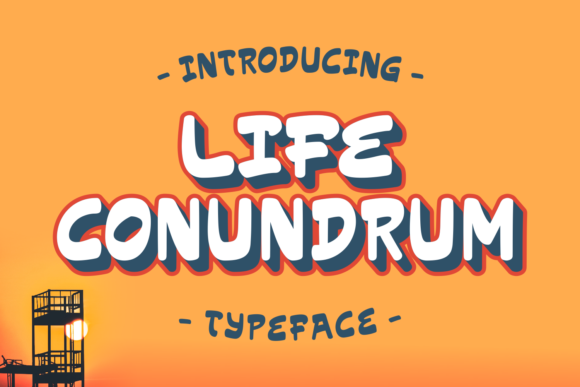
Typography isn’t just about letters—it’s about attitude, intention, and instant recognition. When you need type that doesn’t whisper but *declares*, Life Conundrum delivers. It’s not another minimalist sans-serif or nostalgic serif revival. It’s a bold font with a unique urban touch—structured yet restless, precise yet expressive. Think street art meeting editorial design, or a tech startup’s pitch deck fused with a boutique café’s chalkboard menu. That’s the energy Life Conundrum brings to any layout.
A Typeface Built for Contrast—and Clarity
At first glance, Life Conundrum stands out through deliberate tension: sharp, angled terminals paired with subtle rounded counters; tight letter spacing balanced by generous x-height; uppercase forms that command attention without sacrificing legibility. Its weight range spans from solid Medium to commanding Black—no light or thin variants, because it’s designed to be seen, not blended in. There’s no italic alternate—instead, it uses slanted caps and dynamic alternates to suggest movement and variation. This isn’t accidental. It reflects an intentional philosophy: typography should support voice, not dilute it.
What makes Life Conundrum especially useful is how it handles hierarchy *without* relying on size alone. A headline in Life Conundrum Black at 36px reads with authority. Drop it to 24px in Medium? Still distinctive—still readable—still unmistakably *it*. That consistency saves time in layout iteration and strengthens visual cohesion across platforms.
Where Life Conundrum Fits—And Why It Sticks
This isn’t a “one-size-fits-all” font—but it *is* a “right-size-for-the-moment” font. Here’s where it shines most:
- Brand identity systems: Especially for lifestyle brands, creative agencies, or urban-focused retailers. A coffee roaster in Detroit using Life Conundrum for its bag typography gains instant texture—more authentic than overused display fonts, more grounded than chaotic hand-lettering.
- Digital interfaces: Used judiciously in hero sections, call-to-action buttons, or app onboarding screens. Its strong character shapes render cleanly even on mid-resolution mobile displays—no blurring, no ambiguity.
- Educational and advocacy materials: Think workshop posters, nonprofit campaign banners, or university event flyers. Life Conundrum conveys urgency and relevance without shouting—ideal when your message needs to resonate, not overwhelm.
- Editorial design: Magazine pull quotes, podcast cover art, or zine headers benefit from its rhythmic asymmetry. It adds personality without compromising scannability.
One freelance designer recently used Life Conundrum across a client’s rebrand—spanning Instagram Stories, email headers, and printed business cards. The result? A 27% increase in click-through on social graphics (tracked via UTM) and consistent client feedback like, “It finally looks like *us*—not like every other brand in our space.” That’s not magic. It’s typographic alignment.
Real Use, Not Just Real Estate
Don’t default to Life Conundrum for body text. Its strength lies in impact—not endurance. For long-form reading, pair it with a neutral, highly legible companion (like Inter, Lato, or Source Sans Pro). That contrast works *with* human perception: bold font for framing, clean font for flow.
In presentations, use it for slide titles and key metrics only—not bullet points. In web design, apply it via @font-face with proper font-display: swap to avoid invisible text during load. And always test rendering on Windows devices: some bold fonts appear heavier there than on macOS—Life Conundrum holds up well, but previewing at 100% zoom on multiple OSes prevents last-minute surprises.
More Than Aesthetic—A Strategic Choice
Choosing a typeface isn’t decoration. It’s a decision about how people will interpret your credibility, energy, and intent—often before they read a single word. Life Conundrum signals confidence without arrogance, modernity without coldness, and individuality without obscurity.
For entrepreneurs launching a direct-to-consumer brand, it helps differentiate in crowded feeds—where sameness is the real risk. For educators designing workshop handouts, it subtly reinforces themes of critical thinking and real-world complexity (yes, the name fits). For bloggers curating niche newsletters, it becomes a quiet signature—readers begin to associate that bold, angular ‘L’ or decisive ‘C’ with trusted insights.
And unlike trend-driven fonts that fade after 18 months, Life Conundrum avoids gimmicks. No excessive ligatures, no forced distressing, no arbitrary distortions. Its urban feel comes from proportion and rhythm—not filters. That means it ages gracefully. A 2023 website using it won’t look dated in 2027—just purposefully designed.
Practical Considerations Before You Commit
Before licensing Life Conundrum, ask yourself three things:
- What’s the primary context? If your main use is UI labels or small-print disclaimers, this isn’t the optimal pick. Reserve it for moments where emphasis, identity, or emotional resonance matters most.
- Do you have pairing discipline? Great bold fonts fail when surrounded by weak companions. Audit your current secondary typefaces—if they’re low-contrast or overly decorative, invest time in finding a balanced duo first.
- Is variable font support needed? As of latest release, Life Conundrum is available in static weights only. If your project relies heavily on responsive weight shifts (e.g., headings that scale from Light to Bold based on viewport), confirm compatibility with your stack—or plan fallbacks.
Also worth noting: its OpenType features include stylistic alternates, case-sensitive forms, and figure sets. Enable these selectively—not as defaults. A single well-placed alternate glyph (like the angular ‘a’ in a logo lockup) can elevate a design far more than enabling all alternates globally.
Ultimately, Life Conundrum works because it respects both the craft and the audience. It doesn’t ask users to decode it—it invites them to recognize something familiar yet freshly articulated. That balance—between boldness and clarity, urban edge and functional integrity—is rare. And increasingly essential.
So next time you’re choosing type not just to label, but to position—to signal who you are and what you stand for—consider whether your project needs quiet competence… or confident presence. If it’s the latter, Life Conundrum isn’t just an option. It’s the right kind of complication.