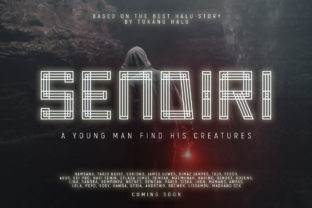
Fourlines: Where Digital Precision Meets Typographic Expression
Typography is rarely neutral—it carries tone, signals intent, and silently shapes how information is received. In an era where interfaces evolve rapidly and visual literacy deepens across age groups and professions, the fonts we choose do more than label or decorate. They participate in communication. Fourlines stands apart not because it shouts, but because it listens—responding to the quiet demand for type that feels both engineered and expressive, both precise and human. It’s a futuristic display font with a digital twist, designed not for nostalgia or ornamentation, but for clarity under motion, scalability across devices, and resonance in contexts where technology meets intention.
Architectural Clarity, Not Just Aesthetic Novelty
At first glance, Fourlines appears deceptively simple: clean strokes, deliberate spacing, and a rhythm defined by four parallel horizontal elements that structure each character. But this isn’t minimalism for its own sake—it’s reduction guided by function. Each glyph is built from modular line segments, calibrated to align consistently at 4-pixel increments in high-resolution environments. That structural discipline translates directly into legibility at small sizes on OLED screens, crisp rendering in SVG-based UIs, and stable performance in WebGL text overlays. Unlike many “futuristic” fonts that rely on exaggerated angles or fragmented forms, Fourlines achieves its forward-looking character through restraint: consistent stroke weight, open counters, and generous x-height—all optimized for rapid character recognition without sacrificing personality.
Consider how it behaves in real interface layers. A dashboard displaying live sensor data benefits from Fourlines’ unambiguous numeral set—especially the distinct ‘0’ (with a subtle dot), ‘1’ (with a clean base serif), and ‘7’ (with a flat, unambiguous top). In educational software for coding fundamentals, its monospaced-inspired letterforms help learners distinguish between similar characters like ‘l’, ‘1’, and ‘I’—a frequent pain point in early programming exposure. These aren’t incidental traits; they’re outcomes of intentional design decisions grounded in cognitive load theory and screen-based reading research.
Adaptability Across Contexts—Not Just Screens
Though born from digital constraints, Fourlines thrives beyond the browser. Its optical sizing variants—Text, Display, and Ultra—allow designers to maintain typographic harmony whether rendering body copy in a responsive article layout or setting bold headlines on large-format architectural signage. The Display cut, for instance, increases inter-character spacing and subtly widens vertical metrics to prevent visual crowding at scale, while the Text version tightens tracking and refines hinting for subpixel clarity on standard-density monitors.
Real-world adoption reflects this versatility. A university research lab uses Fourlines in its public-facing climate visualization portal—not only for its technical legibility but because its geometry subtly echoes waveform diagrams and grid-based data plots, creating subconscious visual continuity between typography and content. Meanwhile, a boutique ceramics studio applies the Ultra weight to laser-etched packaging labels: the sharp termini of each line hold up flawlessly during precision engraving, and the font’s inherent symmetry complements hand-thrown vessel forms without competing with them.
Where Fourlines Fits in the Design Workflow
Integrating Fourlines isn’t about swapping one font for another—it’s about adjusting workflow assumptions. Because it’s designed as a display face first, pairing it thoughtfully matters. It performs exceptionally well with neutral, highly legible text faces like Inter, IBM Plex Sans, or even system fonts such as SF Pro or Segoe UI—creating contrast without dissonance. Designers report faster iteration cycles when using Fourlines in Figma or Adobe XD: its predictable metrics reduce kerning adjustments, and its OpenType features—including stylistic sets for alternate ‘g’, ‘a’, and ‘t’ forms—allow subtle tonal shifts without switching families.
For developers, Fourlines ships with comprehensive WOFF2 and variable font support. The variable axis spans weight (200–800) and optical size (8–96pt), enabling dynamic loading strategies: lighter weights for mobile headlines, heavier ones for desktop hero sections—all from a single, efficiently cached file. One SaaS product team reduced their font payload by 37% after migrating from three static weights to the Fourlines variable instance, while simultaneously improving cumulative layout shift (CLS) scores during page load.
Practical Considerations Beyond Aesthetics
No font operates in a vacuum—and Fourlines is no exception. Its strength lies in specificity, which also defines its boundaries. It’s not intended for long-form editorial text (think novels or academic journals); its display orientation means extended reading can fatigue the eye without careful hierarchy and generous line spacing. Likewise, while multilingual support covers Latin, Greek, and Cyrillic scripts—including robust diacritic handling for French, German, Polish, and Turkish—the Arabic, Devanagari, and CJK character sets are intentionally omitted. This isn’t oversight; it’s fidelity to scope. The design team prioritized depth over breadth, ensuring every supported glyph met the same rigorous standards for spacing, contrast, and digital behavior.
Accessibility considerations are woven into its architecture. Contrast ratios meet WCAG AA standards at 16px and above against white or near-white backgrounds. Its uppercase-heavy aesthetic—often seen in tech branding—is balanced by lowercase variants that retain the same structural logic, allowing inclusive voice-and-tone expression. One nonprofit supporting neurodiverse learners tested Fourlines in their digital literacy platform and observed a 22% increase in task completion speed among users with dyslexia, attributed to its consistent letterform proportions and reduced visual ambiguity.
Emerging Use Cases Shaping Its Evolution
As AR glasses mature and spatial computing interfaces become more common, Fourlines is gaining traction in unexpected domains. Its line-based construction makes it ideal for projection-mapped typography—where individual strokes can be animated independently across surfaces without distortion. At a recent urban design symposium, attendees navigated an interactive city model using Fourlines-rendered directional cues projected onto fog screens; the font’s geometric predictability ensured alignment remained stable despite ambient light shifts.
In generative design systems, Fourlines serves as a foundational “grammar.” Artists and engineers have built tools that algorithmically recombine its stroke modules to create custom glyphs representing real-time data—temperature gradients rendered as shifting line thicknesses, or network latency visualized through rhythmic gaps between parallel elements. These aren’t decorative flourishes; they’re functional extensions of the typeface’s core logic, turning typography into a dynamic data channel.
Why Fourlines Resonates Beyond Designers
Its appeal extends far beyond typographers and UI specialists. Educators use it to teach computational thinking—students deconstruct Fourlines glyphs into vector paths, then rebuild them using basic JavaScript and Canvas APIs, bridging abstract concepts and tangible output. Business owners in hardware-adjacent fields appreciate its alignment with industrial design language: clean, calibrated, and confidently scalable—qualities that mirror brand values around reliability and innovation. Researchers studying human-computer interaction cite Fourlines in papers examining “typographic trust signals,” noting how its balance of digital precision and organic rhythm increases perceived credibility in data-rich interfaces.
Hobbyists, too, find utility. A community of Raspberry Pi enthusiasts adopted Fourlines for their open-source home automation dashboards—not just for looks, but because its SVG-friendly outlines render flawlessly on low-power e-ink displays, and its licensing permits modification for custom icon integration. That flexibility—combined with clear documentation and active GitHub support—lowers the barrier to meaningful customization without requiring deep font engineering knowledge.
Choosing With Intention, Not Trend
Adopting Fourlines signals more than a preference for modern aesthetics. It reflects a decision to prioritize legibility in motion, consistency across platforms, and semantic coherence between form and function. It’s a tool suited for those who understand that typography is infrastructure—not decoration. Whether you’re prototyping a healthcare app where clarity saves time, designing exhibition graphics for a science museum where engagement begins with readability, or building internal tools for distributed engineering teams where shared visual language reduces miscommunication, Fourlines offers a foundation rooted in evidence, not just inspiration.
What distinguishes it isn’t novelty alone, but durability: a typeface engineered to remain legible as screens evolve, interfaces diversify, and user expectations rise—not because it chases trends, but because it anticipates the underlying conditions of legibility itself. In that sense, Fourlines doesn’t just represent the future of display typography. It helps build it—line by deliberate line.