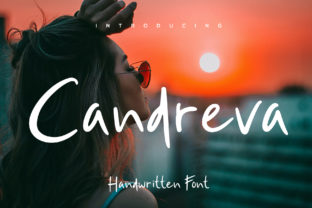
Candreva: A Charming Display Font
Candreva isn’t built for body text or spreadsheets. It’s a display font—designed to catch the eye, set a mood, and lend personality to moments that matter. With soft curves, subtle irregularities, and a hand-crafted rhythm, Candreva feels organic rather than engineered. Letters breathe. Strokes taper gently. Spacing leans into warmth—not perfection. That’s intentional. It’s not trying to disappear into the background. It wants to be noticed, remembered, and felt.
Why a font like Candreva matters—depending on who you are
What makes Candreva useful—or irrelevant—depends entirely on your goals, tools, and context. A graphic designer evaluating typefaces for a luxury skincare launch cares about different things than a teacher preparing a classroom poster. A blogger building a personal brand might test Candreva in a logo mockup, while a small business owner weighing free fonts for social media graphics needs clarity on licensing and compatibility. There’s no universal “best”—only what fits your situation.
For beginners exploring design
If you’re just starting out—maybe using Canva, Google Slides, or Figma—you’ll appreciate how Candreva adds polish without complexity. It doesn’t require kerning adjustments or OpenType features to look good at larger sizes. Try it for a headline on an Instagram story, a podcast episode title, or a handmade product label. Its organic flow helps avoid the “generic template” look—without asking you to learn typography theory first. Just pick a size, pair it with a clean sans-serif (like Inter or Roboto) for supporting text, and go. No plugins. No setup.
For creators and visual storytellers
Illustrators, lettering artists, and content creators often seek fonts that feel like collaborators—not constraints. Candreva’s slight asymmetry and natural stroke variation make it behave more like ink on paper than digital geometry. That’s why some use it as a base layer for hand-drawn reinterpretations: tracing over letters to add texture, scanning in watercolor washes, or animating individual glyphs with gentle bounce. One illustrator used Candreva as the foundation for a series of animated book cover reveals—its rhythm made timing feel intuitive, not mechanical.
For educators and presenters
In learning environments, readability is non-negotiable—but so is engagement. Candreva shines when used sparingly and intentionally: a warm, inviting title slide; a vocabulary word highlighted in a language lesson; a student project banner that feels celebratory, not clinical. It avoids the coldness of ultra-thin fonts or the fatigue of overly decorative ones. Teachers report students responding more positively to posters and handouts where Candreva appears in headings—especially in early childhood, art, or wellness-related units. The key? Use it large (36pt+), with generous line height and high-contrast backgrounds.
For small business owners and marketers
You don’t need a branding agency to benefit from Candreva—but you do need clarity on usage rights. Candreva is typically offered under licenses that permit commercial use, including merchandise and social ads, but always verify the source. A local bakery used it for their seasonal menu board and holiday card suite; the soft curves echoed their hand-rolled croissants and rustic packaging. A freelance copywriter chose it for her website’s hero section—pairing it with a neutral sans-serif for service descriptions—to signal creativity without sacrificing professionalism. For these users, Candreva’s value lies in its ability to reinforce tone quickly and consistently across touchpoints.
For developers and designers integrating fonts
Technically, Candreva is straightforward: it comes in standard OTF/TTF formats and works reliably in CSS via @font-face or platform-native integrations (like Adobe Fonts or Google Fonts, if available there). It has no extensive language support—so it’s best suited for English, Italian, Spanish, and other Latin-script languages with basic diacritics. No variable axes, no alternate glyphs—but that’s by design. Its simplicity means faster load times and fewer rendering hiccups. If your priority is performance and predictability—not granular typographic control—Candreva delivers quietly.
What Candreva isn’t—and why that’s okay
Candreva won’t work for dense paragraphs, legal disclaimers, or multilingual interfaces requiring Cyrillic or Arabic scripts. It’s not meant for UI buttons, data tables, or accessibility-critical labels. And while it pairs beautifully with minimalist layouts, it can feel out of place beside ultra-geometric or high-contrast type systems unless deliberately contrasted for effect.
That’s not a limitation—it’s focus. Like choosing linen over polyester for a summer shirt, Candreva trades versatility for character. It asks you to consider *where* impact matters most: Is it in the headline? The invitation? The opening frame of a video? Those are the places Candreva earns its space.
How to know if Candreva fits your next project
Ask yourself:
- Is this a moment meant to be seen—not skimmed? (e.g., a logo, poster, book cover, presentation title)
- Do you want warmth, approachability, or quiet confidence—not authority, urgency, or neutrality?
- Are you comfortable pairing it with something simpler? (Candreva thrives alongside unadorned sans-serifs or modest serifs—not other display fonts)
- Does your workflow support installing or embedding a single-purpose font? (If you’re locked into strict CMS templates or legacy tools, test compatibility first)
Try this quick test: Write your project’s core message in Candreva at 48pt on a white background. Step back. Does it feel like *you*—or the feeling you want others to have? If yes, it’s likely a fit. If it feels distracting, fussy, or mismatched, that’s useful information too. Not every tool serves every purpose—and recognizing that is part of working well.
A final note on intention
Typography isn’t decoration. It’s voice. Candreva’s voice is unhurried, human-scaled, and quietly confident. It doesn’t shout. It invites. Whether you’re naming a new podcast, designing a wedding suite, or crafting a classroom welcome sign, Candreva offers a way to say something meaningful—without saying more than you need to.