Bandits: Ornate Baroque Display Font
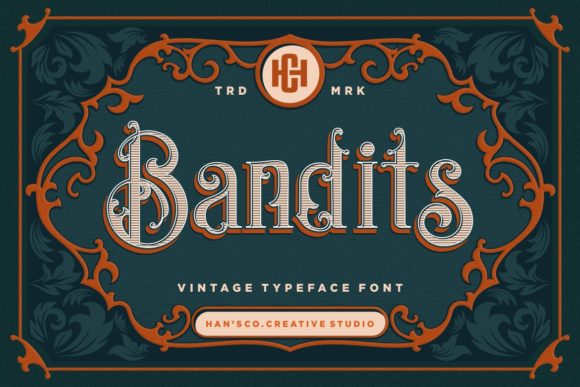
Bandits isn’t just another decorative typeface—it’s a deliberate, confident statement. Designed with trompe l’oeil precision and Baroque exuberance, Bandits invites attention through illusion, depth, and rich ornamentation. Its serifs flare like gilded moldings, its strokes swell and taper like hand-carved woodwork, and its letterforms carry the weight of 17th-century grandeur—yet it feels entirely contemporary in context. If you’re looking to evoke opulence, drama, or curated elegance without relying on imagery alone, Bandits delivers that power directly through typography.
What Makes Bandits Stand Out
Unlike many display fonts that lean into minimalism or digital abstraction, Bandits embraces complexity—thoughtfully. Every character is meticulously crafted with layered outlines, subtle shadows, and dimensional flourishes that mimic engraved metal or carved stone. The trompe l’oeil effect isn’t gimmicky; it’s structural. Letters appear recessed, embossed, or even slightly lit from the upper left—creating visual hierarchy before a single word is read.
This isn’t a font for body text—and it shouldn’t be. Bandits thrives where impact matters most: headlines, logos, packaging, posters, and invitation suites. Its strength lies in intentionality: it asks the designer to slow down, consider scale, contrast, and negative space, and commit to a mood rather than defaulting to neutrality.
Creative Applications That Work—Not Just Look Good
Bandits excels when paired with purpose—not decoration for decoration’s sake. Here are real-world uses grounded in audience needs and platform realities:
- Luxury branding: A small-batch perfume label or artisanal chocolate box gains instant gravitas with Bandits as the product name—especially when set against matte black or deep velvet paper. The font signals craftsmanship before the customer even smells or tastes.
- Editorial emphasis: In long-form blog posts or digital magazines, use Bandits sparingly—for pull quotes, section dividers, or chapter titles. Its presence creates rhythm and pause, guiding readers through dense content without visual fatigue.
- Event identity: Wedding invitations, gallery openings, or theater programs benefit from Bandits’ ceremonial tone. When combined with a clean sans-serif for details (like date, time, RSVP info), it establishes hierarchy while preserving readability.
- Social media assets: On Instagram or Pinterest, Bandits works best in static visuals—not carousels or stories where legibility suffers at small sizes. Try it over high-contrast photography (e.g., marble textures, candlelit interiors) where its depth enhances, rather than competes with, the background.
Who Uses Bandits—and How It Serves Different Goals
Designers and marketers aren’t the only ones who find value in Bandits. Its versatility across roles comes from how easily it adapts to intent—not just aesthetics.
Freelancers and small business owners use Bandits to elevate perceived value quickly. A local bakery rebranding its holiday cookie boxes might swap generic script fonts for Bandits on the front panel—immediately communicating “handmade,” “limited edition,” and “special occasion.” No new photography or illustration needed—just intentional typography.
Educators and workshop leaders apply Bandits in presentation decks for title slides or certificate designs. It adds distinction without distraction—particularly effective when teaching topics like art history, design theory, or luxury marketing, where visual literacy supports learning.
Bloggers and content creators integrate Bandits into newsletter headers or downloadable resource covers (e.g., “Baroque-Inspired Mood Board Kit”). Because it’s distinctive but not obscure, it builds brand recognition over time—especially when used consistently across lead magnets and social banners.
Keeping Bandits Effective—Not Overwhelming
Ornamentation carries responsibility. Bandits rewards restraint. Here’s how to keep it clear and audience-friendly:
- Limit usage to one prominent element per layout. If Bandits appears in the headline, avoid using it again in subheads, captions, or buttons. Repetition dilutes impact and muddies hierarchy.
- Pair deliberately. Contrast is essential. Bandits pairs best with neutral, highly legible typefaces—think geometric sans-serifs (like Montserrat or Inter) or crisp humanist options (like Lora or Source Serif). Avoid other decorative or script fonts nearby—they’ll compete, not complement.
- Respect size and spacing. At smaller sizes (under 36pt), Bandits loses definition. Use it large—48pt minimum for print, 60px+ for web—with generous letter-spacing (50–100 tracking units) to let each flourish breathe.
- Test across contexts. Print samples on your intended stock. Preview web use at multiple viewport widths. Check contrast ratios for accessibility—especially if placing Bandits over textured or photographic backgrounds.
Going Beyond the Obvious: Unexpected Twists
While Bandits naturally suits luxury and heritage themes, creative users push further—without breaking coherence. Consider these grounded variations:
- Monochrome reinterpretation: Use Bandits in solid black on white, then add a single accent color only to one letter (e.g., the “B” in “Bandits” or the first initial of a brand name). This draws focus while preserving elegance.
- Animated reveal: On websites or digital presentations, animate Bandits letters to “engrave” onto screen—one stroke at a time. Subtle, purposeful motion reinforces the craft narrative without flashiness.
- Textured layering: Overlay a faint, low-opacity scan of aged parchment or etched copper beneath Bandits. The font’s built-in depth interacts with the texture, creating organic richness—ideal for book covers or historical fiction branding.
None of these require advanced tools—just attention to context and consistency. Bandits doesn’t need embellishment to shine. What it does need is thoughtful placement, honest intent, and respect for the viewer’s experience.
If you’ve been reaching for safe, familiar fonts to convey sophistication—pause. Bandits offers a different path: one rooted in craft, clarity, and controlled drama. It won’t solve every design problem. But when the goal is to make people pause, remember, and feel something specific—Baroque warmth, quiet confidence, or timeless detail—it earns its place—not as decoration, but as strategy.