Patchwork Duo: A Versatile, Layered Font That Works Harder
Typography isn’t just about legibility—it’s about texture, intention, and tactile storytelling. Enter Patchwork Duo, a refreshingly clever font family from salt and pepper designs. It’s not just another display typeface. It’s a thoughtfully engineered pair: two complementary layers designed to be used together—or apart—with equal confidence.
More Than Just a Font—It’s a Design System in Two Glyphs
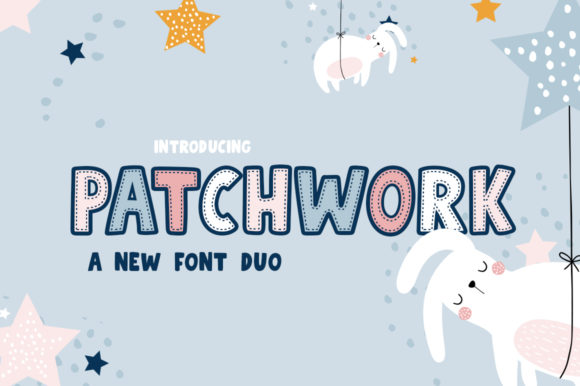
At its core, Patchwork Duo consists of two distinct but harmonized fonts: the Stitched version and the Background version. The Stitched layer features delicate, hand-guided stitch lines—subtle, rhythmic, and unmistakably crafted. The Background layer is bold, solid, and generously proportioned: a chunky, confident base that anchors the composition.
What makes Patchwork Duo special isn’t just how they look—but how they behave. Unlike static layered fonts that rely on complex OpenType features or manual alignment, Patchwork Duo is built for immediate, intuitive use. Both fonts share identical metrics, kerning, and spacing. Drop them into any design app—Figma, Illustrator, Affinity Designer, or even modern web CSS—and they align pixel-perfectly with zero fiddling.
Two Modes, One Purpose: Flexibility Built In
You have real choice—no compromise required:
- Use the Background version solo when you need impact without embellishment: signage mockups, poster headlines, apparel tags, or UI hero text where clarity and weight matter most.
- Layer Stitched over Background to unlock the full “patchwork” effect—the gentle contrast between solid form and stitched contour creates dimension, warmth, and craft. It feels handmade, but scales flawlessly from mobile screens to billboard-sized prints.
This duality means Patchwork Duo adapts to your workflow—not the other way around. You’re not locked into a single aesthetic. You’re equipped with a responsive typographic tool.
Why Designers Are Choosing Patchwork Duo Right Now
In an era saturated with ultra-thin sans-serifs and over-polished variable fonts, Patchwork Duo stands out by embracing tactility and authenticity. Its appeal spans industries and applications—not because it’s trendy, but because it solves real problems:
- Branding teams use the layered version for logotypes that feel artisanal yet scalable—ideal for makers’ markets, sustainable fashion labels, or indie book publishers.
- Web designers deploy the Background version as a robust, performant heading font (light file size, excellent hinting), then add the Stitched layer via CSS
::afterpseudo-elements for subtle depth on hover or scroll-triggered reveals. - Print designers love how cleanly the layers separate for spot-color printing—stitch lines can be set in a contrasting thread tone or foil stamp, while the background holds rich black or deep navy.
- Product designers apply Patchwork Duo to packaging where texture implies care: ceramic mugs, woven tote bags, or handmade soap labels—all benefit from that quiet suggestion of stitching without literal imagery.
And yes—it works beautifully in motion. Animate the Stitched layer to gently “sew” itself onto the Background version in an intro sequence. Or fade one layer independently for elegant transitions in presentations or digital kiosks.
Practical Tips for Getting the Most From Patchwork Duo
Like any powerful tool, Patchwork Duo rewards thoughtful application. Here’s what seasoned users consistently highlight:
Start Simple—Then Build Intentionally
Don’t default to layering everything. Try the Background version alone first. See how it performs at different sizes, weights, and line heights. Notice where it shines (e.g., tight caps lockup on a business card) and where the stitch layer adds meaningful nuance (e.g., a soft “Welcome” headline on a boutique homepage).
Respect the Rhythm
The stitch pattern isn’t random—it follows consistent spacing and stroke density. That means letters like “O”, “S”, and “B” carry balanced visual weight. But extended all-caps phrases or dense paragraphs can overwhelm the effect. Use Patchwork Duo primarily for short, high-impact text: headlines, quotes, product names, or callouts—not body copy.
Pair With Restraint
Because Patchwork Duo carries strong character, it pairs best with neutral, highly legible companions. Think: crisp geometric sans-serifs (like Inter, Poppins, or IBM Plex Sans) or warm humanist options (such as Lora or Work Sans). Avoid competing decorative fonts—let Patchwork Duo be the voice, not part of a chorus.
Test Color Contrast Early
The stitch layer relies on contrast to read clearly. Dark-on-light works reliably. Light-on-dark? Ensure sufficient luminance difference—especially for accessibility. A light gray stitch over charcoal may vanish on some screens. Test with real devices and consider WCAG contrast ratios if used in public-facing interfaces.
How It Fits Into Modern Creative Workflows
Patchwork Duo reflects a broader shift in typography: away from rigid, monolithic families and toward modular, context-aware systems. It’s part of a growing wave of “duo fonts,” “layer fonts,” and “craft-first type”—designed not just to be seen, but to be *used*.
For freelancers juggling multiple clients, Patchwork Duo cuts down revision time. A client who loves the look but wants “less busy” gets the Background-only version in under a minute. One who asks, “Can we make it feel more handmade?” gets the layered version—already perfectly aligned.
For agencies building brand guidelines, Patchwork Duo offers built-in flexibility: define primary (layered) and secondary (background-only) usage tiers, assign color treatments per layer, and document accessible fallbacks—all without custom development.
Even developers appreciate it. The fonts are well-structured WOFF2 files, include full Latin-1 and basic Latin Extended support, and come with clear licensing for web, desktop, and app embedding. No obscure plugins. No fragile SVG hacks.
What to Consider Before You Adopt Patchwork Duo
It’s not for every project—and that’s by design. Ask yourself:
- Is texture part of the story? If your brand voice is clinical, futuristic, or ultra-minimal, Patchwork Duo’s warmth may clash.
- Do you control the output environment? While it renders well everywhere, precise layer alignment depends on consistent rendering engines. Very old email clients or legacy PDF workflows may flatten layers unintentionally—test thoroughly.
- Is scalability critical at tiny sizes? Below 24px, the stitch detail begins to soften. Reserve layered use for 32px and up for best results.
- Are you licensing for commercial use? salt and pepper designs offers clear, tiered licenses—including options for unlimited projects and extended redistribution rights. Always verify scope before launch.
When it’s the right fit, Patchwork Duo doesn’t just sit on the page—it invites touch, suggests process, and quietly communicates care. That’s rare. And increasingly valuable.
Final Thought: Typography With Heart and Precision
Patchwork Duo succeeds because it bridges opposites: digital precision and handmade charm, simplicity and richness, utility and expression. It doesn’t shout. It stitches itself meaningfully into your work—literally and figuratively. Whether you’re naming a small-batch candle line, designing an interactive museum exhibit, or refreshing a nonprofit’s visual identity, Patchwork Duo gives you room to be both intentional and human.
And that’s why, across studios and screens, designers aren’t just downloading Patchwork Duo—they’re reaching for it first.