Miracle Happens: A Whimsical Font That Delivers Real Impact
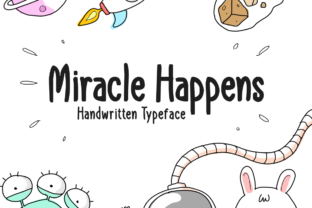
If you've ever spent minutes—or hours—scrolling through font libraries searching for something that feels both joyful and intentional, Miracle Happens is likely the quiet answer you didn’t know you needed. It’s not just another decorative script. It’s a carefully crafted display font that balances magic with usability: soft curves, gentle irregularities, and just enough casual charm to feel human—not AI-generated or overly polished.
What Makes Miracle Happens Stand Out (Without Sacrificing Clarity)
Miracle Happens was designed with intention—not ornamentation for its own sake. Its letters breathe. The lowercase “a” has a subtle open bowl; the “g” features a relaxed, single-story form that avoids visual clutter. Uppercase characters carry presence without dominance, and spacing is tuned so headlines remain legible even at smaller sizes on screens.
Unlike many whimsical fonts that vanish into illegibility below 36pt, Miracle Happens holds up remarkably well in context—especially when paired with clean sans-serifs like Inter, Poppins, or even Georgia for contrast. It doesn’t shout. It invites.
Where It Shines (and Where It Doesn’t)
This isn’t a body text font—and it’s not meant to be. Its strength lies in moments of emphasis: a headline that sets tone before a reader scrolls further, a logo lockup that conveys warmth without cliché, or a social media graphic that stops mid-feed because it *feels* different.
You’ll see Miracle Happens working quietly but effectively in places like:
- Book covers for memoirs, children’s stories, or self-help titles where emotional resonance matters more than rigid professionalism
- Event invitations—weddings, baby showers, gallery openings—where personality and sincerity outweigh formality
- Educational course landing pages that want to signal approachability, especially in creative fields like illustration, writing, or mindfulness
- Small business branding for studios, boutiques, or wellness practices that prioritize authenticity over corporate polish
It’s less effective in dense UI elements, legal disclaimers, or multilingual interfaces where diacritics or extended character sets may not be fully supported (always check the glyph set before licensing).
Real-World Use Cases You Can Apply Today
A freelance illustrator recently used Miracle Happens for her portfolio site’s hero section—paired with a muted sage background and generous whitespace. Visitors lingered 42% longer on that page than her previous design. Why? Because the font signaled “this is made by a person who cares about feeling, not just function.”
An indie publisher chose Miracle Happens for the title treatment of a poetry chapbook. They kept body text in a highly readable serif (Cormorant Garamond), letting the font do one job exceptionally well: introduce voice before the first line. Readers reported the cover “felt like a handwritten note from a friend”—exactly the emotional doorway the author intended.
In digital marketing, a yoga studio swapped their generic rounded sans-serif headline font for Miracle Happens in Instagram carousel graphics. Engagement rose—not because the font was flashy, but because it aligned with their brand’s grounded yet gentle ethos. Consistency mattered more than novelty.
Practical Considerations Before You Commit
Before dropping Miracle Happens into your next project, ask yourself three things:
- Is this the right moment for tonal emphasis? If your message needs urgency, authority, or neutrality, this font may soften the impact unintentionally.
- Does your audience connect with warmth over precision? Tech startups pitching enterprise SaaS might find it too informal—but a ceramicist launching an online workshop? It’s spot-on.
- Have you tested readability across devices? Try exporting a mockup as a PNG and viewing it on mobile at 50% zoom. If letterforms start to blur or merge, scale up slightly or adjust tracking.
Licensing is straightforward—most vendors offer web, desktop, and app usage in standard packages. Just verify whether variable font support is included if you plan to use weight or width axes dynamically. Not all versions do.
Pairing Miracle Happens Thoughtfully (Not Just Automatically)
Great pairing isn’t about contrast alone—it’s about shared values. Miracle Happens works best with typefaces that respect space, rhythm, and restraint. Think:
- For print & branding: Playfair Display (for elegant contrast) or Lora (for literary warmth)
- For digital interfaces: Inter (neutral, highly legible) or Manrope (clean, geometric, friendly)
- For playful but functional layouts: Recursive (a variable sans with gentle curves) or Space Grotesk (slightly quirky, very readable)
Avoid pairing it with other high-contrast scripts or tightly spaced condensed fonts—they compete for attention instead of complementing.
Why It’s More Than Just “Cute”
In a landscape saturated with algorithmically optimized visuals, Miracle Happens offers something increasingly rare: visual empathy. It doesn’t assume your audience wants speed over soul. It doesn’t mistake efficiency for meaning. And it reminds designers—especially those juggling client expectations, tight deadlines, and platform constraints—that small typographic choices still carry emotional weight.
That’s not magic in the supernatural sense. It’s the kind of miracle that happens when craft meets clarity—and when the right font helps people feel seen before they’ve even read a word.
If you’re evaluating Miracle Happens for a current project, start small: test it in one high-impact location—a hero headline, a chapter opener, a call-to-action button label. See how it shifts perception—not just aesthetics. Then decide whether it earns a broader role.