Louvre: A Display Font That Carries Editorial Authority and Quiet Confidence
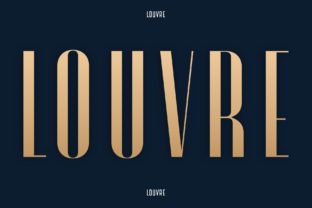
Named after one of Paris’s most enduring cultural landmarks, Louvre isn’t just a typographic homage—it’s a deliberate design statement. This display font balances architectural clarity with editorial refinement, offering designers and communicators a tool that feels both timeless and freshly relevant. It’s not built for body text or interface labels; it’s crafted for moments that demand attention, intention, and a subtle nod to sophistication—like a headline in a quarterly report, a book cover that lingers on a shelf, or the opening frame of a documentary series.
What Makes Louvre More Than Just Another Display Typeface?
Louvre stands apart through disciplined contrast and restrained elegance. Its letterforms feature clean vertical stress, modest but purposeful serifs, and open apertures that support legibility even at larger sizes. Unlike many contemporary display fonts that lean into exaggerated quirks or retro exaggeration, Louvre opts for nuance: slightly flared terminals, consistent stroke modulation, and a rhythm that feels measured—not mechanical. It doesn’t shout. It invites closer reading.
This restraint aligns with a broader shift in visual communication: audiences are increasingly fatigued by visual noise. In an era where users scroll past dozens of headlines in under a minute, clarity and tonal consistency have become competitive advantages. Louvre supports that need—not by being minimalist, but by being intentionally composed. It works as well in a luxury skincare campaign as it does in an independent magazine’s masthead, because its authority comes from proportion and balance, not ornamentation.
Evolving Expectations in Brand Voice and Visual Identity
A decade ago, many brands leaned heavily on custom wordmarks or ultra-thin sans-serifs to signal modernity. Today, more organizations—including startups, publishers, and mission-driven nonprofits—are choosing typefaces that convey depth, credibility, and human-centered craft. Louvre fits naturally into this recalibration. It doesn’t mimic handwriting or evoke nostalgia; instead, it suggests editorial rigor—the kind you associate with thoughtful curation, whether in print or digital storytelling.
Consider how a university communications team might use Louvre: not across every page, but in the title treatment of an annual impact report, reinforcing seriousness without stiffness. Or how a food writer launching a Substack might pair Louvre with a warm, readable serif for body copy—creating hierarchy that feels grounded, not generic. These aren’t stylistic flourishes; they’re quiet signals about values, audience respect, and attention to detail.
Where Louvre Fits in Modern Creative Workflows
Designers today juggle speed, scalability, and brand coherence—often across platforms and collaborators. Louvre was developed with practical deployment in mind: it includes robust OpenType features (small caps, discretionary ligatures, stylistic alternates), multiple optical sizes optimized for screen and print, and variable font axes for fine-tuned weight and width control. That means a single file can adapt gracefully—from a bold, tight headline on mobile to a lighter, expanded version in a printed brochure.
This flexibility matters especially for freelancers and small studios. Instead of licensing separate fonts for web, app, and print use, creators can streamline assets while preserving expressive range. And because Louvre avoids extreme contrast or eccentric shapes, it pairs intuitively with widely available system fonts (like Inter or Georgia) or other well-designed text faces—reducing the risk of visual dissonance when sharing files with non-designers or developers.
Real-World Pairing Strategies
- For editorial projects: Combine Louvre Light with a sturdy, low-contrast serif like Literata or Crimson Text. The contrast between Louvre’s structured presence and the warmth of the text face creates natural hierarchy and readability.
- In digital dashboards or presentations: Use Louvre Bold at medium sizes for section headers—then switch to a neutral, highly legible sans-serif (e.g., Manrope or IBM Plex Sans) for data labels and captions. The result feels curated, not cluttered.
- For branding systems: Reserve Louvre for primary logotype treatments or hero banners only. Let supporting type do the heavy lifting elsewhere—this preserves its impact and avoids visual fatigue.
Why Designers—and Their Clients—Are Paying Closer Attention
There’s been a quiet but steady rise in demand for typefaces that feel “human but precise.” Clients no longer ask simply, “Does this look modern?” They ask, “Does this reflect who we are *now*—not who we imagined ourselves to be five years ago?” Louvre answers that question with quiet confidence. It doesn’t chase trends; it anticipates how tone translates across media, devices, and cultural contexts.
This is especially evident in sectors where trust is non-negotiable: healthcare, education, finance, and public service. A hospital’s patient portal doesn’t need flashy animation—but it *does* benefit from typography that conveys care, competence, and calm. Louvre’s even color, generous spacing, and lack of visual aggression make it a compelling option—not as a gimmick, but as part of a holistic user experience strategy.
Not Just for Designers: Practical Value Across Roles
You don’t need to be a typographer to benefit from understanding what Louvre represents. Educators selecting fonts for course materials can use it to elevate key concepts without overwhelming students. Entrepreneurs building landing pages can test Louvre headings against standard web fonts to see if conversion rates improve with added gravitas. Marketers evaluating brand refreshes can assess whether their current type system communicates clarity—or just familiarity.
Even hobbyists creating personal zines or Instagram carousels will find Louvre useful—not as a default, but as a considered choice. Its strength lies in specificity: it’s not for everything, but it’s exceptionally strong where it’s needed. That selectivity mirrors how thoughtful creators now approach tools overall: fewer, better, more intentional.
Looking Ahead: Typography as a Signal of Integrity
As AI-generated visuals and templated layouts become more common, distinctive, human-crafted elements carry increasing weight. Louvre doesn’t resist automation—it integrates thoughtfully within it. Its variable capabilities mean it can respond dynamically to context, while its design roots keep it anchored in real-world readability and aesthetic coherence.
That duality—technical readiness paired with editorial sensibility—is why Louvre resonates beyond aesthetics alone. It reflects a growing preference for tools that support clarity over cleverness, longevity over virality, and resonance over reach. In a landscape saturated with options, choosing Louvre signals a commitment to meaning, not just appearance.
It won’t solve every design challenge. But when used with awareness—paired deliberately, spaced generously, and reserved for moments that merit emphasis—it becomes more than a font. It becomes a quiet collaborator in communicating what matters.