Crava: Vintage Boldness, Modern Flexibility
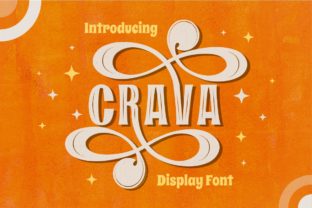
Crava isn’t just another display font—it’s a confident handshake between eras. With its high-contrast letterforms, expressive swashes, and subtle geometric undertones, Crava delivers vintage character without leaning into pastiche. It feels hand-drawn but precisely engineered; nostalgic but never dusty. That balance makes it unusually versatile—especially when you understand how to activate its strengths intentionally.
What Makes Crava Stand Out (Beyond the Swashes)
Yes, the swashes are bold—and yes, they’re eye-catching. But Crava’s real utility lies in its thoughtful construction. Each weight maintains consistent x-height and spacing, so headlines scale cleanly across sizes. The italic isn’t just slanted—it’s redrawn with fluid terminals and rhythmic curves that guide the eye without overwhelming. And unlike many retro-inspired fonts, Crava avoids exaggerated quirks that compromise legibility at smaller sizes or on screen.
It includes OpenType features like discretionary ligatures, stylistic alternates, and swash variants—tools that let you fine-tune tone without switching fonts. A single word like “Celebrate” can shift from elegant ceremony (using the formal swash on the ‘C’ and ‘e’) to playful energy (swashing only the ‘t’ and ‘e’) depending on your context. That kind of control matters—not for ornament’s sake, but for clarity of voice.
Ideas That Work—Not Just Look Good
Crava thrives where personality and purpose align. Here’s how different creators use it meaningfully:
- Small business owners use Crava for shop signage and packaging labels—not as a full-body text font, but as a deliberate accent. A ceramicist might set “Hand-thrown | Portland” in Crava Bold, pairing it with a clean sans-serif for ingredients or care instructions. The contrast signals craftsmanship while keeping information scannable.
- Educators and workshop leaders apply Crava to slide headers or printable handouts. One literacy coach sets weekly “Word of the Week” banners in Crava Italic with a single swashed letter—say, the ‘S’ in “Story”—to anchor attention without distracting from the lesson content beneath.
- Bloggers and newsletter writers reserve Crava for section dividers or pull quotes. Instead of defaulting to all-caps or oversized serif treatments, they use Crava Light Italic with minimal swash to create visual breathing room—something human-paced, not algorithmically loud.
The key isn’t using Crava everywhere. It’s using it where a human gesture matters: a title that introduces intention, a logo lockup that hints at values, a poster headline that invites pause—not just scanning.
Practical Pairings That Keep It Clear
Crava gains strength through contrast. Pair it with typefaces that ground its expressiveness—not compete with it. Avoid other high-contrast serifs or overly decorative fonts. Instead, try:
- A neutral, highly readable sans-serif like Inter, Manrope, or Public Sans for body copy, captions, or UI labels. Their even rhythm lets Crava’s swashes land with impact—not clutter.
- A modest monospace (like Inconsolata or Fira Code) for technical contexts—think course syllabi with code snippets or maker project documentation. Crava handles the “Project Name” header; the monospace handles the specs.
- Even a restrained slab-serif (such as IBM Plex Serif) works well in print layouts where both typography and structure need quiet authority.
Test readability early: render Crava at 24px on a mid-brightness mobile screen. If the swashes bleed or letters blur together, dial them back—or switch to the standard (non-swash) variant. Clarity isn’t a compromise. It’s part of the design.
Adapting Crava Across Formats
How you use Crava changes with medium—and that’s by design. On social media, where attention lasts seconds, simplify: use Crava Bold for a single-word Instagram Story sticker (“Yes.”, “Now.”, “Open.”), then follow with plain text in your brand’s body font. No swashes needed—just confident presence.
In email newsletters, Crava shines in preheader text or subject line previews—if your ESP supports web fonts. More reliably, embed Crava-rendered header images (optimized under 100KB) for consistent rendering across clients. Always include fallbacks in your CSS stack: font-family: "Crava", "Helvetica Neue", Arial, sans-serif;
For physical applications—letterpress cards, vinyl decals, embroidered patches—stick to Crava Regular or Bold (not Italic or swash-heavy variants) unless you’ve tested cut paths or ink spread. Simpler outlines reproduce more faithfully at small sizes or on textured surfaces.
One Realistic Project to Try This Week
Create a mini brand palette for a fictional local event—like a neighborhood plant swap or analog film meetup. Use Crava Bold for the event name (“Sunset Film Lab”), Crava Italic (no swashes) for the tagline (“Shoot. Develop. Share.”), and Inter Regular for date, location, and details. Export as a single PDF no larger than 2MB. Share it with one person who fits your target audience—and ask: “What’s the first thing you notice? What would make you want to attend?” Their answer tells you more about Crava’s effectiveness than any spec sheet.
That’s the point: Crava doesn’t replace strategy. It sharpens it. When your message is clear, your audience understood, and your execution intentional—even a single bold letter carries weight. Not because it’s flashy, but because it’s chosen.
So go ahead: pick one application where tone matters more than volume. Set a word. Adjust the swash. Step back. Does it feel like *you*—or the idea you’re standing behind? If yes, you’re using Crava well.