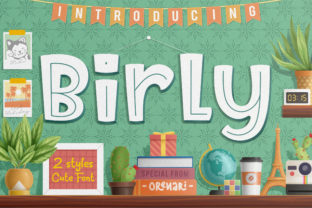
Birly Font
Birly is a hand-drawn, rounded sans-serif typeface designed with deliberate irregularity and gentle asymmetry. It features soft curves, slightly uneven stroke weights, and subtle variations in letter height and spacing—characteristics that evoke the charm of handmade lettering without sacrificing legibility at moderate sizes. Created by independent type designer Julia Gurevich, Birly was released in 2022 and has since gained attention among designers working in craft-focused, educational, and early-childhood contexts.
Why Designers Consider Birly
Designers often seek fonts that reinforce tone and intent—not just convey text. Birly appeals to those prioritizing warmth, approachability, and visual friendliness. Its structure avoids mechanical precision, which makes it stand out in environments where sterile or overly formal typography feels incongruous. Common use cases include handmade product labels, children’s activity sheets, classroom posters, greeting cards, and branding for small creative businesses centered on tactile or nostalgic experiences.
Key Benefits of Using Birly
- Distinctive personality: Unlike many rounded sans-serifs, Birly avoids uniformity—its letters have slight wobbles and organic rhythm, helping designs feel human-made rather than digitally generated.
- Moderate readability: At sizes above 14 pt and in short-form applications (e.g., headings, titles, short captions), Birly remains legible across print and screen. Its open counters and generous x-height support clarity without straining the eye.
- Strong thematic alignment: When paired with natural textures, watercolor backgrounds, or hand-illustrated elements, Birly reinforces a cohesive, craft-oriented aesthetic without requiring additional stylistic intervention.
- Light licensing footprint: Birly is available under a standard desktop license with clear terms for small-scale commercial use—including printed goods, social media graphics, and limited-run merchandise—making it accessible for independent makers and educators.
Tradeoffs and Practical Considerations
Birly is not optimized for all typographic roles. Its expressive qualities come with functional limits. For example, extended body text—such as paragraphs in a brochure or website article—is not advisable: the irregularities that give Birly its charm can reduce reading speed and increase cognitive load over longer passages. Similarly, its narrow range of weights (only Regular and Bold) limits typographic hierarchy options. There is no italic variant, and no condensed or extended versions exist.
Color contrast also matters more with Birly than with high-contrast, engineered typefaces. Because its strokes are relatively light and its forms rounded, low-contrast color pairings (e.g., light gray on white) may compromise legibility, especially in digital settings with variable screen brightness. Testing across devices and viewing conditions is recommended before finalizing layouts.
Another consideration is language support. Birly includes Latin-based characters (including accented letters used in Western European languages), but does not cover Cyrillic, Greek, or extended diacritic sets. Projects requiring multilingual typesetting beyond basic English and Romance-language texts will need supplemental fonts or custom solutions.
When Birly Is a Strong Fit
Birly excels in scenarios where visual tone carries equal or greater weight than typographic versatility. It works well for:
- Printed craft supplies—like embroidery pattern booklets, sticker sheets, or DIY kit instructions—where the font complements tactile materials.
- Early learning resources, such as phonics flashcards or preschool worksheets, where friendly, non-intimidating letterforms help reduce cognitive barriers for beginning readers.
- Branding for micro-businesses focused on handmade goods (e.g., ceramic studios, botanical soap labels, or yarn-dyeing services), especially when paired with consistent illustration styles and muted palettes.
- Social media assets for niche creative communities—such as Instagram posts promoting craft fairs or Etsy shop announcements—where authenticity and visual cohesion matter more than typographic flexibility.
When to Explore Alternatives
Consider other typefaces if your project demands:
- Dense textual content: For websites, long-form newsletters, or instructional manuals, fonts like Inter or Source Sans Pro offer superior readability, extensive weights, and robust language coverage.
- High-contrast or technical environments: In signage, data dashboards, or accessibility-critical interfaces, fonts with higher legibility metrics—such as IBM Plex Sans or Roboto—provide more predictable performance across resolutions and assistive technologies.
- Expanded typographic control: If you need optical sizing, variable axes (e.g., width or grade), or fine-grained OpenType features (like stylistic alternates or automatic ligatures), professionally engineered families like Ideal Sans or Plex offer broader design latitude.
- Broader linguistic requirements: Projects targeting global audiences or supporting multiple scripts should prioritize fonts with comprehensive Unicode coverage—such as Noto Sans—to ensure consistent rendering across languages.
Making an Informed Choice
Selecting Birly should follow from specific design goals—not general preference. Ask yourself: Does the intended audience benefit from visual warmth over typographic neutrality? Is the usage context short-form and image-adjacent, rather than text-dense or interface-driven? Will the font appear alongside other handmade or analog-inspired elements—or will it sit in isolation next to highly structured layouts?
Testing is essential. Import Birly into your actual layout environment—not just a font previewer—and evaluate it at intended sizes, colors, and backgrounds. Compare it side-by-side with alternatives using real content. Note how it behaves in both static and responsive settings. If you find yourself adjusting tracking, scaling, or color excessively to achieve acceptable legibility, that may signal a mismatch.
Finally, consider longevity. Birly’s strength lies in its specificity. That same specificity means it may not scale gracefully if your project evolves—for instance, from a seasonal craft label to a full brand identity system requiring web, app, and environmental applications. Planning for potential font substitution paths early helps avoid rework later.
In summary, Birly serves a defined niche well: projects where expressive, handmade sensibility is central, and where functional constraints—like limited weights or modest language support—are acceptable tradeoffs. It is neither universally suitable nor inherently limited; its value emerges only in alignment with thoughtful, context-aware decisions.