Techno Jump: The Futuristic Font for Sci-Fi Design
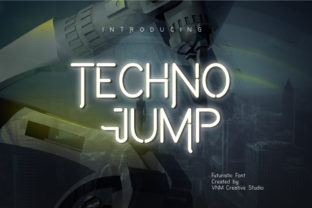
If you’re building a world beyond Earth—or even just designing something that feels like it came from one—Techno Jump isn’t just another font. It’s a deliberate, cohesive typographic statement built for clarity, contrast, and controlled futurism. Unlike overprocessed “cyber” fonts that rely on excessive glitching or forced distortion, Techno Jump balances mechanical precision with subtle human rhythm. It doesn’t shout “futuristic”—it embodies it through intelligent structure.
What Makes Techno Jump Stand Out
At its core, Techno Jump is a geometric sans-serif—but not the kind you’d find in standard UI kits. Its letterforms feature tight apertures, uniform stroke weights, and carefully calibrated terminals that suggest motion without sacrificing legibility. The uppercase ‘M’ and ‘W’ have crisp, angled shoulders; the lowercase ‘a’, ‘g’, and ‘t’ carry restrained modularity—no exaggerated loops or unnecessary flourishes. Even the spacing is tuned: generous word spacing prevents visual crowding at small sizes, while vertical metrics allow clean line heights in both headings and body text.
It includes a full Latin character set, robust punctuation, and OpenType features like tabular numerals and stylistic alternates—useful when you need to toggle between technical documentation and immersive interface labels. Importantly, Techno Jump renders well across devices and platforms, whether embedded in a WebGL scene, rendered in Figma at 2x scale, or exported as SVG for an interactive exhibit.
Where Techno Jump Delivers Real Value
This isn’t just about aesthetics—it’s about alignment. When your message hinges on credibility, immersion, or forward-looking intent, typeface choice directly impacts how users process information. Techno Jump works because it supports, rather than competes with, content. Here’s where it consistently earns its place:
- Game UI & Interactive Media: Developers and UX designers use Techno Jump for HUD elements, mission logs, and terminal-style interfaces—especially in narrative-driven indies or VR experiences. Its monospaced-like consistency (without actual monospacing) gives code-like reliability while remaining highly readable at glanceable sizes.
- Educational Tech & STEM Outreach: Science communicators and edtech creators apply Techno Jump to explain quantum computing concepts, AI ethics frameworks, or space mission timelines—not to “make it look cool,” but because its neutrality conveys objectivity. Students associate its structure with systems thinking, not gimmicks.
- Brand Identity for Innovation-Focused Businesses: Startups in robotics, climate tech, or neuro-interface hardware use Techno Jump in pitch decks, investor reports, and product documentation. It signals competence without leaning into sterile corporate minimalism or distracting sci-fi tropes.
- Print & Physical Experiences: Exhibition designers print Techno Jump on acrylic panels, laser-etched signage, and augmented reality overlays. Its high x-height and open counters ensure legibility under ambient lighting or at oblique viewing angles—critical for museum installations or trade show booths.
Practical Tips for Implementation
Like any professional tool, Techno Jump performs best when matched thoughtfully to context—not just applied universally. Here’s what seasoned designers observe in practice:
Start with hierarchy. Techno Jump shines strongest at display sizes (24px and up), especially in bold or black weights. For extended reading—say, whitepapers or tutorial copy—pair it with a neutral, highly legible companion like Inter or IBM Plex Sans. Never force it into dense paragraphs below 16px unless testing rigorously across devices.
Watch color contrast. Its sharp terminals and tight spacing mean low-contrast combinations (e.g., light gray on off-white) can blur detail. Aim for at least a 4.5:1 contrast ratio—and test on OLED screens, where thin strokes sometimes render fainter than expected.
Respect its rhythm. Techno Jump isn’t designed for kinetic animation or heavy tracking adjustments. Avoid stretching, skewing, or layering multiple weights unnaturally. Let its built-in optical balance do the work. If you need emphasis, use weight shifts—not faux-bold tricks or outline effects.
Consider licensing early. Techno Jump is available in both desktop and webfont formats, with clear commercial licensing terms. Some versions include variable axis support (weight and width), which streamlines responsive typography without loading multiple files. Always verify usage rights if embedding in SaaS dashboards or downloadable apps.
Real-World Observations From Users
A robotics educator told us she switched from a generic “tech” font to Techno Jump for her student-facing curriculum modules. “Students stopped asking, ‘Is this supposed to be hard to read?’ and started asking questions about the content instead.” That shift—from distraction to engagement—isn’t incidental. It reflects intentional design hygiene.
A freelance motion designer uses Techno Jump exclusively for title sequences in client projects involving AI ethics documentaries. “Clients don’t ask me to ‘make it more futuristic.’ They say, ‘Make it feel trustworthy and grounded—but unmistakably next-gen.’ Techno Jump delivers that duality without compromise.”
Even in unexpected places, it holds up: a regional transit authority used Techno Jump for digital wayfinding signage during a pilot smart-mobility initiative. Riders reported faster comprehension of real-time updates—not because the font is flashy, but because its consistent proportions and spacing reduced cognitive load during brief glances.
When Techno Jump Isn’t the Right Fit
Transparency matters. Techno Jump excels in contexts where clarity, modernity, and subtle authority are priorities—but it’s not universal. Avoid it for:
- Brands rooted in organic, artisanal, or heritage narratives (e.g., craft breweries, handmade ceramics).
- Highly emotional or whimsical storytelling (children’s books, fantasy RPGs with medieval themes).
- Situations requiring extreme accessibility accommodations beyond standard WCAG guidelines—its tight apertures may challenge some low-vision users at smaller sizes without careful testing.
If your project leans heavily into retro-futurism (think 1970s NASA posters or synthwave), consider pairing Techno Jump with a complementary display face—like Orbitron for headers—rather than substituting it outright. Its strength lies in forward-looking realism, not nostalgic pastiche.
Final Thought: Typography as Intentional Infrastructure
Choosing Techno Jump isn’t about chasing a trend. It’s about selecting infrastructure that quietly reinforces your goals: helping users understand faster, believe deeper, and engage longer. Whether you’re prototyping a neural interface dashboard, designing a university course on quantum literacy, or launching a hardware startup’s first website—Techno Jump offers a rare blend of discipline, distinction, and quiet confidence. It doesn’t replace strategy. It strengthens it—letter by precise letter.