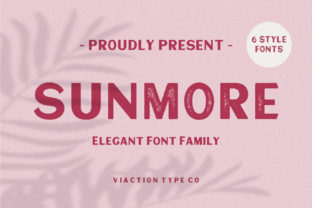
Sunmore: A Strategic Choice for Summer-Themed Visual Communication
Sunmore is a fresh, warm, and friendly display font—designed not just to look summery, but to function with intention in real-world creative and business contexts. It’s not merely decorative; it’s a tool that carries tone, signals seasonality, and supports clarity when used deliberately. For entrepreneurs launching seasonal product lines, educators designing summer learning kits, marketers building limited-time campaigns, or small business owners refreshing their social visuals—it offers a distinct tonal advantage. But its value isn’t automatic. It emerges only when paired with clear goals, audience awareness, and thoughtful execution.
Why Sunmore Fits Strategic Communication—Not Just Aesthetic Preference
Fonts shape perception faster than words. Sunmore’s rounded terminals, open letterforms, and gentle contrast convey approachability and lightness without sacrificing legibility at medium sizes. That makes it especially effective where warmth and accessibility matter: children’s activity sheets, farmers’ market signage, wellness retreat branding, or community event posters. Unlike overly playful fonts that risk undermining credibility—or sterile sans-serifs that feel detached from seasonal energy—Sunmore occupies a balanced middle ground. It supports trust while inviting engagement.
This balance matters operationally. When you choose Sunmore for a summer email campaign header, you’re not just picking a “fun” font—you’re aligning visual language with message intent. A subject line like “Your Summer Kit Is Ready!” gains subtle psychological reinforcement from Sunmore’s rhythm and spacing. Readers subconsciously register ease, generosity, and immediacy. That alignment reduces cognitive load and increases the likelihood of action—especially among time-pressed professionals or parents planning seasonal activities.
When Sunmore Adds Real Value—and When It Doesn’t
Sunmore works best as a display font—not for body text, long paragraphs, or dense interfaces. Its strength lies in short, high-impact applications: headlines, logos, banners, social media graphics, packaging accents, and printed collateral like postcards or workshop handouts. In those contexts, it helps anchor a seasonal identity without demanding attention away from core content.
Consider this practical decision framework before using Sunmore:
- Audience alignment: Does your audience associate warmth and informality with trust? Educators working with families or wellness practitioners targeting self-care seekers often find Sunmore reinforces their values. B2B SaaS companies announcing Q3 feature updates may not.
- Context consistency: If your brand voice is consistently crisp and data-driven, introducing Sunmore abruptly—even for a summer sale—can create dissonance. Instead, layer it gradually: start with a single campaign asset, measure engagement lift, then assess whether broader integration supports long-term positioning.
- Technical constraints: Sunmore performs well on screen at 24–48px, but avoid scaling below 18px for digital use or under 14pt for print. Always test rendering across devices—especially iOS and Android native browsers—where hinting and fallback behavior can affect perceived warmth.
Practical Integration: From Concept to Execution
Start with purpose—not aesthetics. Ask: What outcome do I want this piece to drive? If it’s sign-ups for a summer workshop series, Sunmore might headline the landing page—but pair it with a highly legible, neutral body font (like Inter or Lato) to ensure scanning and conversion aren’t compromised. If it’s packaging for a new line of citrus-infused teas, Sunmore could anchor the front label, while supporting typography handles ingredients and certifications cleanly.
Here’s how creators successfully embed Sunmore into workflow:
- Define usage boundaries early: Document where Sunmore appears (e.g., “H1 only on seasonal campaign pages,” “Logo lockups only with approved color variants”) to prevent inconsistent application across teams or freelancers.
- Pair intentionally: Avoid pairing Sunmore with other high-contrast or overly decorative fonts. Its friendliness thrives alongside clean, humanist sans-serifs—not geometric extremes or script fonts competing for attention.
- Test readability in context: Print a sample banner at actual size. View a mockup on mobile at 50% brightness. Does the warmth remain legible—or does it blur into softness? Adjust tracking or weight if needed; Sunmore’s Regular and Bold weights respond well to modest tightening for tighter spaces.
- Measure impact, not just preference: Run A/B tests on two versions of a summer promo graphic—one with Sunmore, one with your standard display font. Track click-through rate, time-on-page, or conversion lift. Let performance—not instinct—guide expansion.
Risks of Using Sunmore Without Strategy
Using Sunmore without grounding it in goals introduces quiet but meaningful risks. The most common is tonal drift: applying it broadly across non-seasonal materials dilutes brand coherence. A financial advisor using Sunmore on a retirement planning guide may unintentionally signal informality where clients expect precision and stability.
Another risk is accessibility oversight. While Sunmore meets WCAG 2.1 AA contrast standards at recommended sizes, its low stroke contrast can challenge readers with mild visual impairments when used over busy backgrounds or with insufficient spacing. Always validate contrast ratios using tools like WebAIM’s Contrast Checker—and never rely solely on visual judgment.
Finally, there’s the context mismatch risk. Sunmore communicates optimism and ease—but not urgency, authority, or technical rigor. Applying it to error messages, compliance notices, or crisis communications misaligns tone with user need and may erode trust.
Long-Term Positioning: Beyond Seasonal Trends
Seasonal fonts often get treated as disposable—used once and archived. But Sunmore can support longer-term brand evolution when approached as part of a flexible typographic system. Think of it not as a “summer-only” asset, but as a contextual amplifier: a tool that strengthens messaging when timing, audience, and objective align.
For example, a local bookstore might use Sunmore each June for its “Summer Reading Challenge” poster series—building recognition year after year. Over time, customers begin associating that warmth and openness with the store’s community ethos, not just the season. That consistency transforms a stylistic choice into a subtle brand cue.
Similarly, an online course platform could reserve Sunmore for “Beginner Pathway” banners—leveraging its friendly tone to reduce perceived barriers to entry. In that case, the font becomes part of an inclusive design strategy, not a decorative flourish.
Making Intentional Decisions—Not Just Pretty Ones
Choosing Sunmore shouldn’t be about chasing trendiness or filling a design template. It should follow a sequence: clarify goal → understand audience → assess context → select type → validate performance. That sequence keeps decisions grounded in outcomes—not assumptions.
Ask yourself before implementation:
- Does this use advance a specific, measurable objective—or is it primarily stylistic?
- Will this reinforce how my audience already perceives me—or introduce unintended ambiguity?
- Have I tested it where it will actually appear—not just in Figma or Adobe, but on real devices, in real lighting, with real users?
- If I removed Sunmore tomorrow, what would change about how people understand or act on this message?
When Sunmore serves those questions—not the other way around—it earns its place. It becomes more than a font. It becomes part of a deliberate communication strategy: one that respects attention, honors context, and supports meaningful connection. That’s how seasonal tools evolve into enduring assets.
Next Steps for Practitioners
Don’t redesign everything at once. Start small: pick one upcoming summer-facing asset—a social carousel, a workshop flyer, a product launch banner—and apply Sunmore with the guidelines above. Document your rationale, track results, and reflect on whether the tonal shift supported your goal. Then decide whether to scale—not based on preference, but on evidence.
Sunmore doesn’t guarantee success. But used with discipline, it can help make summer-themed communication clearer, warmer, and more resonant—without sacrificing professionalism or purpose.