Disnaily: A Strategic Choice for Distinctive Visual Communication
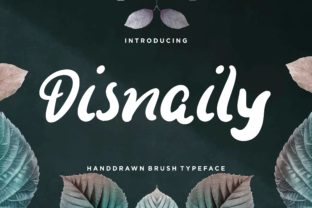
Disnaily is a display font—simple in structure, sweet in tone, and quietly confident in presence. It’s not designed for body text or dense interfaces. Instead, Disnaily excels where intention meets visibility: hand-lettered signage, product packaging, social media visuals, workshop invitations, brand launch assets, and curated print collateral. Its charm isn’t accidental—it’s calibrated. Rounded terminals, gentle contrast, and balanced spacing give Disnaily warmth without sacrificing clarity. That makes it unusually effective when your goal isn’t just to be seen, but to be remembered with feeling.
Why Disnaily Fits Into Purpose-Driven Design Strategy
Choosing a typeface is rarely about aesthetics alone. It’s a signal—a quiet but consistent reinforcement of positioning, audience alignment, and strategic intent. Disnaily communicates approachability, care, and creative intentionality. That matters most when your work hinges on emotional resonance: educators designing classroom posters that invite curiosity; small business owners crafting seasonal menus that feel personal; freelancers building pitch decks that reflect their collaborative ethos.
Unlike fonts engineered for neutrality or universality, Disnaily carries tonal weight. That means it works best when you’ve already clarified two things: who you’re speaking to, and what feeling you want to anchor in their memory. Use it without that clarity, and it risks feeling decorative rather than directional—pretty, but unmoored from purpose.
Where Disnaily Delivers Measurable Value
Disnaily shines in contexts where visual hierarchy and emotional tone directly influence outcomes:
- Customer-facing touchpoints: A boutique bakery’s weekly chalkboard menu gains authenticity and charm when set in Disnaily—supporting perceived craftsmanship and local warmth.
- Educational materials: Teachers using Disnaily for classroom banners or learning station labels report higher student engagement—not because the font “teaches,” but because its friendliness lowers cognitive barriers to interaction.
- Brand launches and repositioning: When a wellness studio shifts from clinical to holistic positioning, swapping sterile sans-serifs for Disnaily in key visual assets signals the change before a single word is read.
- Digital-first storytelling: Bloggers and newsletter creators use Disnaily sparingly—in headlines, pull quotes, or section dividers—to break monotony and reinforce voice without compromising readability on screen.
The value isn’t in the font itself—it’s in how deliberately it supports your communication architecture. Disnaily doesn’t replace strategy; it amplifies it when placed with precision.
How to Use Disnaily Intentionally (Not Just Decoratively)
Intentional use starts with constraints—and Disnaily rewards them. Consider these practical filters before applying it:
- Is this a moment where tone matters more than density? If the content is meant to be scanned, absorbed quickly, or referenced repeatedly (e.g., instructions, pricing tables), Disnaily is likely misaligned. Reserve it for moments of impression, invitation, or emphasis.
- Does the surrounding design support legibility at scale? Disnaily performs best at 24pt and above in print, and 32px+ on digital displays. Pair it with generous line height, ample white space, and high-contrast backgrounds. Avoid thin weights on low-resolution screens or busy textures.
- Is there consistency across touchpoints? Using Disnaily only on Instagram graphics but defaulting to generic system fonts elsewhere dilutes its effect. Decide where it lives—and stick to that scope. For example: “Disnaily is used exclusively for all headline treatments in our email campaigns and printed workshop guides.”
- Does it coexist well with your functional typeface? Disnaily needs a strong, neutral companion—something like Inter, Lato, or Source Sans Pro—for body copy, captions, and data. The pairing should feel complementary, not competitive.
One common misstep is overuse. Disnaily’s charm fades when repeated too often or applied without rhythm. Think of it as punctuation—not the sentence itself.
Risks of Using Disnaily Without Context
Without clear goals, Disnaily can unintentionally undermine credibility or accessibility. Its rounded, informal character may clash with audiences expecting authority (e.g., legal services, financial reporting, technical documentation). In those cases, it doesn’t humanize—it confuses.
There’s also a subtle operational risk: teams without typography guidelines may begin substituting Disnaily for any heading, regardless of context. That leads to visual noise, inconsistent brand perception, and extra revision time during production. A font shouldn’t require constant justification—but it should always have one.
Accessibility is another layer. While Disnaily passes basic contrast checks at appropriate sizes, its low stroke contrast and tight letterfit make it unsuitable for long-form reading or users relying on screen magnification. Always test with real users—not just validators—and never use it for critical information like safety instructions or legal disclaimers.
Planning for Long-Term Typography Alignment
Disnaily fits best within a broader typographic system—not as a standalone flourish, but as one deliberate voice among several. Start by mapping your most frequent communication types: What’s read? What’s glanced at? What’s saved or shared? Then assign roles:
- Headlines & hero statements: Disnaily (with defined size ranges and weight rules)
- Body copy & interface text: A highly legible, accessible sans-serif
- Numbers, labels, captions: A monospaced or geometric variant for functional clarity
This system doesn’t lock you in—it gives you flexibility within boundaries. You’ll spend less time debating “what font goes here?” and more time ensuring each choice serves the user’s next step.
Realistic Expectations for Disnaily’s Impact
Disnaily won’t increase conversion rates by itself. It won’t fix unclear messaging or compensate for poor user experience. But when paired with strong content and thoughtful layout, it can strengthen recognition, soften friction, and elevate perceived quality—all of which compound over time.
Consider a freelance illustrator who uses Disnaily only in her email signature and portfolio project titles. Over six months, clients begin referencing “that warm, handwritten-feeling branding”—not because they studied typography, but because Disnaily helped shape an impression that stuck. That kind of recall builds trust faster than features ever could.
Similarly, a nonprofit using Disnaily in its annual impact report cover—paired with candid photography and plain-language storytelling—creates a visual tone that matches its mission: human-centered, grounded, hopeful. The font doesn’t speak for the organization—but it helps the organization speak more clearly.
Making the Decision: Is Disnaily Right for This Project?
Ask yourself three questions before committing:
- What outcome do I want this piece to drive? If it’s awareness, connection, or delight—Disnaily is worth testing. If it’s accuracy, speed, or compliance—look elsewhere.
- Who will encounter this—and what do they need first? A parent scanning a school newsletter needs clarity before charm. A bride browsing wedding stationery vendors needs emotion before efficiency. Match the priority.
- Do I have the capacity to use it consistently? If rollout depends on multiple contributors without shared guidelines, start smaller: pilot Disnaily in one high-impact asset (e.g., event posters), measure response, then expand only if results justify the effort.
Disnaily is not a shortcut. It’s a lever—one that multiplies effect when pulled at the right moment, with the right force, toward the right end.
Final Thought: Typography as Quiet Strategy
In a world saturated with visual noise, the most strategic fonts are those that help people pause, recognize, and relate—not those that shout loudest. Disnaily works because it invites attention without demanding it. It supports meaning instead of obscuring it. And when used with discipline, it becomes part of your organization’s unspoken language: consistent, considerate, and unmistakably yours.
That kind of coherence doesn’t happen by accident. It happens when you choose Disnaily not because it’s available—but because it’s aligned.