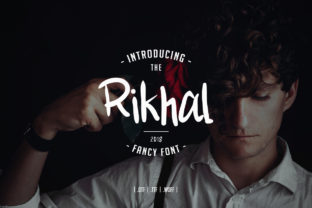
Rikhal Fancy: A Stylish, Expressive Font
Rikhal Fancy isn’t just another decorative typeface—it’s a carefully crafted comic-inspired font with personality. Its defining traits include a gently varying baseline (so letters seem to sway or bounce), smooth, confident curves, and subtle asymmetries that evoke hand-drawn charm without sacrificing readability. It balances classic typographic warmth with contemporary flair—think vintage signage meets modern editorial design.
Why This Font Stands Out—Beyond Aesthetics
What makes Rikhal Fancy more than a visual novelty is how its structure supports expression. Unlike rigid geometric fonts or overly formal serifs, it invites rhythm and informality. The baseline variation adds natural energy, while the consistent stroke weight and open letterforms keep it legible even at medium sizes. It’s not meant for long paragraphs—but where tone, identity, and light-hearted impact matter, it delivers.
For Designers & Creative Professionals
If you’re a graphic designer, branding specialist, or UI/UX practitioner, Rikhal Fancy works best as a focused accent. Use it for logo lockups where playfulness aligns with brand voice (e.g., a boutique bakery, indie podcast, or creative workshop). Pair it with a clean sans-serif like Inter or Lato for body text—this contrast reinforces hierarchy without competing. Experienced designers appreciate how its organic flow avoids looking “clip-art,” especially when kerned thoughtfully and spaced generously.
For Educators & Content Creators
Teachers building slide decks, educators designing classroom posters, or bloggers illustrating concept-based posts often need fonts that signal approachability. Rikhal Fancy helps make abstract or intimidating topics feel more inviting—imagine using it for a “Fun Facts” header in a science explainer or a “Try This!” callout in a language-learning worksheet. Its friendly shape lowers perceived cognitive load, especially for younger learners or neurodiverse audiences. Just avoid dense blocks of text; reserve it for short, high-impact phrases.
For Small Business Owners & Marketers
When launching a new product, rebranding a local shop, or crafting social media visuals, authenticity matters—and Rikhal Fancy conveys sincerity through craft, not polish. A handmade soap brand might use it on product labels to suggest artisanal care; a coffee roaster could apply it to limited-edition bag designs to evoke warmth and character. It’s not about looking “corporate-ready”—it’s about looking *human-made*. That said, test it across devices: its baseline variation can sometimes render inconsistently on older Android browsers, so always preview on mobile before finalizing digital assets.
For Beginners Exploring Typography
If you’re just starting with design tools—whether Canva, Figma, or Google Slides—Rikhal Fancy is forgiving but instructive. It teaches core concepts like visual hierarchy (use it only for headlines), contrast (pair it with something neutral), and intentionality (ask: does this font serve the message, or distract from it?). You don’t need advanced skills to use it well—but you do need to pause and consider context. Try swapping it in for one headline in your next project, then compare how the tone shifts versus using Arial or Roboto. That small experiment builds real intuition.
For Freelancers & Self-Publishers
Freelance illustrators, zine makers, or indie authors often juggle tight budgets and tight deadlines. Rikhal Fancy offers expressive value without licensing complexity—many versions are available under SIL Open Font License, meaning you can use it freely in client work, print books, or digital downloads, as long as you credit the designer. For someone delivering a 24-page illustrated guide or designing a Patreon banner, that flexibility saves time and legal overhead. Just double-check the license file included with your download—some variants may have different terms.
What to Consider Before Using It
Rikhal Fancy shines brightest when used deliberately—not everywhere, but where it matters. Here’s how to match it to your goals:
- Ease of use: Install it like any font (OTF/TTF) and it works in most desktop apps. No plugins or web-font setup needed—unless you’re embedding it on a live site, in which case self-hosting or a trusted CDN is safest.
- Quality & reliability: Look for versions with full Latin character sets, proper diacritics, and OpenType features like ligatures or stylistic alternates. Free downloads from unofficial sites sometimes lack polish or contain outdated glyphs.
- Creativity vs. clarity: It excels in evoking mood but fades in function. Never use it for addresses, pricing tables, or accessibility-critical text (like error messages or form labels).
- Long-term usefulness: Because it’s stylistically distinct—not trend-chasing—it ages well. A poster designed with Rikhal Fancy today won’t look dated in three years, unlike fonts tied tightly to a specific aesthetic moment (e.g., ultra-thin serifs or aggressive glitch effects).
A Real-World Example: Two Projects, One Font
A local florist redesigning their Instagram grid uses Rikhal Fancy for weekly “Bloom of the Week” story headers—paired with soft pastel backgrounds and candid photos. The font’s gentle bounce echoes the organic movement of petals, reinforcing brand warmth without saying a word.
A high school art teacher creates a printable “Design Elements Checklist” for student projects. They use Rikhal Fancy only for the title (“Your Visual Toolkit”) and switch to Nunito for the bullet points. Students notice the title first—and remember the checklist because its look feels intentional, not generic.
Does Rikhal Fancy Fit Your Next Project?
Ask yourself:
- Is the goal to communicate joy, curiosity, or handmade authenticity—not neutrality or authority?
- Will it appear in short bursts (headlines, logos, buttons), not extended reading?
- Do you have control over spacing, size, and pairing—or are you constrained by a template or CMS that limits typography options?
- Does your audience respond well to expressive, human-centered design cues? (Test it: show two versions of the same headline—one in Rikhal Fancy, one in Helvetica—and ask which feels more aligned with your intent.)
If most answers point “yes,” Rikhal Fancy is likely a thoughtful, effective choice—not just a decorative flourish, but a quiet collaborator in how your work is felt and remembered.