Educated Deers
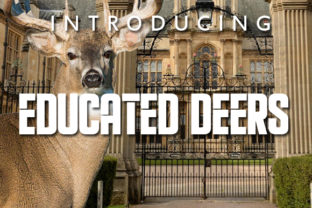
Educated Deers is a distinctive bold display font designed primarily for visual impact in titles, headers, and short-form typographic statements. It features strong, slightly irregular letterforms with expressive stroke contrast and subtle personality—neither strictly geometric nor purely organic, but somewhere between confident and approachable. As a display typeface, it is not intended for extended body text; instead, it excels where emphasis, hierarchy, and character are priorities.
Why Consider Educated Deers?
Designers and content creators often seek fonts that reinforce brand voice or elevate a layout’s visual tone without relying on imagery alone. Educated Deers appeals to those looking for a display font that stands apart from common sans-serif or slab-serif options—offering recognizability at a glance while retaining readability in larger sizes. Its name suggests wit and intentionality, and its form delivers on that impression: letters feel deliberate, slightly stylized, yet grounded enough to avoid appearing gimmicky.
People researching display fonts may be evaluating Educated Deers alongside alternatives for specific use cases—such as branding a creative studio, designing a poster series, or establishing visual identity for a digital product’s landing page. In these contexts, typography functions not just as communication but as part of the aesthetic language. Educated Deers offers one way to signal originality without sacrificing clarity.
Benefits and Practical Strengths
One of Educated Deers’s primary advantages is its immediate legibility at scale. Its generous x-height, open counters, and balanced spacing support quick recognition—even in fast-scrolling or mobile-first environments. The font includes standard Latin characters and basic punctuation, making it suitable for English-language headlines and short taglines across web and print.
Its bold weight provides strong contrast against lighter body text, supporting clear typographic hierarchy. When used thoughtfully—paired with a neutral, highly readable sans-serif like Inter or Lato—it creates effective visual rhythm. Designers also appreciate its consistent rhythm across letter combinations, which reduces the need for extensive manual kerning in most headline applications.
Additionally, Educated Deers is relatively lightweight in file size and widely compatible with modern web font delivery methods (e.g., variable font support is not present, but static WOFF2 versions render reliably across browsers). This makes implementation straightforward for developers integrating it into CSS-based design systems.
Tradeoffs and Limitations
Like all display fonts, Educated Deers has boundaries. Its design prioritizes presence over versatility: it is not optimized for small sizes, long paragraphs, or dense UI elements such as navigation menus or data tables. Attempting to use it below 24px—or in interface components requiring high functional legibility—can compromise readability and accessibility.
It also lacks extended language support beyond basic Latin. Users working with multilingual content—including accented characters for French, Spanish, or Central/Eastern European languages—should verify glyph coverage before committing. Similarly, no italic or condensed variants exist, limiting stylistic flexibility within a single family.
Another consideration is tone alignment. Because Educated Deers carries subtle character—slight irregularity, gentle modulation—it may feel mismatched in contexts demanding strict neutrality (e.g., government documentation, financial dashboards, or medical interfaces). Its personality is an asset in some settings, but a liability where impartiality or formality is expected.
When Educated Deers Is a Strong Fit
Educated Deers works especially well in projects where visual distinction matters more than typographic neutrality. Examples include:
- Branding for independent publishers, art collectives, or design-forward startups seeking memorable, ownable typography;
- Event posters, album covers, or exhibition titles where typography functions as graphic element;
- Landing pages or hero sections where a single headline must capture attention and convey attitude quickly;
- Social media banners or profile headers where large, bold text appears against simple backgrounds.
In each case, the font supports intent: to be seen, remembered, and aligned with a specific mood—not to recede into the background.
When Alternatives May Be Preferable
For users needing broader typographic functionality—such as multiple weights, italics, or extended language support—other display families may better serve long-term needs. Fonts like Clash Grotesk, Neue Haas Grotesk Display, or GT America offer similar boldness with greater range and refinement across sizes.
If the goal is high-contrast pairing with body text that remains accessible under WCAG guidelines, a more tested option like Montserrat Black or IBM Plex Sans Condensed Bold might provide stronger contrast ratios and wider browser fallback reliability.
For editorial or publishing workflows involving frequent reuse across templates, a variable font with optical sizing (e.g., Inter Variable or Recursive) often delivers more flexibility than a static display face like Educated Deers.
Making an Informed Choice
Choosing a display font involves balancing aesthetic goals with practical constraints. Ask yourself:
- What role does this font play? If it’s only for top-level headings—and those headings are consistently large, short, and visually isolated—Educated Deers is a viable candidate.
- Who is the audience? Does the tone match their expectations? A playful, confident voice suits creative industries but may feel incongruous in regulated or institutional contexts.
- What technical requirements exist? Confirm compatibility with your CMS, design tools, and deployment pipeline. Test rendering across devices and assistive technologies if accessibility compliance is required.
- How scalable is the decision? If future iterations may require additional weights or language expansion, consider whether Educated Deers can grow with the project—or whether starting with a more extensible family would reduce friction later.
Finally, test early and test specifically. Render real content—not lorem ipsum—in context: on the intended background, at actual sizes, alongside chosen body type. Observe how it performs under real conditions, not just in isolation. Typography decisions compound over time; a thoughtful, evidence-informed choice now supports consistency and efficiency downstream.
In summary, Educated Deers is a purpose-built tool—not a universal solution. Its value lies in specificity: when bold, expressive, and concise typographic presence is the goal, it delivers with clarity and character. For other objectives, different tools may serve better. Understanding that distinction is the first step toward selecting typography that supports, rather than obscures, communication.