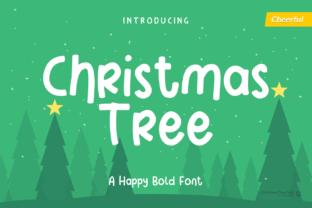
Christmas Tree
There’s something instantly uplifting about the Christmas Tree font — a playful, hand-drawn display typeface designed to evoke warmth, nostalgia, and quiet holiday magic. It’s not just another festive script; it’s crafted with subtle irregularities, gentle curves, and cheerful spacing that makes headlines, greeting cards, social posts, and shop signage feel personal and inviting. Whether you’re designing a small-batch ornament label or launching a seasonal email campaign, Christmas Tree adds sincerity without sacrificing readability.
What People Often Misunderstand About Christmas Tree
Many assume Christmas Tree is “just for December” — or worse, that it’s suitable for body text, long paragraphs, or digital interfaces requiring fast scanning. Neither is true. Its charm lies in intentionality: it shines where attention is brief but meaningful — banners, invitations, product tags, Instagram story headers. Using it where clarity or speed matters (like navigation menus or legal disclaimers) dilutes its impact and strains legibility.
Another frequent oversight? Treating it like a free-for-all decorative element. Because it’s labeled “fun” and “festive,” some users layer it over busy backgrounds, shrink it into tiny captions, or pair it with three other display fonts in one layout. That doesn’t amplify cheer — it creates visual noise and undermines hierarchy.
Why These Choices Backfire
When Christmas Tree is misapplied, the cost isn’t just aesthetic. A café owner who uses it for their entire menu — including prices and allergen notes — risks confusing customers and slowing service. A blogger embedding it in blog post titles *and* pull quotes *and* sidebar widgets loses contrast and rhythm, making content feel cluttered rather than curated. And a freelancer quoting a flat rate for a logo using Christmas Tree without clarifying licensing terms may later face client pushback when they try to use it on merchandise or video intros.
Even technical choices matter. Some download unofficial versions from sketchy font sites, assuming “free” means “safe.” But unverified files often lack proper OpenType features, contain malware, or omit critical weights and glyphs (like accented characters for bilingual holiday messages). That leads to broken layouts, inconsistent rendering across devices, or last-minute redesigns — all avoidable with careful sourcing.
How to Use Christmas Tree Well — Without Overthinking It
Start by asking: Where does this need to be seen — and for how long? If it’s something people glance at once (a storefront window decal, an event poster, a limited-time promo banner), Christmas Tree is an excellent fit. If it’s something people read repeatedly (an e-book chapter, a help center article, a multi-step form), choose a clear, neutral sans-serif instead — then bring in Christmas Tree only for section headers or callouts.
Pairing matters. Avoid stacking it with other highly stylized fonts. Instead, balance its whimsy with a friendly, humanist sans like Nunito, Lato, or Inter. Those fonts share its warmth but offer structure — letting Christmas Tree stand out without competing. For print projects, test it at actual size: what looks joyful at 72pt on screen may become illegible at 14pt on a gift tag.
Before You Download or Buy — Check These Five Things
- Licensing scope: Does the license cover your use case? Web embedding? Merchandise? Video? Commercial apps? Don’t assume “personal use” includes your Etsy shop or client project.
- File integrity: Are you getting the full family — regular, bold, maybe an alternate glyph set — or just a single weight? Check the vendor’s preview tools to see how it renders with punctuation, numbers, and common symbols like & or @.
- Language support: If your audience includes Spanish, French, or Scandinavian speakers, verify diacritics and extended Latin characters are included — not just English A–Z.
- Technical compatibility: Does it load reliably on your CMS or email platform? Some older systems don’t support variable fonts or newer OpenType features. When in doubt, export static PNGs for critical assets instead of relying solely on live web font loading.
- Designer intent: Read the foundry’s notes. The creators of Christmas Tree intentionally avoided sharp angles and rigid spacing — so if you’re manually tightening letter-spacing to “fix” perceived looseness, you’re working against the design’s purpose.
A Better Way to Get Inspired — Not Just Decorated
Instead of searching for “more Christmas fonts,” spend five minutes studying how Christmas Tree behaves in real contexts. Look at well-designed holiday packaging — not just the font, but how much space surrounds it, how color supports (not fights) its texture, and whether supporting type is sized and spaced to create breathing room. Notice how brands like Milk Bar or Snowe use seasonal type: sparingly, consistently, and always in service of tone — never as decoration alone.
Try this quick test before finalizing: convert your Christmas Tree-heavy layout to grayscale and squint. Can you still tell what’s most important? If not, simplify. Remove one decorative element. Increase padding. Swap one instance for a simpler font. That restraint is what makes the remaining Christmas Tree moments feel intentional — not incidental.
Final Thought: Cheer Is Earned, Not Applied
Christmas Tree doesn’t generate joy by default. Its effectiveness comes from thoughtful placement, respectful scaling, and alignment with your message — not from how many times you use it. When chosen deliberately and paired with care, it becomes more than a font: it’s a quiet signal that says, “This moment matters.” That’s why designers, educators, small business owners, and marketers return to it year after year — not because it’s flashy, but because it’s trustworthy, warm, and human-scaled.
So go ahead and enjoy its charm. Just remember: the best holiday displays aren’t the fullest — they’re the most considered.