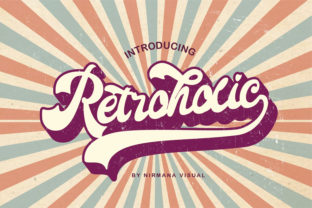
Retroholic: The Authentic Retro Font That Brings 70s and 80s Energy to Modern Design
If you’ve ever scrolled through a vintage record sleeve, paused at a neon-lit diner sign, or admired the bold typography of an old arcade cabinet—you know that certain visual energy is unmistakable. It’s warm, confident, and full of personality. Retroholic captures that essence with precision. More than just a nostalgic nod, it’s a carefully crafted typeface inspired by the iconic design language of the 1970s and 1980s—think groovy curves, high-contrast strokes, playful terminals, and just the right amount of analog texture. Designed for clarity and character, Retroholic delivers authentic retro flair without sacrificing legibility or versatility.
Why Designers and Brands Are Turning to Retroholic Today
Many creators face a common challenge: how to evoke nostalgia without slipping into cliché. Vintage aesthetics are popular—but generic “retro” fonts often feel hollow, overused, or visually inconsistent. Others lean too heavily on distortion or noise, making them impractical for real-world use—especially in digital interfaces, packaging, or branding systems where readability and scalability matter.
That’s where Retroholic stands apart. It doesn’t rely on gimmicks. Instead, it interprets the spirit of mid-century modernism and synth-pop-era typography with thoughtful detail: generous x-heights for screen-friendly clarity, balanced letter spacing that works across sizes, and subtle irregularities that suggest hand-drawn charm—not digital fatigue. Whether you’re refreshing a small-batch coffee brand, launching a podcast about analog culture, or designing a festival poster, Retroholic offers a grounded, intentional way to signal authenticity and warmth.
Practical Applications—Where Retroholic Delivers Real Value
Retroholic shines most when it serves a clear purpose—not as decoration, but as communication with intention. Here’s how different users apply it effectively:
- Small business owners use Retroholic for signage, product labels, and social media visuals—especially in food & beverage, boutique retail, or wellness spaces. A craft soda label set in Retroholic instantly signals artisanal roots and approachable confidence.
- Marketing teams integrate it into campaign headlines or limited-edition packaging to create emotional resonance. Unlike fleeting trend fonts, Retroholic’s time-tested structure ensures consistency across email headers, billboards, and app banners.
- Independent designers and illustrators pair Retroholic with custom icon sets or hand-drawn elements to unify visual identity—without needing to illustrate every word. Its strong rhythm and open forms hold up beautifully beside textured backgrounds or layered photography.
- Educators and content creators choose it for workshop titles, course modules, or presentation decks focused on design history, pop culture, or creative entrepreneurship—leveraging its inherent storytelling power to reinforce theme and tone.
Importantly, Retroholic isn’t meant for body text or long-form reading. Its strength lies in impact—in moments where tone, memory, and identity converge. Think of it like a well-chosen accent wall: it defines the space without overwhelming it.
Getting the Most Out of Retroholic: Smart Implementation Tips
Like any expressive font, Retroholic performs best when paired thoughtfully and used intentionally. Here are practical considerations that help users avoid common pitfalls:
- Pair with neutral, highly legible sans-serifs (e.g., Inter, Lato, or even Helvetica Neue) for supporting text. This contrast lets Retroholic lead while keeping information accessible.
- Respect hierarchy: Use it for display sizes (36px and up on screen, 24pt+ in print). Avoid scaling it down below 18px—it’s designed to breathe, not shrink.
- Test color contrast rigorously, especially on digital screens. Its medium-weight base works well against light or muted backgrounds, but avoid low-contrast combos like grey-on-grey—even if they look “vintage,” they fail accessibility standards.
- Consider licensing early. Retroholic is available for both personal and commercial use, but verify permissions for web embedding (WOFF2), app integration, or merchandise before finalizing your workflow.
Also worth noting: Retroholic includes extended Latin character support and basic OpenType features like stylistic alternates and ligatures—small details that let experienced users fine-tune rhythm and expression without switching fonts.
Different Users, Different Approaches—All Centered on Purpose
A freelance graphic designer building a brand identity might start with Retroholic as the cornerstone of a visual system—then build complementary color palettes and iconography around its warmth and weight. In contrast, a nonprofit organizing a community music archive may use Retroholic selectively: only on exhibit banners or vinyl reissue sleeves—keeping all digital navigation clean and neutral. Both approaches honor the font’s strengths while staying aligned with audience needs.
Similarly, developers integrating Retroholic into a website should prioritize performance: serve optimized WOFF2 files, declare fallback fonts in CSS, and avoid loading unnecessary weights. For accessibility, always ensure headings using Retroholic have proper semantic HTML structure (h1–h6) and sufficient contrast ratios (at least 4.5:1 against background).
More Than Nostalgia—A Tool for Meaningful Connection
What makes Retroholic resonate today isn’t just its aesthetic—it’s its ability to foster connection. In a world saturated with algorithm-driven minimalism and homogenized UI patterns, choosing a font like Retroholic is a quiet act of intention. It says: This matters. This has history. This is made for people—not just pixels.
It supports goals that go beyond visual appeal: building trust through familiarity, inviting engagement through warmth, and reinforcing values like craftsmanship, inclusivity, and joy. When a local bookstore uses Retroholic on its window decal, it doesn’t just say “books”—it says “come in, stay awhile.” When a sustainable fashion label uses it on a seasonal campaign, it signals continuity, care, and human-centered design—not fast trends.
Retroholic doesn’t ask you to recreate the past. It invites you to reinterpret it—with respect, clarity, and purpose. And in doing so, it helps turn everyday projects into memorable experiences.